Multiple Treated Units
TASC.jl can mask several treated rows after the intervention. Put all treated units first or pass their row indices through treated_rows.
using TASC
using Statistics

Y, params, signal = simulate_tasc(N = 18, T = 70, d = 3, seed = 22)
T0 = 40
treated_rows = [1, 2, 3]

model = fit_tasc(
    Y;
    d = 3,
    T0 = T0,
    treated_rows = treated_rows,
    n_em = 25,
    tol = 1e-4,
)

pred = predict_counterfactual(model, Y)

size(pred.target), size(pred.effect), size(pred.variance)
((3, 70), (3, 70), (3, 70))For multiple treated rows, target, effect, and variance are matrices with one row per treated unit:
post = (T0 + 1):size(Y, 2)
unit_att = vec(mean(pred.effect[:, post]; dims = 2))
overall_att = mean(unit_att)

(unit_att = round.(unit_att, digits = 3), overall_att = round(overall_att, digits = 3))
(unit_att = [-0.006, -0.011, 0.046], overall_att = 0.01)Post-treatment donor observations remain available to update the latent state. Only the treated rows are treated as missing after T0.
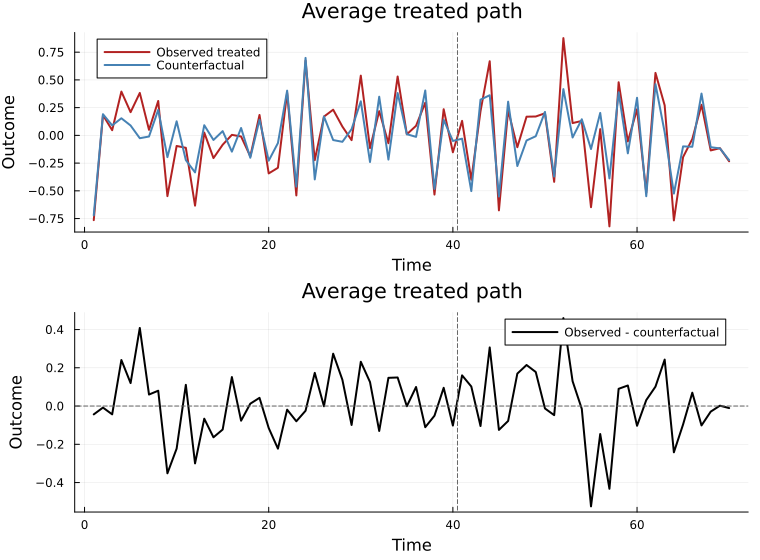
The plotting recipe averages over the treated rows when treated_rows contains more than one unit:
using Plots

plt = plot(
    tasc_plot(model, Y);
    ci = false,
    show_effect = true,
    title = "Average treated path",
    xlabel = "Time",
    ylabel = "Outcome",
)