Code
Survival analysis is also called time to event analysis or event history analysis. We use survival models to analyze data that have the following characteristics:
Censoring is what makes this its own subject, and it carries an assumption that belongs before any estimator. Kaplan-Meier and the Cox partial likelihood below both require censoring to be independent, or noninformative: conditional on the covariates in the model, units censored at a given time must be neither more nor less likely to experience the event than comparable units still under observation. Put plainly, being censored may not carry information about when the event would have happened.
This is an identification assumption, not a technical footnote. It fails whenever units leave for reasons tied to the outcome – patients withdrawing because they are deteriorating, firms vanishing from a sample shortly before they fail, workers leaving a spell study just as re-employment arrives. Nothing in the data announces the failure and no sample size repairs it. The usual response is to bring the relevant variables into the model, since the assumption is conditional on covariates, and then to argue explicitly why the censoring that remains is unrelated to the event process.
Let \(T\) denote the time variable, a nonnegative, continuous random variable with PDF \(f(t)\) and CDF \(F(t)\), where \(t\) is a realization of \(T\). The survival function is defined by
\[ S(t) = Pr(T>t) = 1-F(t) \tag{10.1}\]
The graph of \(S(t)\) against \(t\) is known as the survival curve. If there is no censoring, then the survival function is easy to estimate by the ratio of the number of units surviving beyond \(t\) to the total number of units in the sample. The most common method to estimate the survival function with a survival data set containing censored observations is the Kaplan-Meier method. The basic idea is to use the product of a series of conditional probabilities.
First sort the event times from the smallest to the largest:
\[ t_{(1)} \le t_{(2)} \le ... \le t_{(r)} \tag{10.2}\]
Then the survival curve is estimated by:
\[ \hat S(t) = \prod_{j | t_{(j)} \le t} (1-\frac{d_j}{r_j}), \tag{10.3}\]
where \(r_j\) is the number of units at risk at \(t_{(j)}\) and \(d_j\) is the number of “failure” or events at \(t_{(j)}\). Note that units censored at \(t_{(j)}\) are included in \(r_j\).
The variance of this estimator can be estimated by:
\[ \hat {var} (S(t)) = (\hat S(t))^2 \sum_{j | t_{(j)} \le t} \frac{d_j}{r_j(r_j-d_j)}. \tag{10.4}\]
We are often interested in which periods have the highest or lowest change of “death” or “failure” or other events. That is, we may be interested in the probability that a state ends between \(t\) and \(t+ \Delta t\) conditional on having reached \(t\) in the first place.
The probability is \[ \mbox{Pr} (t<T \leq t+\Delta t | T \geq t)=\frac{F(t+\Delta t)-F(t)}{S(t)} \tag{10.5}\]
The hazard function is defined by \[ h(t)=\lim_{\Delta t \rightarrow 0}\frac{\mbox{Pr} (t<T \leq t+\Delta t | T \geq t)}{\Delta t}=\frac{f(t)}{S(t)}=\frac{f(t)}{1-F(t)} \tag{10.6}\]
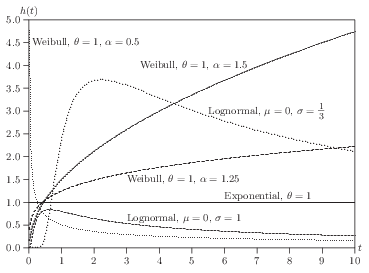
One of the simplest functional forms is the exponential distribution \[ f(t,\theta)=\theta e^{-\theta t} \tag{10.7}\]
Therefore, the hazard function is \[ h(t)=\theta \tag{10.8}\]
A much more flexible functional form is Weibull, with CDF, survival, and density \[ F(t,\theta, \alpha)=1-\exp(-(\theta t)^{\alpha}), \quad S(t)=\exp(-(\theta t)^{\alpha}), \quad f(t)=\alpha \theta^{\alpha} t^{\alpha-1}\exp(-(\theta t)^{\alpha}). \tag{10.9}\]
Hazard function can be shown to be \[ h(t)=\alpha \theta^{\alpha} t^{\alpha-1} \tag{10.10}\]
However, Weibull distribution does not allow for the possibility that the hazard may first increase then decrease over time. Log-normal distribution does allow this.
Suppose we have \(n\) units with a survival function \(S(t)\), density \(f(t)\), and hazard \(h(t)\). If for unit \(i\), the event happens at \(t_i\), it’s contribution to the likelihood function is the density at that point:
\[ L_i=f(t_i)=S(t_i)h(t_i) \tag{10.11}\]
If no event at \(t_i\), all we know is that the lifetime exceeds \(t_i\). The probability is \[ L_i=S(t_i), \tag{10.12}\] which is the contribution to the likelihood function from a censored observation.
Therefore, if \(U\) denotes the set of uncensored observations, the log-likelihood function for the entire sample can be written as \[ \ell (t, \theta)=\sum_{i \in U} \log h(t_i | {{\symbf{X}}}_i, \theta)+\sum_{i=1}^n \log S(t_i | {{\symbf{X}}}_i, \theta) \tag{10.13}\]
One class of models that is quite widely used is the proportional hazard models (based on Cox (1972)). \[ h(t | {{\symbf{x}}}_i)=h_0(t)\exp ({{\symbf{x}}}'_i \beta), \tag{10.14}\]
In this model \(h_0(t)\) is called baseline hazard rate; it describes the risk for units with \({\symbf{x_i = 0}}\). \(\exp ({{\symbf{x}}}'_i \beta)\) represents the relative risk, a proportionate increase or decrease in risk, due to \({\symbf{x_i}}\). The interpretation of \(\beta\) is that \(\exp(\beta_i)\) gives the relative risk change associated with an increase of one unit in \(x_i\), all other explanatory variables remaining constant.
\(\beta\) is estimated by maximizing a partial likelihood function. It is partial likelihood function since the baseline hazard is factored out. Suppose one event happens at time \(t_j\). Conditional on this event the probability that case \(i\) dies (meaning this event happened to case \(i\), not other cases in the risk set) is
\[ L_i=\frac{h_0(t_j) \exp(x_i' \beta)} {\sum_l I(T_l \ge t_j) h_0(t_j) \exp(x_l' \beta)}=\frac{ \exp(x_i' \beta)} {\sum_l I(T_l \ge t_j) \exp(x_l' \beta)} \tag{10.15}\]
We can see here that Cox’s model is for continuous time survival data. It is assumed there is no ties at time \(t_j\) (in continuous time is not possible for two events to happen at the same time). In reality, we observe ties of event time, because in many situations, we observe grouped data. For example, we observe case \(m\) and \(n\) have events at the same time \(j\). In that case, in the denominator, whether we include case \(m\) in the calculation of the likelihood of case \(n\) is ambiguous. In that case, special treatment is needed. The standard approximation here is Breslow’s:
\[ L_{m \in D(t_j)} \simeq \frac{ \prod_{m \in D(t_j)} \exp(x_m' \beta)} {[\sum_{l \in R(t_j)} \exp(x_l' \beta)]^{d_j}} \tag{10.16}\]
where \(D(t_j)\) is the set of cases that die at time \(t_j\) and \(d_j\) denotes the number of cases that die at time \(t_j\). This approximation works well with small number of ties relative to total number of cases at risk. Peto’s approximation is a close relative of it. Efron’s is a finer adjustment that apportions the risk set among the tied cases, and it is the more accurate of the two when ties are common. The defaults differ by software: R’s coxph uses Efron, Stata’s stcox uses Breslow, so the same data can produce slightly different coefficients in the two without either being wrong.
One important feature (disadvantage?) for the proportional hazard model is that for all units, the effect is the same at all time \(t\). To see this:
\[ \frac{h_1(t)}{h_2(t)} = \frac{h_0(t)\exp ({{\symbf{x}}}_1' \beta)}{h_0(t)\exp ({{\symbf{x}}}_2' \beta)}= \frac{\exp ({{\symbf{x}}}_1' \beta)}{\exp ({{\symbf{x}}}_2' \beta)}, \tag{10.17}\] which does not depend on \(t\).
One advantage of Cox’s model is that it is considered as a semi-parametric model since it does not have to specify the distribution of the survival time. The estimation process relies only on the order in which events occur, not on the spacing between them. The exact times still matter, because they are what determines who sits in each risk set. What drops out is the baseline hazard, and with it any need to model how far apart the events are. Parameter estimates are derived assuming continuous survival times.
In the equation above, if we would like to calculate the partial effect of \(x_j\) on \(h\), we have:
\[ \partial h(t | {{\symbf{x}}}_i) / \partial x_j=h_0(t)\exp ({{\symbf{x}}}'_i \beta) \beta_j = \beta_j h(t | {{\symbf{x}}}_i), \tag{10.18}\]
If we do it the other way, plug in \(x_j + 1\) will generate
\[ h_0(t)\exp ({{\symbf{x}}}'_i \beta + \beta_j) = \exp (\beta_j) h(t|{{\symbf{x}}}_i) \tag{10.19}\]
Therefore, a one unit change in \(x_j\) multiplies the hazard by \(\exp(\beta_j)\) (a proportionate change of \(\exp(\beta_j)-1\)).
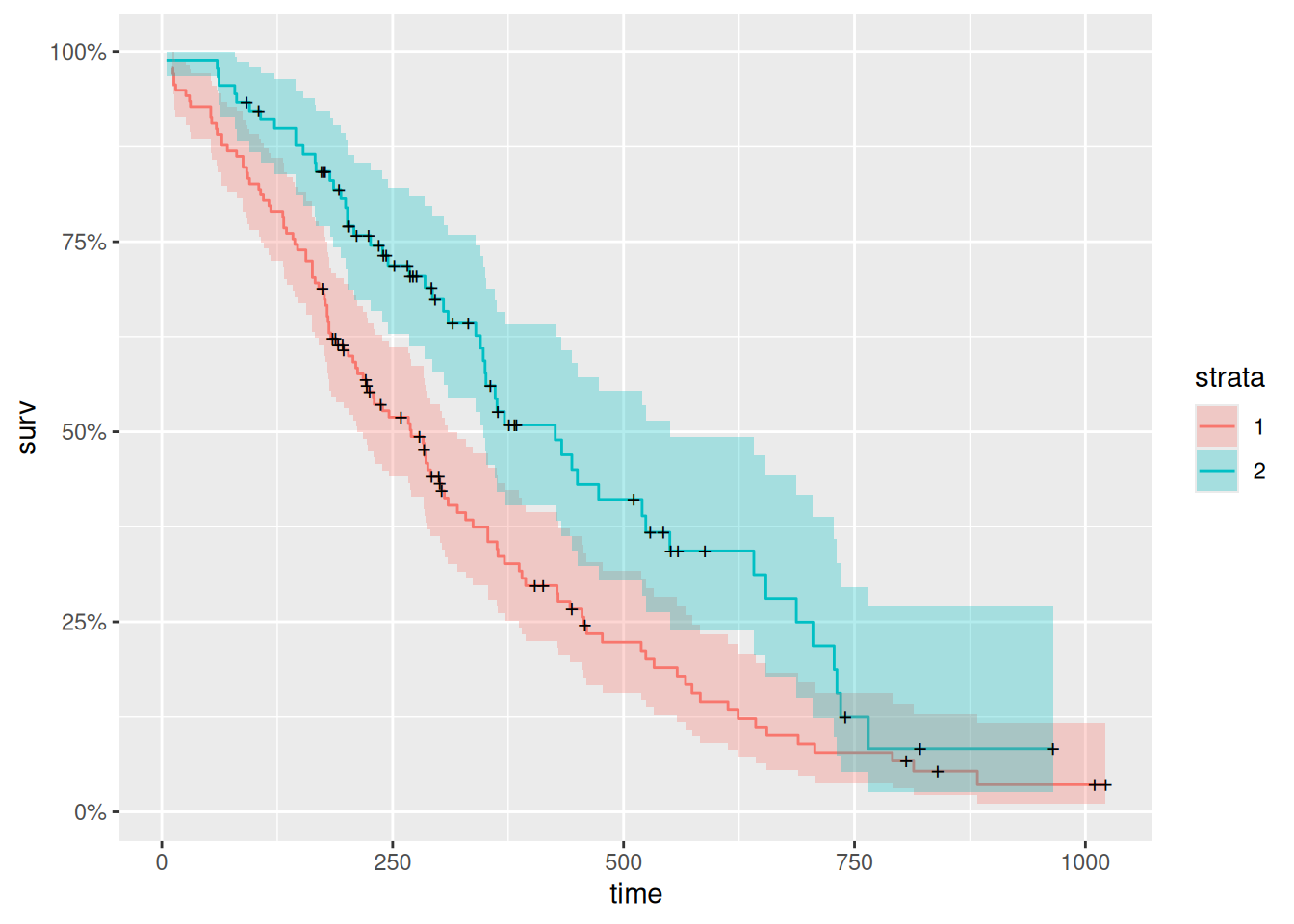
Censored observations are denoted by crosses. This is the so-called Kaplan-Meier curve.
Now let’s do a Cox model example.
Call:
coxph(formula = Surv(time, status) ~ sex + age, data = lung,
    method = "breslow")

  n= 228, number of events= 165

         coef exp(coef)  se(coef)      z Pr(>|z|)
sex -0.512565  0.598957  0.167462 -3.061  0.00221 **
age  0.017013  1.017158  0.009222  1.845  0.06506 .
---
Signif. codes:  0 '***' 0.001 '**' 0.01 '*' 0.05 '.' 0.1 ' ' 1

    exp(coef) exp(-coef) lower .95 upper .95
sex     0.599     1.6696    0.4314    0.8316
age     1.017     0.9831    0.9989    1.0357

Concordance= 0.603  (se = 0.025 )
Likelihood ratio test= 14.08  on 2 df,   p=9e-04
Wald test            = 13.44  on 2 df,   p=0.001
Score (logrank) test = 13.69  on 2 df,   p=0.001
Examples of parametric survival models: exponential, Weibull, or log-logistic:
Call:
survreg(formula = Surv(time, status) ~ sex + age, data = lung,
    dist = "exponential")
               Value Std. Error     z      p
(Intercept)  6.35967    0.63547 10.01 <2e-16
sex          0.48093    0.16709  2.88  0.004
age         -0.01562    0.00911 -1.72  0.086

Scale fixed at 1

Exponential distribution
Loglik(model)= -1156.1   Loglik(intercept only)= -1162.3
    Chisq= 12.48 on 2 degrees of freedom, p= 0.002
Number of Newton-Raphson Iterations: 4
n= 228
Call:
survreg(formula = Surv(time, status) ~ sex + age, data = lung,
    dist = "weibull")
               Value Std. Error     z       p
(Intercept)  6.27485    0.48137 13.04 < 2e-16
sex          0.38209    0.12748  3.00  0.0027
age         -0.01226    0.00696 -1.76  0.0781
Log(scale)  -0.28230    0.06188 -4.56 5.1e-06

Scale= 0.754

Weibull distribution
Loglik(model)= -1147.1   Loglik(intercept only)= -1153.9
    Chisq= 13.59 on 2 degrees of freedom, p= 0.0011
Number of Newton-Raphson Iterations: 5
n= 228
Call:
survreg(formula = Surv(time, status) ~ sex + age, data = lung,
    dist = "loglogistic")
               Value Std. Error     z       p
(Intercept)  5.92232    0.53269 11.12 < 2e-16
sex          0.47751    0.14036  3.40 0.00067
age         -0.01401    0.00771 -1.82 0.06946
Log(scale)  -0.56991    0.06543 -8.71 < 2e-16

Scale= 0.566

Log logistic distribution
Loglik(model)= -1152.9   Loglik(intercept only)= -1160.9
    Chisq= 16.07 on 2 degrees of freedom, p= 0.00032
Number of Newton-Raphson Iterations: 4
n= 228
One caveat when reading these next to the Cox fit above. survreg estimates accelerated failure time models, parameterized on log survival time, whereas coxph estimates proportional hazards. The coefficients therefore carry opposite signs for the same underlying effect: a covariate that raises the hazard shortens expected survival time. A sign flip between the two tables is the expected result of the differing parameterizations, not a contradiction.
Expect the reversal of direction; do not expect mirror-image magnitudes. Exponential and Weibull are the families that are both PH and AFT, and there the two parameterizations are related exactly through the shape parameter, so the AFT coefficient scaled by the shape recovers the PH coefficient up to sign. Log-logistic, the third fit above, is an AFT family that is not proportional hazards at all, so it has no PH coefficient to be the mirror of. Setting a log-logistic fit beside a Cox fit compares two different models of the same data, and only the direction of the effect should be expected to agree.
Cox (1972) is the continuous-time proportional hazards model; the discrete-time analogue models the odds of an event at time \(t_j\) given survival up to that point. This proportional-odds specification for the discrete hazard,
\[ \frac{h(t_j | {{\symbf{x}}}_i)}{1- h(t_j | {{\symbf{x}}}_i)} = \frac{h_0(t_j)}{1- h_0(t_j)} \exp({{\symbf{x}}}'_i \beta), \tag{10.20}\] is a discrete-time proportional-odds hazard model rather than a direct discretization of Cox’s continuous-time proportional hazards model. (The complementary log-log link is the discrete-time form that corresponds more directly to a grouped continuous-time proportional hazards model.) If we take logs on both sides, we have
\[ {{\mathrm{logit}}} (h(t_j | {{\symbf{x}}}_i)) = \alpha_j + {{\symbf{x}}}'_i \beta, \tag{10.21}\] This looks very similar to a logit model. In fact, we can fit a discrete-time proportional hazard model by running a logistic regression on a set of pseudo observations generated by “filling in” the observations between the start time to the event time or time at the end of the study period (censored). The outcome of this process is 0 unless there is an event, then it turns 1. It is treated as independent Bernoulli observations with probability given by hazard \(h_{ij}\) for individual \(i\) at time \(t_j\). The likelihood function for the discrete-time survival model coincides with the likelihood of a sequence of independent Bernoulli trials (Singer and Willett, 1993, has more details).
To do a discrete-time survival model in Stata, your data set needs to be set up as by unit-time. For example, observations by company month. The event (or failure) variable needs to be set to zero until the event happens. If no event until the end of the study period, then it is censored. A data set by unit-time can be analyzed by logit model, optionally with clustered standard error. To set up a structure like this, user-written programs called \(dthaz\) and \(prsnperd\) (means person-period) can be used.
To do a continuous-time survival model in Stata, your data can be either set up as discrete-time case (in which case you can use a time-varying explanatory variable) or a single-record-per-person data set. Stata has built-in command \(stset\) to set up a survival analysis structure. Then you can run \(stcox\) for Cox’s proportional hazard model.