---
title: "Causal Forest in panel data"
date: "2017-10-23"
---
## Introduction
In this simulation exercise, we use Causal Forest (Now is implemented in Generalized Random Forest) (https://github.com/swager/grf) to calculated conditional average treatment effect (or heterogeneous treatment effect). We assume three different data generating processes. The first one is a linear interaction between a variable of interest and the treatment dummy. The second one assumes a nonlinear function (a step function) of a variable of interest, say $X$, and the treatment dummy $W$. The third one is also nonlinear, assuming we have variable $X$, but the real DGP is the interaction of log of $X$ and $W$.
## Linear effect
Suppose we have a panel of firms over time, treatment assignment is random. We split the data into training and test. Then we generate 10 random variables, the first two are highly correlated. Then we collapse V2 into firm means, and use that as the unit effect.
Concretely: $n = 400$ firms over $t = 10$ periods, 4,000 observations, with
$p = 10$ standard normal covariates of which $V1$ and $V2$ are correlated at
0.9025. Treatment is $W \sim \text{Bernoulli}(0.5)$, assigned independently of
everything, and a further coin flip splits the sample roughly in half into
training and test sets (about 2,014 rows for training). The unit effect
$\alpha_i$ is the firm mean of $V2$.
That is, we have a DGP as:
$$y_{it} = \alpha_i + V1_{it} + W_{it} + V1_{it}*W_{it} + \epsilon_{it} $$ {#eq-causal-forest-panel-1}
Here $\alpha_i$ is not observed, and it is correlated with $V1$, so leaving it out is in principle a source of bias.
It is worth being precise about how much bias, though, because the results below
are less dramatic than that setup suggests. The unit effect is the *firm mean* of
$V2$ over all $t=10$ periods, and averaging attenuates its correlation with
contemporaneous $V1$ by a factor of $t$: with
$\mathrm{Cor}(V1_{it}, V2_{it}) = 0.9025$ we get
$\mathrm{Cov}(V1_{it}, \bar V2_i) = 0.9025/10$, and
$\mathrm{Cor}(V1_{it}, \alpha_i) \approx 0.29$. So the omitted-variable bias on
$V1$ is only about $0.05$--$0.09$, not a qualitative failure.
That is what the three models show: FE, RE and OLS all recover $V1 \approx 1$,
$W \approx 1$ and $V1{:}W \approx 1.05$, essentially the truth. Note in
particular that the *treatment* coefficients are unbiased in all three, because
$W$ is randomized and so independent of $\alpha_i$ — omitting a unit effect
cannot bias the effect of a randomly assigned treatment. If you want a panel
example where FE visibly beats OLS, the unit effect has to be correlated with
$V1$ *contemporaneously* (or $t$ has to be small), and the treatment has to be
non-random.
```{r}
#| label: chunk1
#| warning: false
#| cache: true
#| message: false
# This is a simulation exercise to see how causal forest performs
# First we run a linear model, with panel setting
# Then two nonlinear situations, with panel setting.

library(lfe, quietly = TRUE)
library(lme4)
require(snowfall)
library(MASS)
library(grf)
library(tidyverse)
set.seed(666)
rm(list = ls())
# t is no. of periods. p is no. of variables, n is no. of firms.
t <- 10
p <- 10
n=400
# generate p random variables
data1 = as.data.frame(matrix(rnorm(n*t*p), n*t, p))
names(data1) <- paste0("X", 1:p)

firm=seq(1,n)
time=seq(1,t)
data <- expand.grid(firm=firm,time=time)


# W is the treatment assignment
data$W <- rbinom(n*t, 1, 0.5)
data$train <- rbinom(n*t, 1, 0.5)


# generate two correlated variables
covarMat = matrix( c(1, .95^2, .95^2, 1 ) , nrow=2 , ncol=2 )
data.2  = as.data.frame(mvrnorm(n=n*t , mu=rep(0,2), Sigma=covarMat ))
names(data.2) <- c("V1", "V2")

data <- bind_cols(data,data.2) %>%
    tibble()

data <- bind_cols(data,data1)

# generate unit effect by firm means of V2, which is correlated with V1
data <- data %>%
    group_by(firm) %>%
    mutate(unit.effect=mean(V2)) %>%
    ungroup() %>%
    arrange(firm, time)

y<-c()
unit<-c()
X<-c()
k <- 0
for(i in 1:n){
    for(j in 1:t){
        k<-k+1
        unit[k]<-i
        y[k]<-1+ data$V1[k] + data$W[k] + data$V1[k]*data$W[k] + data$unit.effect[k]+rnorm(1,mean=0,sd=1)
    }
}
data$unit=unit
data$y=y


data.train <- data %>%
    filter(train==1)
data.test <- data %>%
    filter(train==0)

# run fixed effect, random effect, and ols to see whether they are
# biased.
# in general we should expect fe performs better, since we are
# omitting unit.effect in the other two models
fe <- felm(y ~ V1 * W | unit, data=data.train)
re <-lmer(y~V1*W+(1 | unit), data=data.train)
ols <- lm(y ~ V1 * W , data=data.train)
summary(fe)
summary(re)
summary(ols)
```
Now we run Causal Forest on this data. Two clarifications about what is and is not at stake here. First, treatment $W$ is **randomized** (`rbinom(., 0.5)`, independent of the firm effect), so the omitted unit effect $\alpha_i$ does *not* confound the treatment effect — it only enters the nuisance functions (and hence precision), it does not create treatment-effect bias. The panel issue here is therefore mainly *dependence and nuisance fit*, not confounding. Second, the firm structure should be handled in two ways: we include the firm dummies in $X$ so the forest can absorb $\alpha_i$ in the nuisance models, **and** we pass `clusters = firm` so that `grf`'s honest sample splitting and its variance estimates keep each firm's repeated observations together rather than treating them as independent rows. Including the dummies alone does neither of those.
```{r}
#| label: chunk2
#| warning: false
#| cache: true
#| message: false
# ensure consistent factor levels across train/test
all_firms <- levels(factor(data$firm))
data.train$firm <- factor(data.train$firm, levels = all_firms)
data.test$firm <- factor(data.test$firm, levels = all_firms)

# a is a data set of firm dummies
# Caution: this one-hot-encodes all ~400 firms into individual dummy columns
# of X. Random forests split poorly on such a high-cardinality sparse block
# of binary columns (each dummy is only informative for a tiny fraction of
# observations). A fixed-effects forest (demean y, W, and the continuous
# covariates within firm first, then run causal_forest on the demeaned
# variables) or a method that handles unit effects natively would typically
# perform better than including firm as raw dummies.
a <- as.data.frame(model.matrix(y~firm, data.train))
X <- as.matrix(bind_cols(data.train[,c(5,7:16)],a))
Y <- data.train$y
W <- data.train$W
# causal forest is run on y against V1, to X10 and firm dummies.
# clusters = firm makes honest splitting and the variance estimates respect
# the panel structure (a firm's repeated rows are kept together, not treated
# as independent observations).
tau.forest = causal_forest(X, Y, W, clusters = as.integer(data.train$firm))

average_treatment_effect(tau.forest, target.sample = "all")
average_treatment_effect(tau.forest, target.sample = "treated")
a <- as.data.frame(model.matrix(y~firm, data.test))
X.test <- as.matrix(bind_cols(data.test[,c(5,7:16)],a))
Y.test <- data.test$y
W.test <- data.test$W

tau.hat = predict(tau.forest, X.test, estimate.variance = TRUE)
sigma.hat = sqrt(tau.hat$variance.estimates)

data.test$pred <- tau.hat$predictions
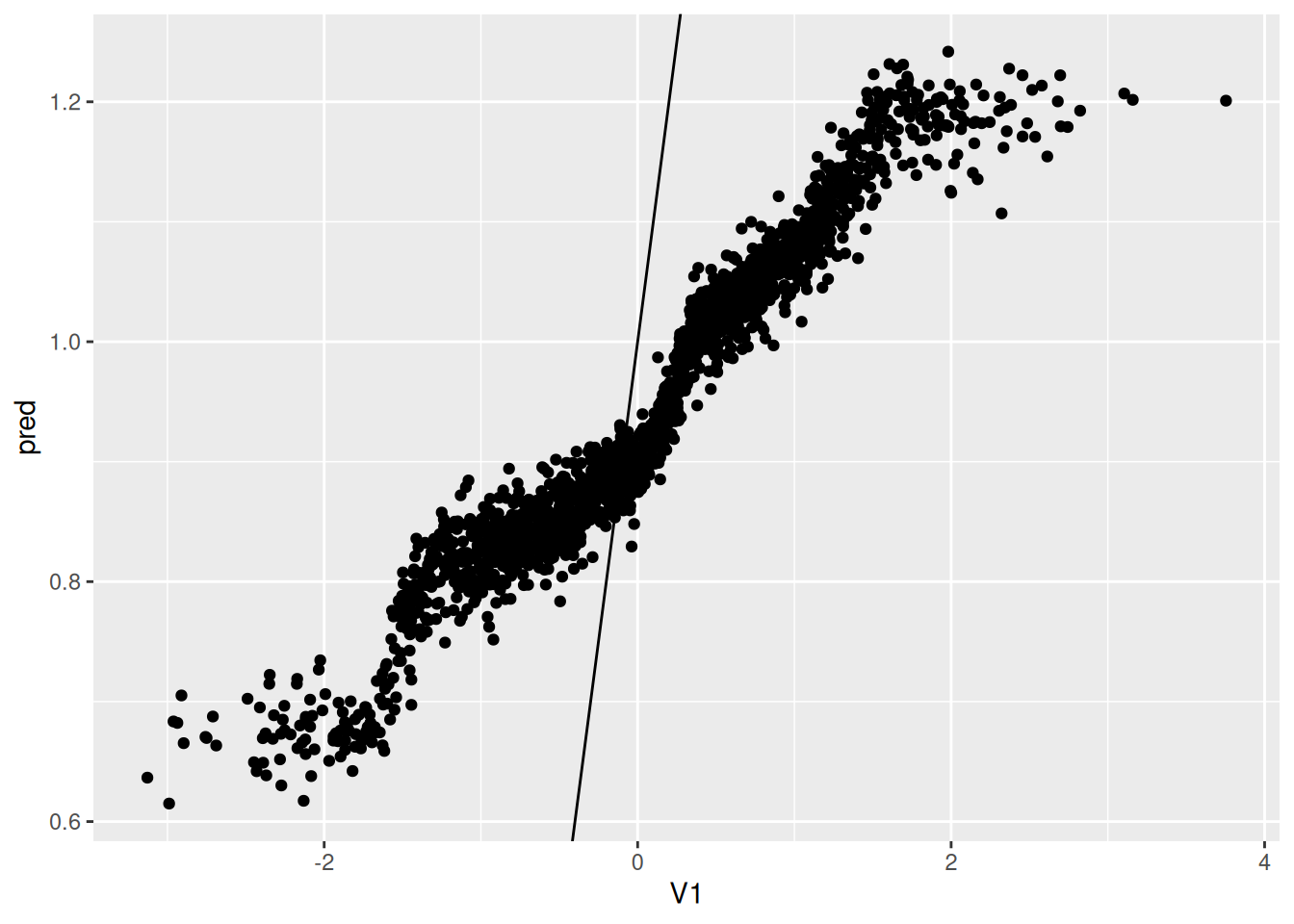
ggplot(data.test, aes(x=V1, y=pred)) + geom_point() + geom_abline(intercept = 1, slope = 1)
```
The forest's doubly-robust ATE comes out at 0.9356 with a standard error of
0.0823, and 0.9317 with 0.0816 for the second variant. The true ATE is
$E[1 + V1] = 1$, so both are within one standard error of it — the forest costs
a little precision against the correctly specified linear models but is not
biased.
This graph is the predicted value of CATE on the test data, vs. the value of $V1$.
The points should sit on the 45-degree line, and the error bars in the second
panel show how much of the scatter is estimation noise rather than a failure to
track the true $1 + V1$.
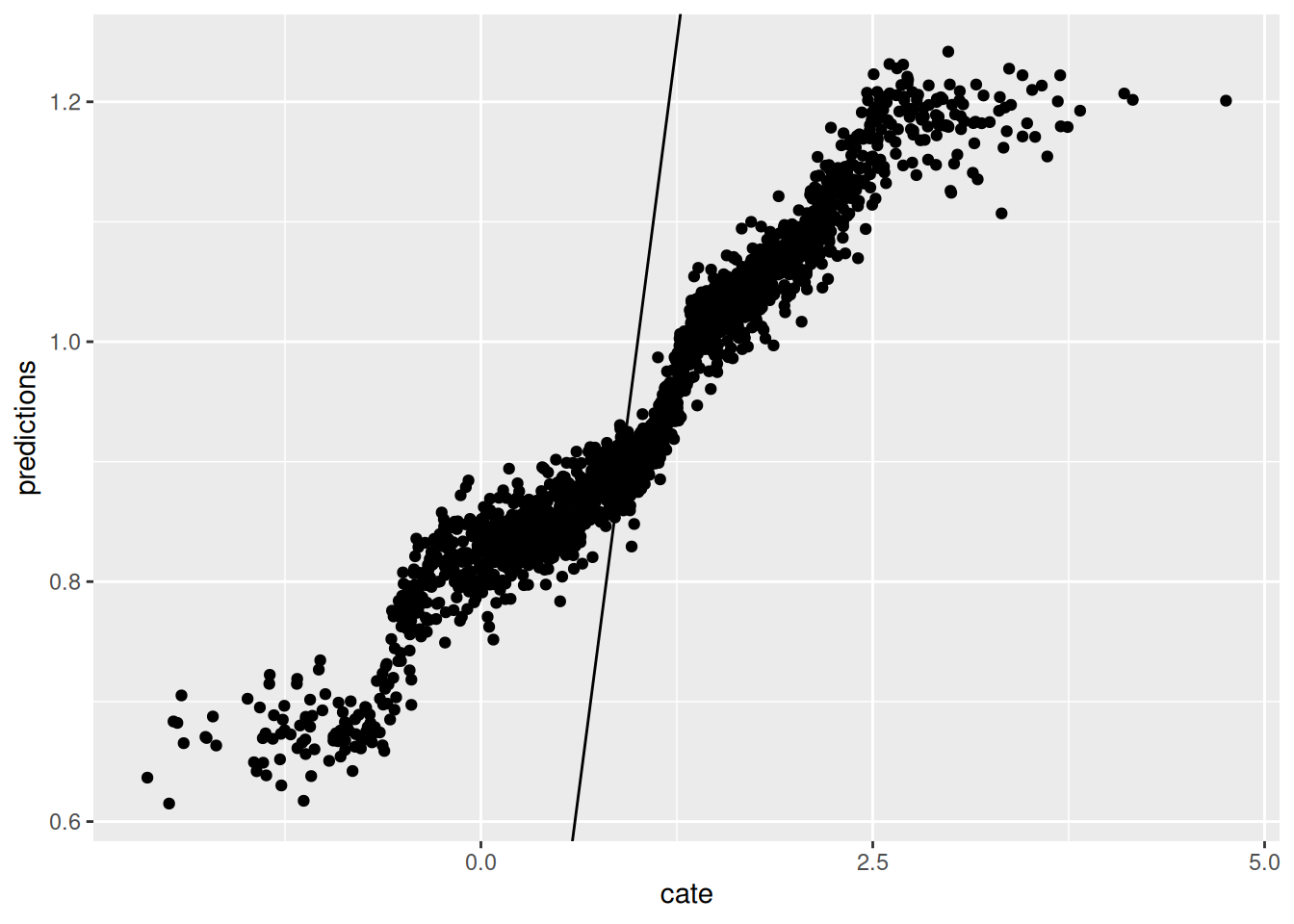
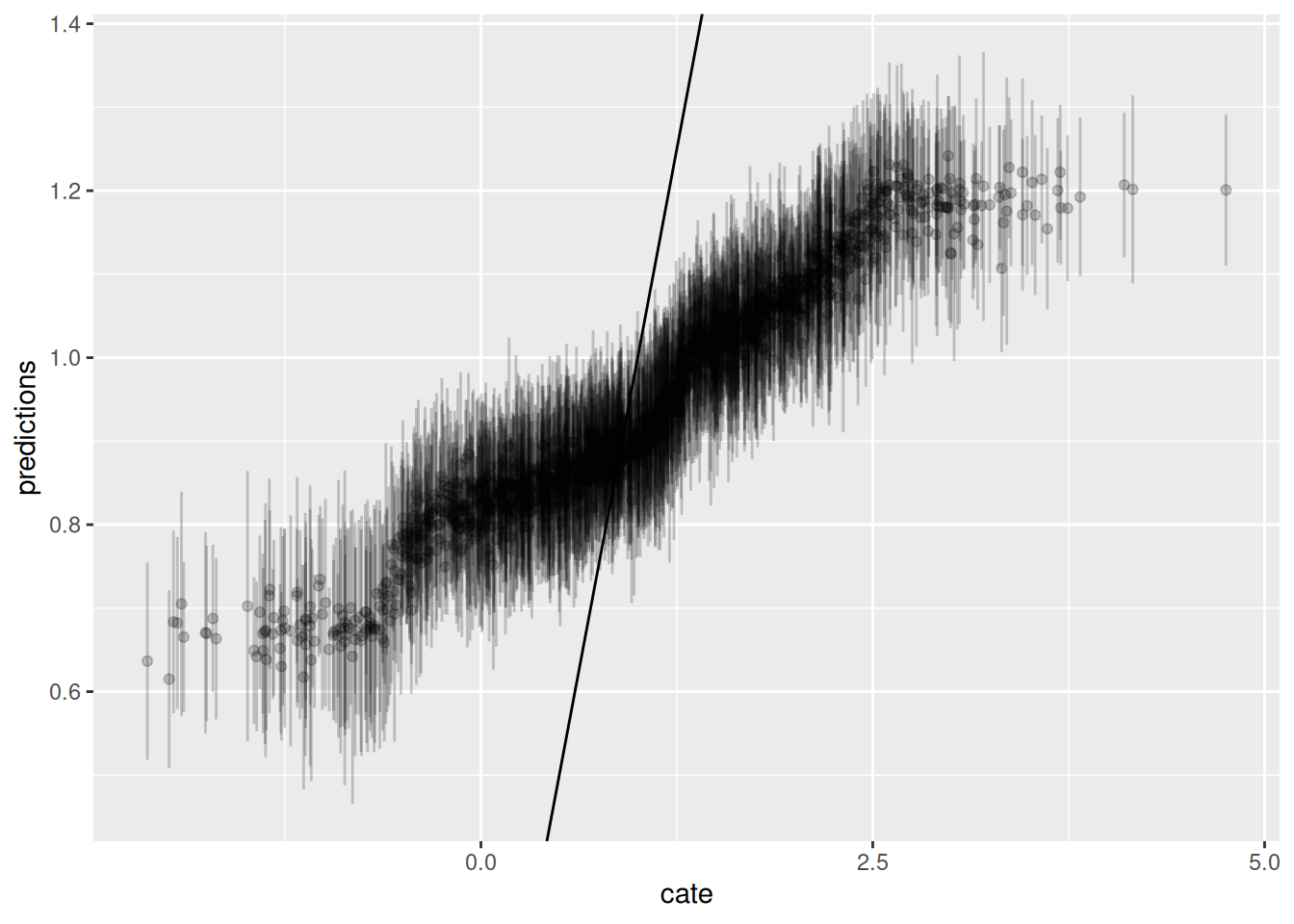
Now we graph the predicted CATE against the true CATE. The other nice feature of Causal Forest is that it returns variance for CATE for each observation. We also graph the error bar here.
```{r}
#| label: chunk3
#| warning: false
#| cache: true
#| message: false
graph.data  <- as.data.frame(tau.hat )
graph.data  <- graph.data  %>%
    mutate(cate=1+data.test$V1) %>%
    mutate(lower=predictions - sigma.hat , upper=predictions + sigma.hat )

ggplot(graph.data , aes(x=cate, y=predictions)) + geom_point()  + geom_abline(slope = 1)
ggplot() + geom_errorbar(graph.data , mapping=aes(x=cate, ymin=lower,ymax=upper), alpha = 0.2) + geom_point(graph.data , mapping=aes(x=cate, y=predictions), alpha = 0.2) + geom_abline(slope = 1)
```
## Nonlinear effect case 1
In the first situation, we assume DGP:
$$y_{it} = 1 + \alpha_i + max(V1_{it},0)*W_{it} + \epsilon_{it} $$ {#eq-causal-forest-panel-2}
```{r}
#| label: chunk4
#| warning: false
#| cache: true
#| message: false
# if we have a nonlinear effect
# suppose we have the same X, but y is generated nonlinearly.
# in this example, y is a nonlinear function of V1 and W
set.seed(666)
rm(list = ls())
# t is no. of periods. p is no. of variables, n is no. of firms.
t <- 10
p <- 10
n=400
# generate p random variables
data1 = as.data.frame(matrix(rnorm(n*t*p), n*t, p))
names(data1) <- paste0("X", 1:p)

firm=seq(1,n)
time=seq(1,t)
data <- expand.grid(firm=firm,time=time)


# W is the treatment assignment
data$W <- rbinom(n*t, 1, 0.5)
data$train <- rbinom(n*t, 1, 0.5)


# generate two correlated variables
covarMat = matrix( c(1, .95^2, .95^2, 1 ) , nrow=2 , ncol=2 )
data.2  = as.data.frame(mvrnorm(n=n*t , mu=rep(0,2), Sigma=covarMat ))
names(data.2) <- c("V1", "V2")

data <- bind_cols(data,data.2) %>%
    tibble()

data <- bind_cols(data,data1)

# generate unit effect by firm means of V2, which is correlated with V1
data <- data %>%
    group_by(firm) %>%
    mutate(unit.effect=mean(V2)) %>%
    ungroup() %>%
    arrange(firm, time)

y<-c()
unit<-c()
X<-c()
k <- 0
for(i in 1:n){
    for(j in 1:t){
        k<-k+1
        unit[k]<-i
        y[k]<-1+ pmax(data$V1[k],0)*data$W[k]  + data$unit.effect[k]+rnorm(1,mean=0,sd=1)
    }
}
data$y=y
data$unit <- unit

data.train <- data %>%
    filter(train==1)
data.test <- data %>%
    filter(train==0)

# run fixed effect, random effect, and ols to see whether they are
# biased.
# they all perform poorly
fe <- felm(y ~ V1 * W | unit, data=data.train)
re <-lmer(y~V1*W+(1 | unit), data=data.train)
ols <- lm(y ~ V1 * W , data=data.train)
summary(fe)
summary(re)
summary(ols)
```
These linear models miss the *shape* of the effect, but it overstates things to
say they return nothing. Each recovers the best linear approximation to the true
CATE $\max(V1,0)$, which is $0.3989 + 0.5\,V1$: the fitted $W$ coefficients are
$0.40$--$0.43$ and the $V1{:}W$ interactions are $0.53$--$0.55$. In particular the
$W$ coefficient is essentially the true ATE, $E[\max(V1,0)] = \phi(0) = 0.3989$.
What a linear specification cannot do is see the kink at $V1 = 0$ — and that is
what the forest is for.
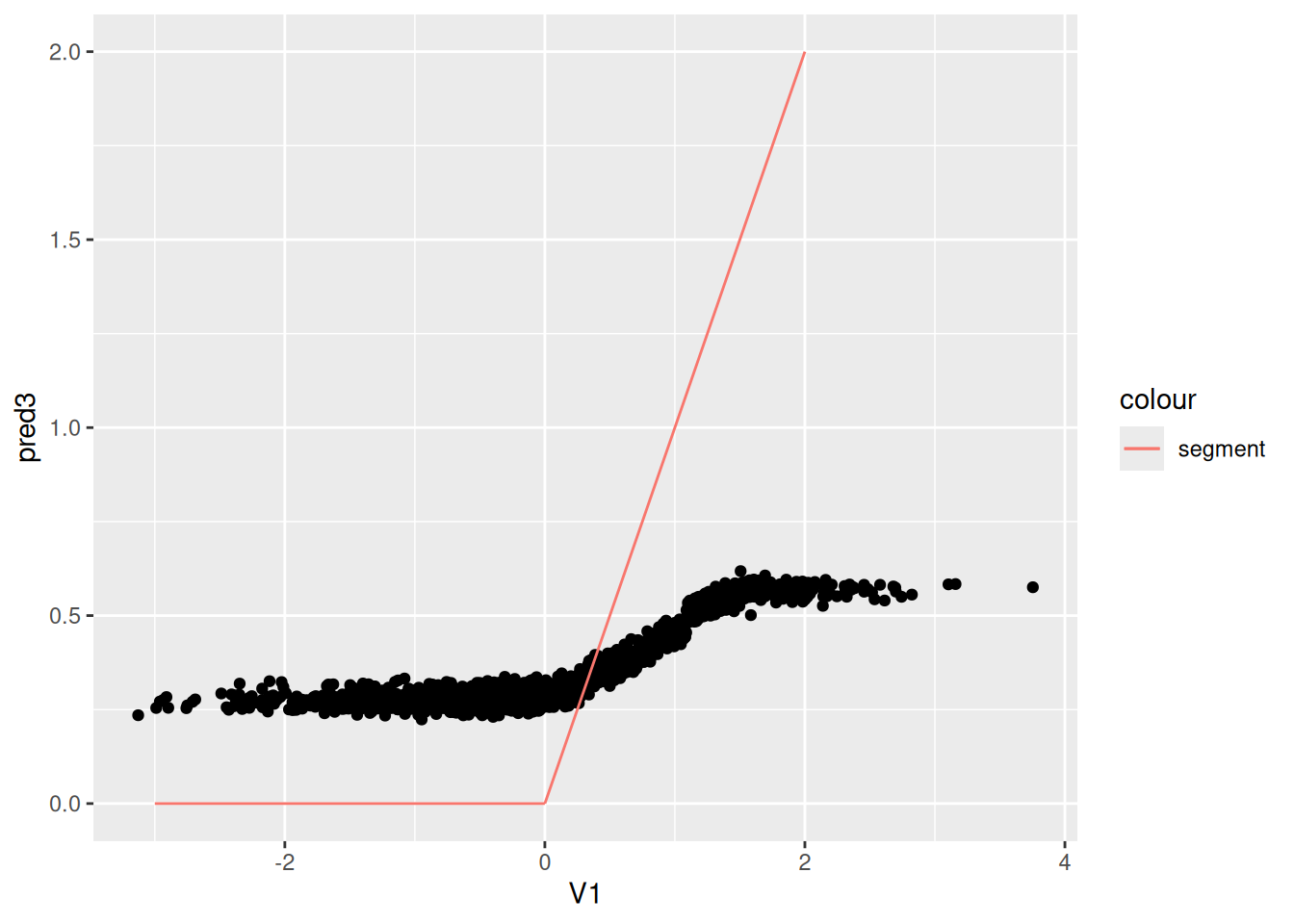
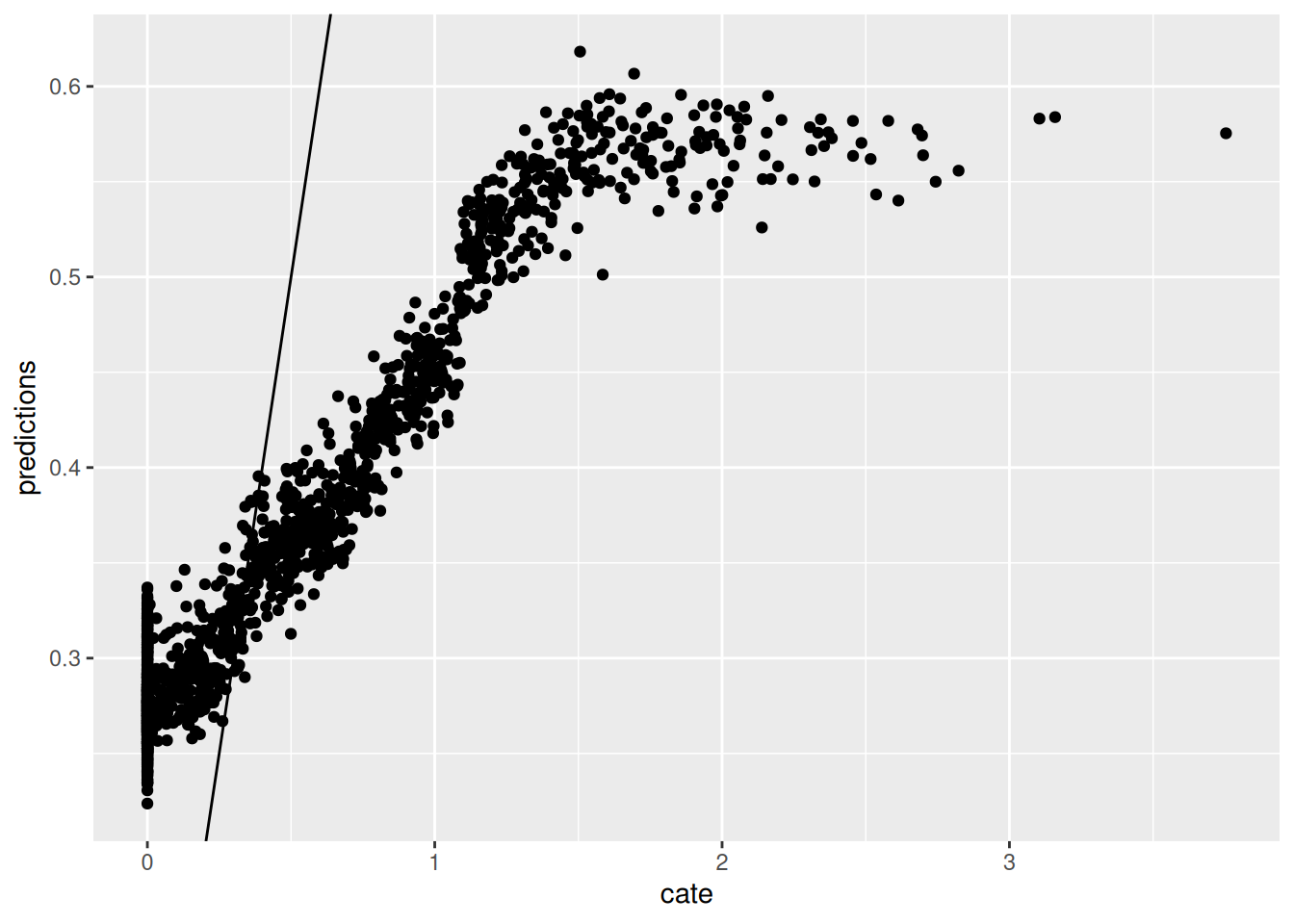
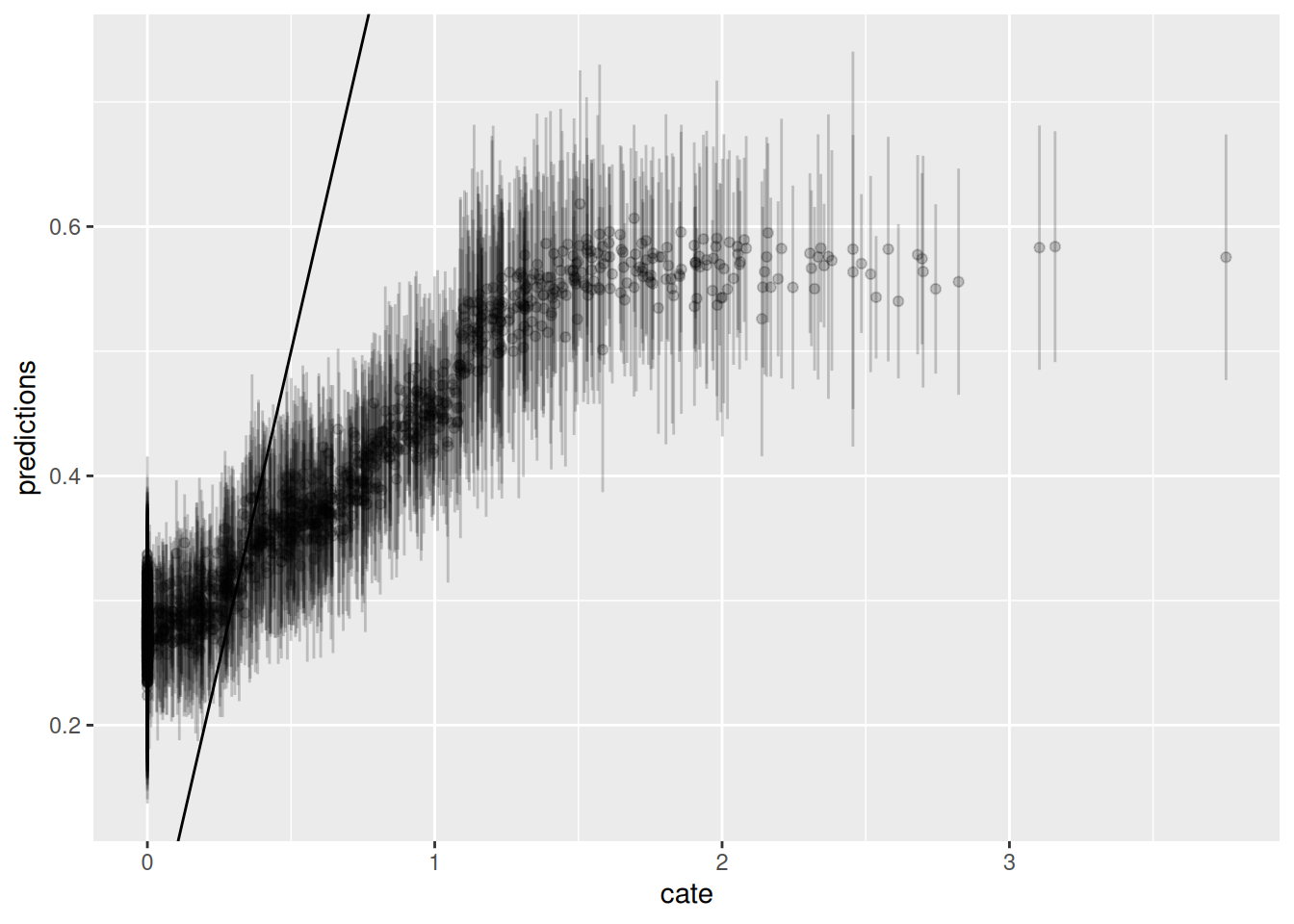
Now we use Causal Forest. The first graph is the predicted CATE against $V1$; the second graph is the predicted CATE against true CATE. The third one adds in error bars.
The forest's ATE is 0.3732 (SE 0.0533) and 0.3722 (SE 0.0529), against the true
$0.3989$ — within half a standard error, and no better than the linear model's
$W$ coefficient at recovering the average. The gain is in the shape: the fitted
CATE should flatten to zero for $V1 < 0$ and rise linearly above it, which is the
kink the linear interaction smooths straight through.
```{r}
#| label: chunk5
#| warning: false
#| cache: true
#| message: false
all_firms <- levels(factor(data$firm))
data.train$firm <- factor(data.train$firm, levels = all_firms)
data.test$firm <- factor(data.test$firm, levels = all_firms)

# a is a data set of firm dummies
a <- as.data.frame(model.matrix(y~firm,data.train))
X <- as.matrix(bind_cols(data.train[,c(5,7:16)],a))
Y <- data.train$y
W <- data.train$W

#tau.forest = causal_forest(X, Y, W, num.trees = 4000)
a <- as.data.frame(model.matrix(y~firm,data.test))
X.test <- as.matrix(bind_cols(data.test[,c(5,7:16)],a))
Y.test <- data.test$y
W.test <- data.test$W

tau.forest3 = causal_forest(X, Y, W, clusters = as.integer(data.train$firm))

average_treatment_effect(tau.forest3, target.sample = "all")
average_treatment_effect(tau.forest3, target.sample = "treated")
#tau.forest3 = causal_forest(X, Y, W, num.trees = 4000)
tau.hat3 = predict(tau.forest3, X.test, estimate.variance = TRUE)
sigma.hat3 = sqrt(tau.hat3$variance.estimates)

data.test$pred3 <- tau.hat3$predictions

seg1 <- data.frame(x1 = -3, x2 = 0, y1 = 0, y2 = 0)
seg2 <- data.frame(x1 = 0, x2 = 2, y1 = 0, y2 = 2)
ggplot(data.test, aes(x=V1, y=pred3)) + geom_point() +
geom_segment(aes(x = x1, y = y1, xend = x2, yend = y2, colour = "segment"), data = seg1)+
geom_segment(aes(x = x1, y = y1, xend = x2, yend = y2, colour = "segment"), data = seg2)
graph.data3 <- as.data.frame(tau.hat3)
graph.data3 <- graph.data3 %>%
    mutate(cate=pmax(data.test$V1,0)) %>%
    mutate(lower=predictions - sigma.hat3, upper=predictions + sigma.hat3)

ggplot(graph.data3, aes(x=cate, y=predictions)) + geom_point()  + geom_abline(slope = 1)
ggplot() + geom_errorbar(graph.data3, mapping=aes(x=cate, ymin=lower,ymax=upper), alpha = 0.2) + geom_point(graph.data3, mapping=aes(x=cate, y=predictions), alpha = 0.2) + geom_abline(slope = 1)
```
## Nonlinear effect case 2
In the second situation, we assume DGP:
$$y_{it} = 1 + \alpha_i + \log(V1_{it}^2)*W_{it} + \min(X3_{it}, 0) + \epsilon_{it} $$ {#eq-causal-forest-panel-3}
But we only observe $V1$, not the log of the squared $V1$. The extra
$\min(X3_{it},0)$ term is a nonlinearity in the *outcome* rather than in the
treatment effect, so it leaves the CATE equal to $\log(V1^2)$; it is there to give
the forest's nuisance models something nonlinear to fit.
```{r}
#| label: chunk6
#| warning: false
#| cache: true
#| message: false
# if we have a nonlinear effect
# suppose we have the same X, but y is generated nonlinearly.
# another example: we observe V1, but the true treatment effect is log(V1^2)
set.seed(666)
rm(list = ls())
# t is no. of periods. p is no. of variables, n is no. of firms.
t <- 10
p <- 10
n=400
# generate p random variables
data1 = as.data.frame(matrix(rnorm(n*t*p), n*t, p))
names(data1) <- paste0("X", 1:p)

firm=seq(1,n)
time=seq(1,t)
data <- expand.grid(firm=firm,time=time)


# W is the treatment assignment
data$W <- rbinom(n*t, 1, 0.5)
data$train <- rbinom(n*t, 1, 0.5)


# generate two correlated variables
covarMat = matrix( c(1, .95^2, .95^2, 1 ) , nrow=2 , ncol=2 )
data.2  = as.data.frame(mvrnorm(n=n*t , mu=rep(0,2), Sigma=covarMat ))
names(data.2) <- c("V1", "V2")

data <- bind_cols(data,data.2) %>%
    tibble()

data <- bind_cols(data,data1)

# generate unit effect by firm means of V2, which is correlated with V1
data <- data %>%
    group_by(firm) %>%
    mutate(unit.effect=mean(V2)) %>%
    ungroup() %>%
    arrange(firm, time)

y<-c()
unit<-c()
X<-c()
k <- 0
for(i in 1:n){
    for(j in 1:t){
        k<-k+1
        unit[k]<-i
        y[k]<-1+ log(data$V1[k]^2)*data$W[k] + pmin(data$X3[k], 0) + data$unit.effect[k]+rnorm(1,mean=0,sd=1)
    }
}
data$y=y
data$unit <- unit

data.train <- data %>%
    filter(train==1)
data.test <- data %>%
    filter(train==0)

# run fixed effect, random effect, and ols to see whether they are
# biased.
# they all perform poorly
fe <- felm(y ~ V1 * W | unit, data=data.train)
re <-lmer(y~V1*W+(1 | unit), data=data.train)
ols <- lm(y ~ V1 * W , data=data.train)
summary(fe)
summary(re)
summary(ols)
```
Here the linear models fail more completely, and instructively so. Because
$\log(V1^2)$ is *even* in $V1$, its linear interaction with $V1$ is zero by
construction: the fitted $V1{:}W$ terms come out at $0.015$, $-0.019$ and
$-0.020$, i.e. no detectable heterogeneity at all, even though the true CATE
varies enormously with $V1$. The $W$ coefficients ($\approx -1.18$) still
approximate the true ATE, $E[\log(V1^2)] = \psi(1/2) + \log 2 = -1.2704$. So a
linear model gets the average right and the heterogeneity completely wrong.
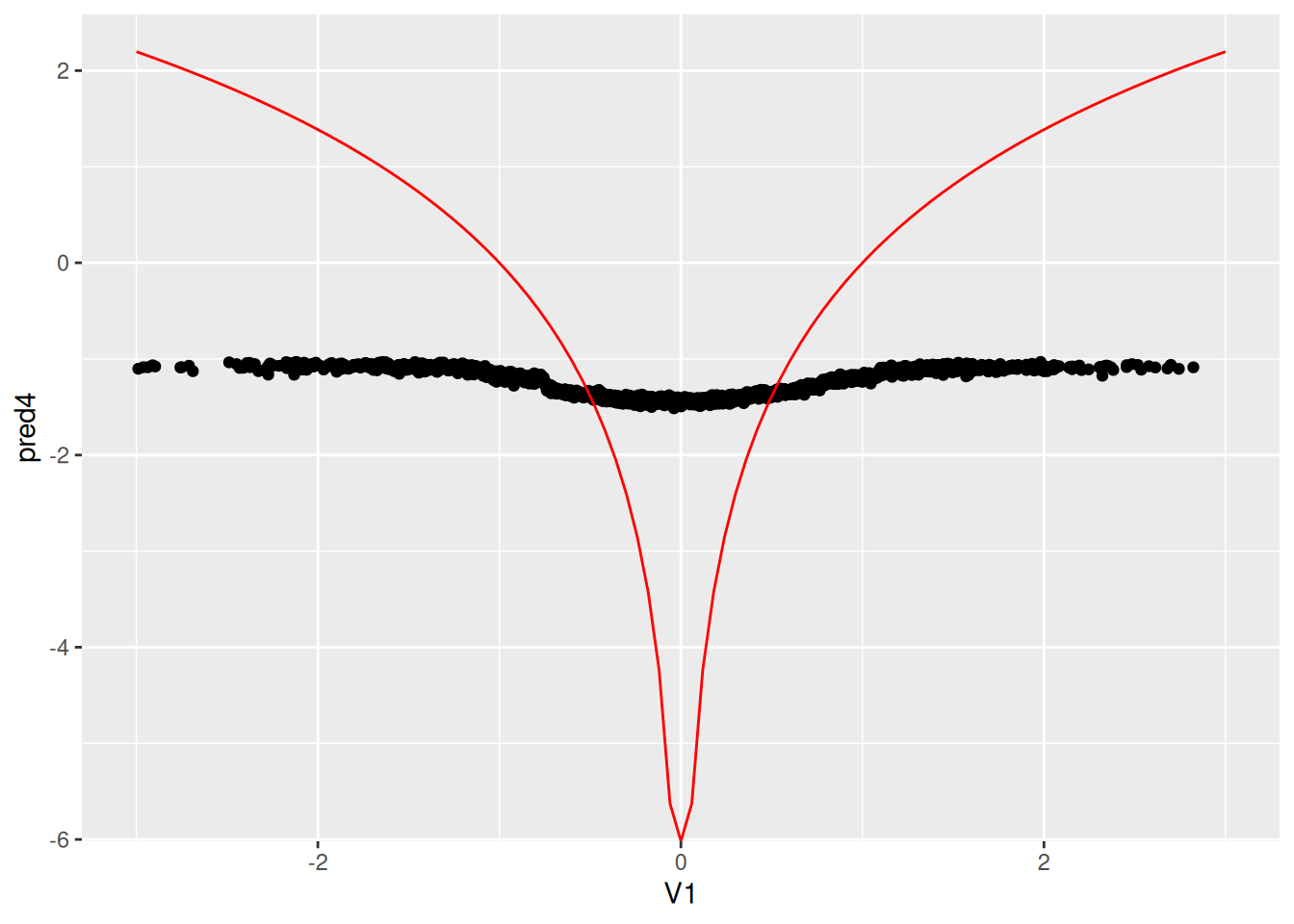
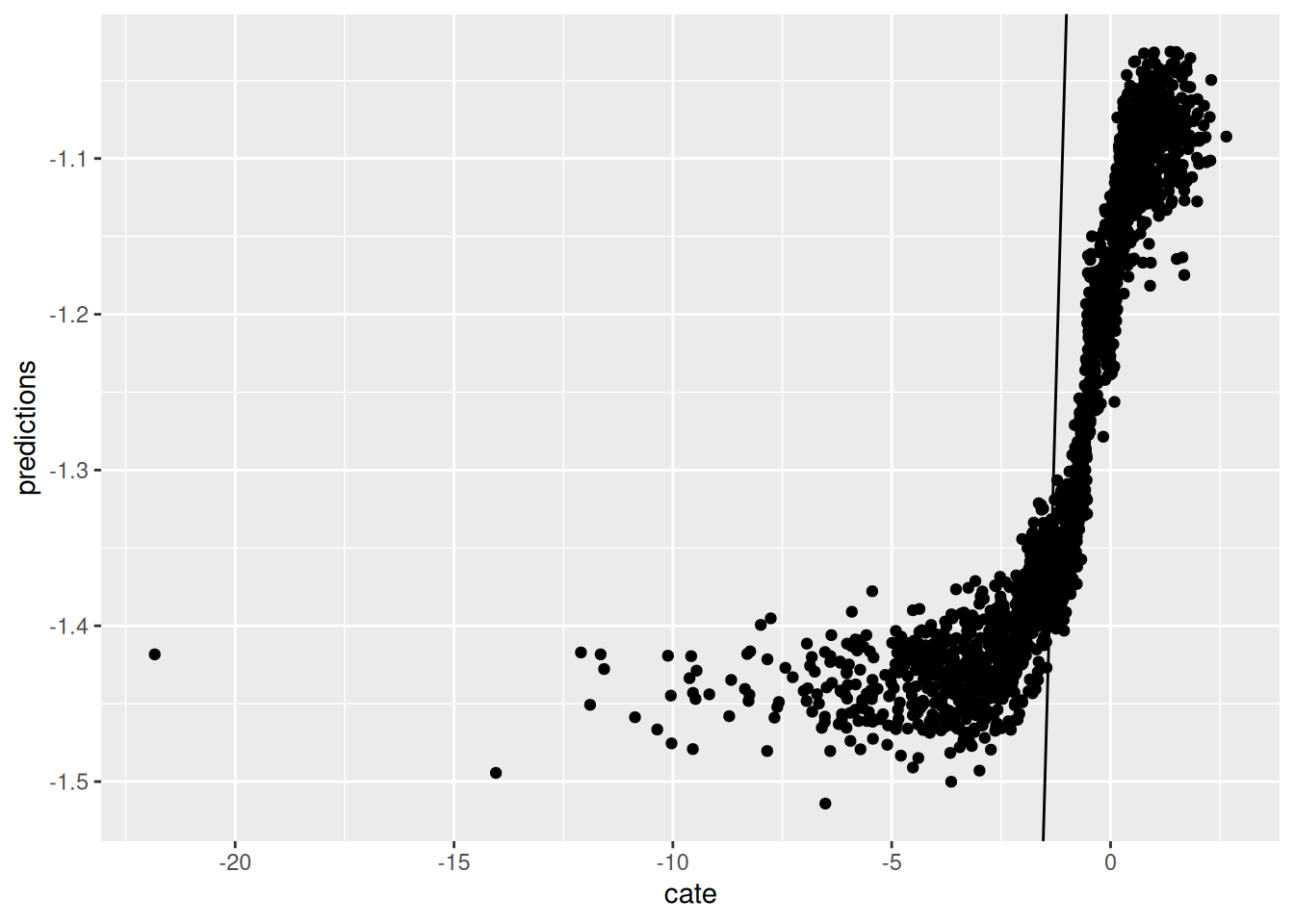
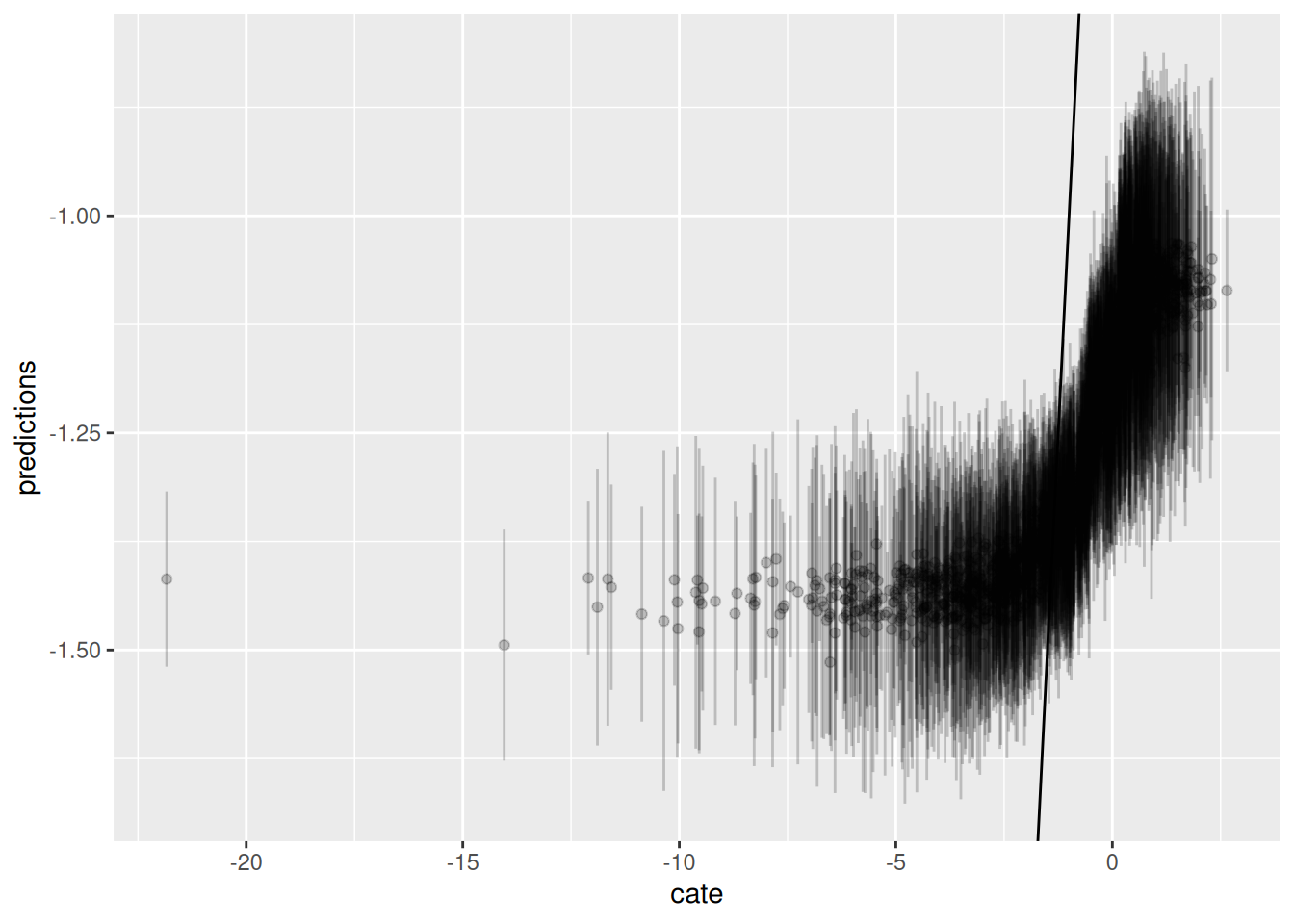
Now we run Causal Forest. Again, first graph is predicted CATE against $V1$, the second one is the predicted CATE against true CATE, the third one adds error bars.
The forest's ATE is $-1.2049$ (SE 0.0813) and $-1.2024$ (SE 0.0798) for the two
variants, against the true $-1.2704$. Like the linear models, it gets the average
about right. The difference is in the plots: the forest's fitted CATE traces the
U-shape of $\log(V1^2)$, which no linear interaction can represent.
```{r}
#| label: chunk7
#| warning: false
#| cache: true
#| message: false
all_firms <- levels(factor(data$firm))
data.train$firm <- factor(data.train$firm, levels = all_firms)
data.test$firm <- factor(data.test$firm, levels = all_firms)

# a is a data set of firm dummies
a <- as.data.frame(model.matrix(y~firm,data.train))
X <- as.matrix(bind_cols(data.train[,c(5,7:16)],a))
Y <- data.train$y
W <- data.train$W

#tau.forest = causal_forest(X, Y, W, num.trees = 4000)
a <- as.data.frame(model.matrix(y~firm,data.test))
X.test <- as.matrix(bind_cols(data.test[,c(5,7:16)],a))
Y.test <- data.test$y
W.test <- data.test$W

tau.forest4 = causal_forest(X, Y, W, clusters = as.integer(data.train$firm))

average_treatment_effect(tau.forest4, target.sample = "all")
average_treatment_effect(tau.forest4, target.sample = "treated")
#tau.forest3 = causal_forest(X, Y, W, num.trees = 4000)
tau.hat4 = predict(tau.forest4, X.test, estimate.variance = TRUE)
sigma.hat4 = sqrt(tau.hat4$variance.estimates)

data.test$pred4 <- tau.hat4$predictions

fun.1 <- function(x) log(x^2)
ggplot(data.test, aes(x=V1, y=pred4)) + geom_point() +
stat_function(fun = fun.1, colour="red") + xlim(-3,3)
graph.data4 <- as.data.frame(tau.hat4)
graph.data4 <- graph.data4 %>%
    mutate(cate=log(data.test$V1^2)) %>%
    mutate(lower=predictions - sigma.hat4, upper=predictions + sigma.hat4)

ggplot(graph.data4, aes(x=cate, y=predictions)) + geom_point()  + geom_abline(slope = 1)
ggplot() + geom_errorbar(graph.data4, mapping=aes(x=cate, ymin=lower,ymax=upper), alpha = 0.2) + geom_point(graph.data4, mapping=aes(x=cate, y=predictions), alpha = 0.2) + geom_abline(slope = 1)
```
## Summary
We see in these examples, Causal Forest performs fairly well, while other linear models will not work in the nonlinear DGP situations.
---
<!-- see-also-footer -->
*Systematic treatment: [R](https://xiangao.github.io/causal_econometrics_guide/heterogeneous-effects.html) · [Julia](https://xiangao.github.io/causal_econometrics_julia/heterogeneous-effects.html).*