---
title: "G-computation (g-formula) with time varying covariates"
date: "2024-04-20"
---
## The problem
The g-formula (g-computation algorithm) is a method to estimate the causal effect of a time varying treatment or covariates, developed by Robins (1986). Note this is distinct from **g-estimation** of structural nested models (Robins and Rotnitzky, 1992), a different g-methods estimator that uses instrumental-variable-like estimating equations and does not require modeling the joint distribution of all time-varying confounders. This chapter — and the `gfoRmula`/`gmethods` packages used below — implements the g-formula, not g-estimation.
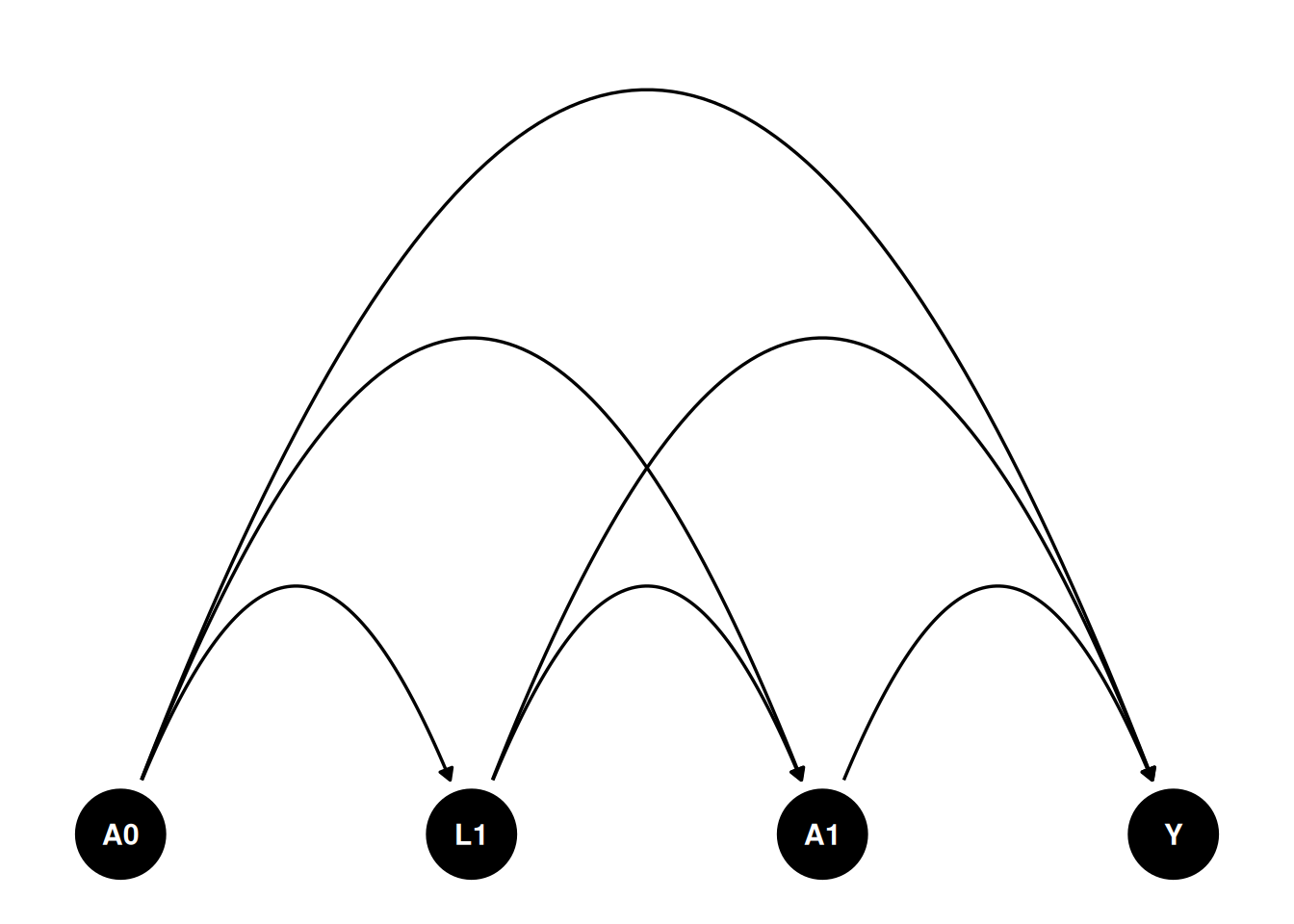
We can imagine such a scenario. Suppose $A0$ and $A1$ are time 0 and time 1 treatment, can be binary or continuous. $L1$ is a time 1 covariate. It can be some intermediate outcome. Say HbA1c. HbA1c can be a result of treatment $A0$. Then it can be a cause for the next period treatment $A1$. $Y$ is the outcome. $U$ is the unmeasured confounder. The causal diagram is shown below. How do we estimate the effect of treatment?
```{r}
#| message: false
#| warning: false
#| cache: true
library(dagitty)
library(ggdag)
library(ggplot2)
library(gfoRmula)
library(gmethods)
library(tidyverse)

dag <- dagify(
  Y ~ A1 + A0 + L1 ,
  A1 ~ A0 + L1,
  L1 ~ A0 ,
  coords = time_ordered_coords()
)

dag %>%
  ggplot(aes(x = x, y = y, xend = xend, yend = yend)) +
  geom_dag_point() +
  geom_dag_edges_arc() +
  geom_dag_text() +
  theme_dag()
```
## Assumptions
There are four potential outcomes, with $A_0$ and $A_1$ can be 0 or 1. The causal estimand is
$$ \tau_{a_0,a_1,a_0',a_1'} = E[Y^{a_0,a_1} - Y^{a_0',a_1'}]$$ {#eq-g-estimation-1}
To identify the effects, we need assumptions.
1. Sequential ignorability
$$ Y^{a_0,a_1} \perp A_0$$ {#eq-g-estimation-2}
$$ Y^{a_0,a_1} \perp A_1^{a_0} | A_0, L_1^{a_0}$$ {#eq-g-estimation-3}
In general, treatment at time $t$ is randomized with probabilities depending on the observed past (covariates and intermediate outcomes): at any time $t$, for every regime $\bar a$,
$$ Y^{\bar a} \perp A_t \mid H_t $$ {#eq-g-estimation-4}
where $H_t$ is the **observed** history of treatment and covariates up to time $t$,
$$H_t=(A_0, A_1, ..., A_{t-1}; L_1,..., L_{t}).$$ {#eq-g-estimation-5}
Read this in terms of the *observed* treatment $A_t$ and the *observed* history $H_t$: conditional on what has actually happened up to time $t$, the next treatment is independent of the future potential outcome. The superscripted objects in the two-period statement above (e.g. $A_1^{a_0}$, $L_1^{a_0}$) denote the values that would arise under setting $A_0=a_0$; by consistency these equal the observed $A_1$, $L_1$ on the subset of units with $A_0=a_0$, which is what lets the conditional-independence statement be checked on observed data.
2. Positivity
$$ 0 < P(A_0=1) < 1$$ {#eq-g-estimation-6}
$$ 0 < P(A_1=1|A_0=1, L_1) < 1$$ {#eq-g-estimation-7}
In general,
$$ 0 < P(A_t=1|H_t) < 1$$ {#eq-g-estimation-8}
3. Consistency
$$ Y^{a_0,a_1} = Y | (A_0=a_0,A_1=a_1)$$ {#eq-g-estimation-9}
## Identifiability
$$
\begin{aligned}
E[Y^{a_0,a_1}] &= E[Y^{a_0,a_1} | A_0=a_0] \\
&= E[Y^{A_0,a_1} | A_0=a_0] \\
&= \sum_{l=0,1}E[Y^{A_0,a_1} | A_0=a_0, L=l] P(L=l | A_0=a_0) \\
&= \sum_{l=0,1}E[Y^{A_0,a_1} | A_0=a_0, L=l, A_1=a_1] P(L=l | A_0=a_0) \\
&= \sum_{l=0,1}E[Y^{A_0,A_1} | A_0=a_0, L=l, A_1=a_1] P(L=l | A_0=a_0)
\end{aligned}
$$ {#eq-g-estimation-10}
This can be expanded to the general case. Basically start from the first period, then the second, based on the first, and so on.
## Estimation
There are two types of components in the g-estimation. The first is the outcome model, then there are models for time-varying covariates, or intermediate outcomes (confounders).
## Parametric g-formula
In this simple case, if $Y$ is continuous, we can use a linear model. If $Y$ is binary, we can use a logistic model.
$$ E[Y | A_0, A_1, L_1] = \beta_0 + \beta_1 A_0 + \beta_2 L_1 + \beta_3 A_1$$ {#eq-g-estimation-11}
Suppose $L_1$ is binary,
$$P(L_1=1 | A_0) = logit^{-1}(\gamma_0 + \gamma_1 A_0)$$ {#eq-g-estimation-12}
$$ L_1 | A_0 \sim Bernoulli\big(logit^{-1}(\gamma_0 + \gamma_1 A_0)\big)$$ {#eq-g-estimation-13}
We may need to simulate the distribution of the time-varying covariates for the expected value of the potential outcomes.
## an example
I am following Christopher Boyer's example in his teaching page: https://christopherbboyer.com/about.
The first example is from his lab3 teaching page.
First we set up a simulated data set.
```{r}
#| message: false
#| warning: false
#| cache: true
# setting up the data -----------------------------------------------------

# The code below creates the frequency table, and then turns it into long format
# data. Read through the code carefully and run it.

# re-create the frequency table for homework 3
hw3_freq <- tribble(
  ~A_0, ~L_1, ~A_1, ~N, ~Y_1,
  0, 0, 0, 6000, 60,
  0, 0, 1, 2000, 60,
  0, 1, 0, 2000, 210,
  0, 1, 1, 6000, 210,
  1, 0, 0, 3000, 240,
  1, 0, 1, 1000, 240,
  1, 1, 0, 3000, 120,
  1, 1, 1, 9000, 120
)

# expand the frequency table to 1 row per person
# (first just assign everyone the average Y value)
dat <- uncount(hw3_freq, N) %>%
  # give those rows an id number
  rowid_to_column(var = "id") %>%
  # for each of the variables except for id, split it into two
  # rows, one for each time point
  pivot_longer(-id,
               names_to = c(".value", "time"),
               names_sep = "_"
  ) %>%
  # make sure that time is read as a number
  mutate(time = parse_number(time),
         # add some random error to Y
         # (nrow(.) means a different value for each row of the dataset in use
         Y = Y + rnorm(nrow(.), 0, 10))


# create lagged variables
# group_by(id) makes this robust to row order -- lag() would otherwise
# silently lag across a different person's rows if dat were ever re-sorted
# (e.g. by time first). Currently harmless here since dat is in id-major
# order with exactly one row per id per time, but safer to be explicit.
t1 <- dat %>%
  group_by(id) %>%
  mutate(lag_A = lag(A)) %>%
  ungroup() %>%
  filter(time == 1)
```
Then calculate the g-formula by hand.
The recipe is the same in both cases: fit a model for the time-1 covariate $L$
given past treatment, fit a model for $Y$ given treatment, past treatment and
$L$, then simulate 10,000 people forward with the treatments *fixed* at the
regime's values, drawing $L$ from its fitted conditional distribution rather
than conditioning on the observed one.
First for $E[Y^{1,1}]$.
```{r}
#| message: false
#| warning: false
#| cache: true
# fit models for covariate and outcome given past on t1
L_mod <- glm(L ~ lag_A, data = t1, family = binomial())
Y_mod <- glm(Y ~ A * lag_A * L, data = t1)

# create new data set with space for 10,000 simulated entries
nsim <- 10000
baseline_pop <- tibble(id = 1:nsim)

# fix intervention values in the new data set to be consistent with the regime
new_dat_11 <- baseline_pop %>%
  mutate(lag_A = 1, A = 1)

# predict covariate means at time 1
new_dat_11$pL <- predict(L_mod, newdata = new_dat_11, type = "response")

# simulate covariate values at time 1
new_dat_11$L <- rbinom(nsim, 1, new_dat_11$pL)

# predict outcome at time 1 based on simulated covariates and fixed treatments
new_dat_11$Ey <- predict(Y_mod, newdata = new_dat_11, type = "response")

# take mean across all simulations to get g-formula estimate!
mean(new_dat_11$Ey)
```
That gives $E[Y^{1,1}] = 150.12$.
Then for $E[Y^{0,0}]$.
```{r}
#| message: false
#| warning: false
#| cache: true
# for 0, 0
new_dat_00 <- baseline_pop %>%
  mutate(lag_A = 0, A = 0)

# predict covariate means at time 1
new_dat_00$pL <- predict(L_mod, newdata = new_dat_00, type = "response")

# simulate covariate values at time 1
new_dat_00$L <- rbinom(nsim, 1, new_dat_00$pL)

# predict outcome at time 1 based on simulated covariates and fixed treatments
new_dat_00$Ey <- predict(Y_mod, newdata = new_dat_00, type = "response")

# take mean across all simulations to get g-formula estimate!
mean(new_dat_00$Ey)
```
And $E[Y^{0,0}] = 134.72$, so always-treat versus never-treat is worth
$150.12 - 134.72 = 15.40$ by hand.
Now with the gfoRmula package.
```{r}
#| message: false
#| warning: false
#| cache: true
# running the g-formula ---------------------------------------------------

# add your comments to the lines below
id <- "id"
time_name <- "time"
covnames <- c("L", "A")
outcome_name <- "Y"
#
outcome_type <- "continuous_eof"
#
histories <- c(lagged)
#
histvars <- list(c("A"))
#
covtypes <- c("binary", "binary")
covparams <- list(covmodels = c(
  L ~ lag1_A,
  A ~ lag1_A * L
))
ymodel <- Y ~ A * L * lag1_A
#
intvars <- list("A", "A", "A", "A")
#
interventions <- list(
  list(c(static, c(0, 0))),
  list(c(static, c(0, 1))),
  list(c(static, c(1, 0))),
  list(c(static, c(1, 1)))
)
int_descript <- c(
  "0, 0",
  "0, 1",
  "1, 0",
  "1, 1"
)

# put it all together
# (the warning "obs_data was coerced to a data table" is fine!)
gform_res <- gfoRmula::gformula(
  obs_data = dat,
  id = id,
  time_name = time_name,
  covnames = covnames,
  outcome_name = outcome_name,
  outcome_type = outcome_type,
  covtypes = covtypes,
  covparams = covparams,
  ymodel = ymodel,
  intvars = intvars,
  interventions = interventions,
  int_descript = int_descript,
  ref_int = 1,
  histories = histories,
  histvars = histvars,
  sim_data_b = TRUE,
  seed = 345636
)
# Use the following code to explore the results. (You can ignore Intervention 0,
# the natural course intervention, for now.) How many models were fit? How can
# you tell which of the data in the `sim_data` object was simulated or predicted
# from a model? Does these results match your answers to the earlier questions,
gform_res
gform_res$coeffs
gform_res$sim_data
```
The package agrees with the hand calculation. Intervention 4 ("1, 1", always
treat) gives a g-formula mean of 150.0516 against the 150.12 computed by hand,
and intervention 1 ("0, 0", never treat) gives 134.5405 against 134.72 — the
small gaps are Monte Carlo error, since both routes simulate rather than
integrate. The table's own contrast of the two, 15.51, matches the 15.40 from
the hand calculation.
The natural course is 141.59, sitting between the two regimes, and the
non-parametric mean of the observed data is 142.46, which is the check that the
model-based natural course is not badly misspecified.
The other two regimes are worth a glance. Treating only at time 0 gives 150.35
and treating only at time 1 gives 134.53 — so essentially all of the effect
comes from the first period's treatment, and the second period adds nothing.
Reading `gform_res$coeffs` shows why this needs the g-formula rather than a
regression. The $L$ model has a coefficient of 1.0986 on lagged treatment, so
past treatment moves the time-1 covariate; and the $Y$ model has 149.85 on $L$
and $-269.83$ on the $L \times \text{lag}_1 A$ interaction, so that covariate
in turn moves the outcome. $L$ is a time-varying confounder affected by past
treatment, which is exactly the configuration where conditioning on it blocks
part of the effect and omitting it leaves confounding.
## A second example
Chistopher Boyer has a package "gmethods" that can be used to estimate the g-formula. To me it's a bit more intuitive than the gfoRmula package. Here is an example in the "gmethods" package, with the same model in the "gfoRmula" package.
The example dataset continuous_eofdata again consists of 7,500 observations on 2,500 individuals with a maximum of 7 follow-up times, where the outcome corresponds to a characteristic only in the last interval (e.g., systolic blood pressure in interval 7). The variables in the dataset are:
t0: The time index
id: A unique identifier for each individual
L1: A time-varying covariate; categorical
L2: A time-varying covariate; continuous
L3: A baseline covariate; continuous
A: The treatment variable; binary
Y: The outcome of interest; continuous
The goal is to estimate the mean outcome at time $K + 1 = 7$ under ‘‘never treat’’ versus ‘‘always treat.’’
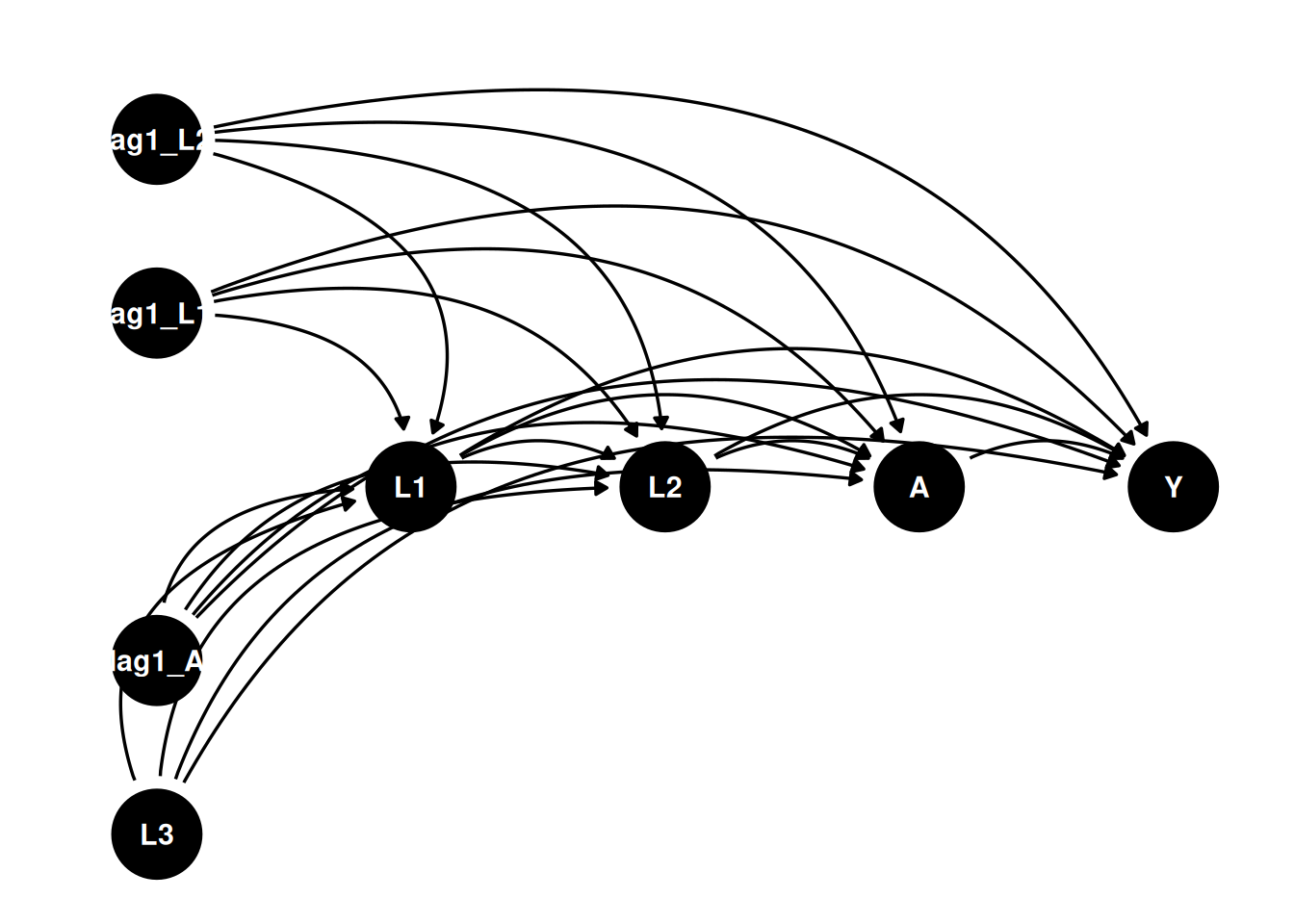
The DAG would be something like:
```{r}
#| message: false
#| warning: false
#| cache: true
dag <- dagify(
  Y ~ A + L1 + L2 + L3 + lag1_A + lag1_L1 + lag1_L2 ,
  L1 ~ lag1_A + lag1_L1 + lag1_L2 + L3 ,
  L2 ~ lag1_A + L1 + lag1_L1 + lag1_L2 + L3,
  A ~ lag1_A + L1 + L2 + lag1_L1 + lag1_L2 + L3,
  coords = time_ordered_coords()
)

dag %>%
  ggplot(aes(x = x, y = y, xend = xend, yend = yend)) +
  geom_dag_point() +
  geom_dag_edges_arc() +
  geom_dag_text() +
  theme_dag()
```
### gFormula results
First use the gFormula package.
```{r}
#| message: false
#| warning: false
#| cache: true
id <- 'id'
time_name <- 't0'
covnames <- c('L1', 'L2', 'A')
outcome_name <- 'Y'
covtypes <- c('categorical', 'normal', 'binary')
histories <- c(lagged)
histvars <- list(c('A', 'L1', 'L2'))
covparams <- list(covmodels = c(L1 ~ lag1_A + lag1_L1 + L3 + t0 +
                                 lag1_L2,
                                L2 ~ lag1_A + L1 + lag1_L1 + lag1_L2 + L3 + t0,
                                A ~ lag1_A + L1 + L2 + lag1_L1 + lag1_L2 + L3 + t0))
ymodel <- Y ~ A + L1 + L2 + lag1_A + lag1_L1 + lag1_L2 + L3
intvars <- list('A', 'A')
interventions <- list(list(c(static, rep(0, 7))),
                      list(c(static, rep(1, 7))))
int_descript <- c('Never treat', 'Always treat')
nsimul <- 50000

gform_cont_eof <- gformula_continuous_eof(obs_data = continuous_eofdata,
                                          id = id,
                                          time_name = time_name,
                                          covnames = covnames,
                                          outcome_name = outcome_name,
                                          covtypes = covtypes,
                                          covparams = covparams, ymodel = ymodel,
                                          intvars = intvars,
                                          interventions = interventions,
                                          int_descript = int_descript,
                                          histories = histories,
                                          histvars = histvars,
                                          model_fits = TRUE,
                                          basecovs = c("L3"),
                                          nsimul = nsimul, seed = 1234)
gform_cont_eof
```
### gmethods results
Now use the gmethods package.
```{r}
#| message: false
#| warning: false
#| cache: true
gf <- gmethods::gformula(
  outcome_model = list(
    formula = Y ~ A + L1 + L2 + lag1_A + lag1_L1 + lag1_L2 + L3,
    link = "identity",
    family = "normal"
  ),
  covariate_model = list(
    "L1" = list(
      formula = L1 ~ lag1_A + lag1_L1 + L3 + t0 + lag1_L2,
      family = "categorical"
    ),
    "L2" = list(
      formula = L2 ~ lag1_A + L1 + lag1_L1 + lag1_L2 + L3 + t0,
      link = "identity",
      family = "normal"
    ),
    "A" = list(
      formula = A ~ lag1_A + L1 + L2 + lag1_L1 + lag1_L2 + L3 + t0,
      link = "logit",
      family = "binomial"
    )
  ),
  data = continuous_eofdata,
  survival = FALSE,
  id = 'id',
  time = 't0'
)

s <- simulate(
  gf,
  interventions = list(
    "Never treat" = function(data, time) set(data, j = "A", value = 0),
    "Always treat" = function(data, time) set(data, j = "A", value = 1)
  ),
  n_samples = 50000
)

s$results
```
Both packages agree closely. `gfoRmula` gives a natural course of $-4.363$,
never-treat $-3.133$ and a mean difference of 1.230; `gmethods` gives $-4.360$,
$-3.139$ and 1.221, with always-treat at $-4.603$ and a difference of $-0.243$.
The two implementations differ in the third decimal, which is Monte Carlo noise
from the 50,000-draw simulation, not a disagreement about the estimand.
Note the results are very close. Also note that in the covariates and treatment models, there is a time variable t0. This is because these models are pooled regression with all time points. Therefore a time fixed effect is included. In the outcome model, there is only the last period data, so the time variable is not included.
Standard errors can be calculated with bootstrapping.
---
<!-- see-also-footer -->
*Systematic treatment: [R](https://xiangao.github.io/causal_econometrics_guide/g-methods.html) · [Julia](https://xiangao.github.io/causal_econometrics_julia/g-methods.html).*