Here I use the Proposition 99 data to compare four panel estimators on the same outcome matrix: DiD, synthetic DiD, synthetic control, and TASC.
This is the standard California smoking example. There are 39 states, annual cigarette sales per capita from 1970 to 2000, and California is treated after the 1988 anti-smoking law. The useful thing about this example is that the estimators do not give exactly the same answer.
19.2 Four estimators, one panel
The panel is the California Proposition 99 data: annual per-capita cigarette sales in packs for 39 states from 1970 to 2000, arranged as a \(39 \times 31\) matrix with California in the treated row, 38 donor states, and 19 pre-treatment years before the 1989 tax increase. Every estimator below sees exactly the same matrix; all that differs is how each weights the donors and the pre-periods.
(These are the values computed live in the companion Julia book’s same analysis; the code in this chapter is eval: false, so that chapter is the authoritative source for the numbers. The DiD and SC figures also match the published synthdid benchmarks for this panel.)
The smallest and largest estimates differ by nearly twelve packs per capita. That is not a rounding issue. It comes from the way each estimator constructs the counterfactual.
19.3 What changes across estimators
DiD (-27.35) assigns equal weight to every control state and every pre-treatment year. California is compared to the average of all 38 donor states. In this data, that average sits well below California before treatment. So the large DiD estimate is not automatically evidence of a larger causal effect. It is partly a warning that equal weights do not fit the pre-period well.
Synthetic control (-19.62) replaces equal weights with donor weights chosen to match California’s 1970-1988 cigarette sales. Once the pre-period fit is better, the post-treatment gap shrinks. The move from about -27 to about -20 is mostly the price of using a better control group.
Synthetic DiD (-15.60) adds time weights. The estimator can put more weight on the pre-treatment years that are more useful for the post-1988 counterfactual. Here that moves the estimate a bit closer to zero.
TASC (-17.11) does something different. Instead of choosing only weights, it fits a state-space model to the pre-treatment panel:
The matrix \(A\) describes how the latent factors move over time. After treatment, the filter continues using the donor panel, and the treated unit’s row of \(H\) maps the latent state to California’s counterfactual. The TASC estimate (-17.11) lands between SC and SDiD in this example.
19.4 The figure
Code
# Counterfactual path for each method. omega_* / intercept_* are the donor# weights and (for DiD/SDiD) intercepts extracted from the fitted objects# above (e.g. tau_sdid.weights.omega for SynthDiD.jl) — this snippet is# schematic and omits that extraction step for brevity; it is not meant to# run as-is (hence eval: false).cfact_did = omega_did'* Y[1:N0, :] .+ intercept_did # parallel trendscfact_sdid = omega_sdid'* Y[1:N0, :] .+ intercept_sdidcfact_sc = omega_sc'* Y[1:N0, :] # no interceptcfact_tasc =vec(pred.target)tasc_se =sqrt.(max.(vec(pred.variance), 0.0))
Four counterfactual paths for California. Dashed lines (DiD, SDiD) use pre-period intercepts to enforce parallel trends; solid lines (SC, TASC) fit levels directly. The shaded band is the TASC 95% posterior interval \(\hat Y_{1t}(0) \pm 1.96\,\hat\sigma_t\).
Two things are visible in the figure that the table cannot show.
First, the pre-treatment paths differ. The DiD control average sits well below California before treatment. SC and TASC track California more closely. This is why the DiD post-treatment gap is larger.
Second, the TASC band is narrow before treatment and wider after 1989. That is what I would expect. Before treatment, the smoother can use information from both directions in time. After treatment, the filter has to move forward without California’s observed outcomes, so the uncertainty accumulates through \(P_{t+1} = AP_tA^\top + Q\).
19.5 What the comparison teaches
Comparison
What it isolates
DiD vs SC
Unit weights — equal vs optimised donor match
SC vs SDiD
Time weights — equal vs recency-weighted pre-period
SC vs TASC
Model — weight fitting vs latent state-space
SC/SDiD vs TASC
Uncertainty — point estimate vs posterior interval
Which estimator I would use depends on the setting. DiD is transparent, but the pre-period fit here is poor. SC improves the donor match. SDiD also weights time periods. TASC is useful when the outcome series has persistent dynamics and we want uncertainty for the counterfactual path, not just one average number.
For this panel, the three methods that try to match the pre-period give estimates between about -15.6 and -19.6. DiD is the outlier. I would read this as a problem with equal weights, not as evidence that the effect of Proposition 99 depends on the estimator.
The SynthDiD.jl package provides did_estimate, synthdid_estimate, and sc_estimate. The TASC.jl package provides fit_tasc and predict_counterfactual. Both packages are available on GitHub.
---title: "Same Data, Different Estimators: A Synthetic Control Comparison"date: "2026-05-15"---## One panel, four estimatorsHere I use the Proposition 99 data to compare four panel estimators on the sameoutcome matrix: DiD, synthetic DiD, synthetic control, and TASC.This is the standard California smoking example. There are 39 states, annualcigarette sales per capita from 1970 to 2000, and California is treated afterthe 1988 anti-smoking law. The useful thing about this example is that theestimators do not give exactly the same answer.## Four estimators, one panelThe panel is the California Proposition 99 data: annual per-capita cigarettesales in packs for 39 states from 1970 to 2000, arranged as a $39 \times 31$matrix with California in the treated row, 38 donor states, and 19 pre-treatmentyears before the 1989 tax increase. Every estimator below sees exactly the samematrix; all that differs is how each weights the donors and the pre-periods.```{julia}#| eval: false#| echo: trueusingCSV, DataFrames, StatisticsusingSynthDiDusingTASCdf = CSV.read("california_prop99.csv", DataFrame)# ... pivot to N×T matrix Y, N0 = 38 donors, T0 = 19 pre-treatment years# (full setup code below)tau_did =did_estimate(Y, N0, T0)tau_sdid =synthdid_estimate(Y, N0, T0)tau_sc =sc_estimate(Y, N0, T0)# TASC: treated unit must be row 1Y_tasc =vcat(Y[(N0+1):end, :], Y[1:N0, :])model =fit_tasc(Y_tasc; d=2, T0=T0, n_em=200, tol=1e-3)pred =predict_counterfactual(model, Y_tasc)```| Estimator | ATT (packs per capita) ||---|---:|| Difference-in-differences | −27.35 || Synthetic control | −19.62 || Synthetic DiD | −15.60 || TASC | −17.11 |(These are the values computed live in the companion Julia book's[same analysis](https://xiangao.github.io/causal_econometrics_julia/synthetic-control-did-tasc.html);the code in this chapter is `eval: false`, so that chapter is the authoritativesource for the numbers. The DiD and SC figures also match the published`synthdid` benchmarks for this panel.)The smallest and largest estimates differ by nearly twelve packs per capita. Thatis not a rounding issue. It comes from the way each estimator constructs thecounterfactual.## What changes across estimators**DiD (-27.35)** assigns equal weight to every control state and everypre-treatment year. California is compared to the average of all 38 donorstates. In this data, that average sits well below California before treatment.So the large DiD estimate is not automatically evidence of a larger causaleffect. It is partly a warning that equal weights do not fit the pre-periodwell.**Synthetic control (-19.62)** replaces equal weights with donor weights chosento match California's 1970-1988 cigarette sales. Once the pre-period fit isbetter, the post-treatment gap shrinks. The move from about -27 to about -20 ismostly the price of using a better control group.**Synthetic DiD (-15.60)** adds time weights. The estimator can put more weighton the pre-treatment years that are more useful for the post-1988counterfactual. Here that moves the estimate a bit closer to zero.**TASC (-17.11)** does something different. Instead of choosing only weights, itfits a state-space model to the pre-treatment panel:$$x_t = A\,x_{t-1} + q_t,\quad q_t \sim \mathcal{N}(0,Q)$$ {#eq-tasc-time-aware-synthetic-control-1}$$y_t = H\,x_t + r_t,\quad r_t \sim \mathcal{N}(0,R)$$ {#eq-tasc-time-aware-synthetic-control-2}The matrix $A$ describes how the latent factors move over time. Aftertreatment, the filter continues using the donor panel, and the treated unit'srow of $H$ maps the latent state to California's counterfactual. The TASCestimate (-17.11) lands between SC and SDiD in this example.## The figure```{julia}#| eval: false#| echo: true# Counterfactual path for each method. omega_* / intercept_* are the donor# weights and (for DiD/SDiD) intercepts extracted from the fitted objects# above (e.g. tau_sdid.weights.omega for SynthDiD.jl) — this snippet is# schematic and omits that extraction step for brevity; it is not meant to# run as-is (hence eval: false).cfact_did = omega_did'* Y[1:N0, :] .+ intercept_did # parallel trendscfact_sdid = omega_sdid'* Y[1:N0, :] .+ intercept_sdidcfact_sc = omega_sc'* Y[1:N0, :] # no interceptcfact_tasc =vec(pred.target)tasc_se =sqrt.(max.(vec(pred.variance), 0.0))```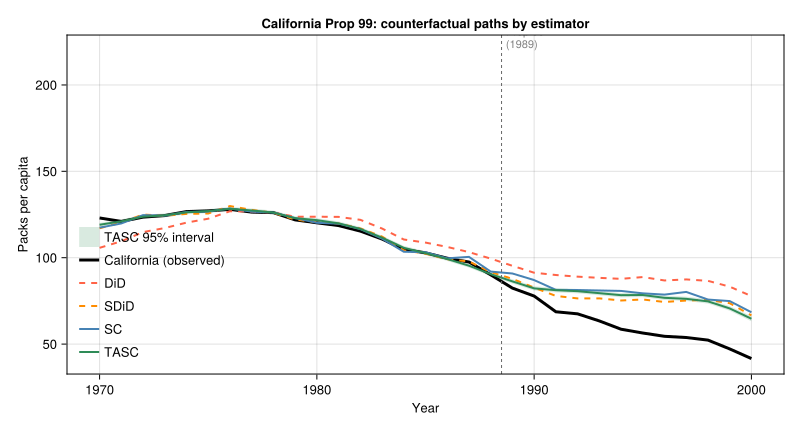Two things are visible in the figure that the table cannot show.First, the pre-treatment paths differ. The DiD control average sits well belowCalifornia before treatment. SC and TASC track California more closely. This iswhy the DiD post-treatment gap is larger.Second, the TASC band is narrow before treatment and wider after 1989. That iswhat I would expect. Before treatment, the smoother can use information fromboth directions in time. After treatment, the filter has to move forwardwithout California's observed outcomes, so the uncertainty accumulates through$P_{t+1} = AP_tA^\top + Q$.## What the comparison teaches| Comparison | What it isolates ||---|---|| DiD vs SC | Unit weights — equal vs optimised donor match || SC vs SDiD | Time weights — equal vs recency-weighted pre-period || SC vs TASC | Model — weight fitting vs latent state-space || SC/SDiD vs TASC | Uncertainty — point estimate vs posterior interval |Which estimator I would use depends on the setting. DiD is transparent, butthe pre-period fit here is poor. SC improves the donor match. SDiD also weightstime periods. TASC is useful when the outcome series has persistent dynamicsand we want uncertainty for the counterfactual path, not just one averagenumber.For this panel, the three methods that try to match the pre-period giveestimates between about -15.6 and -19.6. DiD is the outlier. I would read this as aproblem with equal weights, not as evidence that the effect of Proposition 99depends on the estimator.## Setup code```{julia}#| eval: false#| echo: truedf = CSV.read("california_prop99.csv", DataFrame)states =sort(unique(df.State))years =sort(unique(df.Year))N, T =length(states), length(years)Y_wide =zeros(N, T)treated_vec =zeros(Bool, N)for row ineachrow(df) i =findfirst(==(row.State), states) t =findfirst(==(row.Year), years) Y_wide[i, t] = row.PacksPerCapita treated_vec[i] |= (row.treated ==1)endctrl_idx =findall(.!treated_vec)trt_idx =findall(treated_vec)Y = Y_wide[vcat(ctrl_idx, trt_idx), :] # donors firstN0 =length(ctrl_idx) # 38T0 =findfirst(==(1989), years) -1# 19```The `SynthDiD.jl` package provides `did_estimate`, `synthdid_estimate`, and`sc_estimate`. The `TASC.jl` package provides `fit_tasc` and`predict_counterfactual`. Both packages are available on GitHub.---<!-- see-also-footer -->*Systematic treatment: [Julia](https://xiangao.github.io/causal_econometrics_julia/synthetic-control-did-tasc.html).*
