---
title: "Frengression and Engression"
date: "2026-03-21"
---
In the [causal simulation chapter](causal-simulation.qmd), I used Evans and Didelez (2024)'s decomposition of the joint distribution $p(x,a,y)$ into three pieces:
$$ p(x,a,y) = p(x,a) \cdot p_a(y) \cdot c(x,y|a) $$ {#eq-frengression-1}
where $p(x,a)$ is the "past" distribution of covariates and treatment, $p_a(y)$ is the causal margin, and $c(x,y|a)$ is the copula linking covariates and outcome given treatment. The `causl` package implements this with parametric families. We specify Gaussian, binomial, and so on for each piece.
But real data can be hard to specify parametrically. We may not know the right copula family. The marginal distributions may have mass points, skewness, or other features that are annoying to write down.
Frengression (Yang, Evans and Shen, 2025) keeps the same decomposition but learns the pieces with neural networks.
There are two uses: causal simulation with a learned generative model, and interventional prediction using learned confounding structure. The second part uses engression, so I start there.
## Engression
Engression (Shen and Meinshausen, 2024) stands for energy regression. Standard regression estimates $E[Y|X]$. Engression tries to learn the whole conditional distribution $P(Y|X)$ using neural networks trained with the energy score.
### The Energy Score
The energy score is a proper scoring rule for distributions. Given observations $Y$ and samples $\hat Y, \hat Y'$ from the model:
$$ S(Y, \hat Y, \hat Y') = E\|Y - \hat Y\| - \frac{1}{2}E\|\hat Y - \hat Y'\| $$ {#eq-frengression-2}
The first term rewards samples close to the truth. The second term keeps the simulated distribution from collapsing to one point. This is why the method targets the full distribution rather than only the mean.
### The Stochastic Network (StoNet)
The building block is a `StoNet`, a neural network that adds random noise $\epsilon \sim N(0,I)$ to the input at each layer:
$$\text{StoNet}(x) = f(x, \epsilon), \quad \epsilon \sim N(0,I)$$ {#eq-frengression-3}
Different noise draws produce different outputs. Each output is a sample from the learned conditional distribution. So we can:
- **Predict the mean**: average over many noise draws → $E[Y|X=x]$
- **Predict quantiles**: take quantiles of the noise draws → conditional quantile regression
- **Sample**: each forward pass with fresh noise is a sample from $P(Y|X=x)$
### Why Engression?
Compared with quantile regression or mixture density networks, engression is useful because:
1. it handles multivariate responses directly;
2. it does not require us to specify a Gaussian mixture or a list of quantiles;
3. it gives samples from the conditional distribution, which is convenient for simulation.
### Quick Example
The `engression` R package, separate from `Rfrengression`, provides the
standalone estimator. The code below shows the API. The `Rfrengression`
examples later are the ones I actually run here.
```{r}
#| label: engression_example
#| warning: false
#| cache: true
#| message: false
#| eval: false
library(engression)

# Nonlinear DGP with heteroskedastic noise
n <- 1000
X <- matrix(rnorm(n * 2), ncol = 2)
Y <- (X[,1])^2 + X[,2] + rnorm(n) * (0.5 + abs(X[,1]))

# Fit engression; it learns the full conditional distribution
engr <- engression(X, Y)

# Predict conditional mean (like lm, but nonlinear)
Yhat_mean <- predict(engr, X, type = "mean")

# Predict conditional quantiles (like quantile regression, but joint)
Yhat_quant <- predict(engr, X, type = "quantiles")

# Sample from the learned distribution (generative)
Ysample <- predict(engr, X, type = "sample", nsample = 1)
```
The point is that engression gives a distributional model of $Y|X$, not just a fitted mean.
## From Engression to Frengression
Frengression is frugal simulation plus engression. It uses three engression models to represent the decomposition of $P(X,A,Y)$. Each sub-network is trained with the energy score.
## The Architecture
Frengression has three sub-networks, matching the three pieces of the decomposition:
| Decomposition | causl (parametric) | Frengression (neural net) |
|---|---|---|
| $P(X,A)$ — the past | Specified by family + params | `model_xz`: noise-only generator |
| $P_a(Y)$ — causal margin | Specified by family + params | `model_y`: takes $(x, \text{eta})$, outputs $y$ |
| $c(X,Y \mid A)$ — copula | Gaussian/Frank/etc. copula | `model_eta`: takes $(x,z)$, outputs eta |
The important part is `model_eta`. It takes $(x,z)$ and outputs a latent variable `eta` that carries the dependence between confounders and outcome. During training, a Z-permutation trick forces `eta` to be marginally $N(0,I)$. This means:
- When `eta` comes from `model_eta(x,z)`, it carries the observational confounding information.
- When `eta` is sampled independently from $N(0,1)$, it gives the interventional prediction.
Same network, different source of `eta`. That is the trick.
## Using Rfrengression
The `Rfrengression` package is a native R implementation using `torch`.
```{r}
#| label: setup
#| warning: false
#| cache: false
#| message: false
library(Rfrengression)
```
### Example: Binary Treatment DGP
Use a DGP with binary treatment, binary outcome, and four confounders. We draw
$n = 2000$ observations with $w_1, w_2 \sim \text{Bernoulli}(0.5)$,
$w_3 \sim U(0,4)$ and $w_4 \sim U(0,5)$; treatment is
$A \sim \text{Bernoulli}(\Lambda(-0.4 + 0.2w_2 + 0.15w_3 + 0.2w_4 + 0.15w_2w_4))$;
and both potential outcomes are Bernoulli with the same logit index shifted by
the treatment. Since both are simulated, the realized ATE is known:
```{r}
#| label: dgp
#| warning: false
#| cache: false
#| message: false
set.seed(42)
n <- 2000

w1 <- rbinom(n, 1, 0.5)
w2 <- rbinom(n, 1, 0.5)
w3 <- round(runif(n, 0, 4), 3)
w4 <- round(runif(n, 0, 5), 3)

A <- rbinom(n, 1, plogis(-0.4 + 0.2*w2 + 0.15*w3 + 0.2*w4 + 0.15*w2*w4))
lin <- -1 - 0.1*w1 + 0.3*w2 + 0.25*w3 + 0.2*w4 + 0.15*w2*w4
p1  <- plogis(lin + 1)
p0  <- plogis(lin)
Y.1 <- rbinom(n, 1, p1)
Y.0 <- rbinom(n, 1, p0)
Y <- Y.1 * A + Y.0 * (1 - A)

# Two benchmarks, and they are not the same quantity. The first is the realized
# finite-sample ATE in this particular draw of the Bernoulli outcomes; the second
# averages the true individual probabilities over the sampled covariates, so it
# carries no outcome sampling noise.
true_ate  <- mean(Y.1 - Y.0)
bench_ate <- mean(p1 - p0)
cat("Realized ATE (this draw):", round(true_ate, 4), "\n")
cat("Covariate-averaged ATE: ", round(bench_ate, 4), "\n")
```
### Train Frengression
Training has two stages: first the outcome model (`model_y` + `model_eta`), then the marginal model (`model_xz`).
```{r}
#| label: train
#| warning: false
#| cache: false
#| message: false
# torch keeps its own generator; R's set.seed() does not reach it.
torch::torch_manual_seed(1)

x_mat <- matrix(A, ncol = 1)
z_mat <- as.matrix(data.frame(w1, w2, w3, w4))
y_mat <- matrix(Y, ncol = 1)

model <- frengression(x_dim = 1, y_dim = 1, z_dim = 4,
                      x_binary = TRUE, y_binary = TRUE,
                      z_binary_dims = 2, noise_dim = 10)

model <- train_y(model, x_mat, z_mat, y_mat,
                 num_iters = 1000, lr = 1e-3, print_every = 500)
model <- train_xz(model, x_mat, z_mat,
                   num_iters = 1000, lr = 1e-4, print_every = 500)
```
### Estimate ATE
For interventional prediction, `eta` is sampled from $N(0,1)$ instead of being generated from the observed confounding structure:
```{r}
#| label: ate
#| warning: false
#| cache: false
#| message: false
torch::torch_manual_seed(1)

y1 <- predict(model, matrix(1, ncol = 1), type = "mean", nsample = 2000)
y0 <- predict(model, matrix(0, ncol = 1), type = "mean", nsample = 2000)

cat("Frengression ATE:", round(y1 - y0, 4), "\n")
cat("True ATE:", round(true_ate, 4), "\n")
```
The realized ATE in this draw is $0.1935$, and averaging the true probabilities over the sampled covariates gives $0.2024$. The gap between those two is outcome sampling noise, not model error, and it is worth keeping them apart: the realized figure is the ATE of the potential outcomes actually drawn, while the covariate-averaged figure is the smoother target the estimator is really chasing. Frengression lands a few hundredths below either one.
The training chunks carry `cache: false`, so they re-run on every render, and
torch keeps a generator of its own that R's `set.seed()` does not reach. Seeding
it with `torch_manual_seed()` fixes the weight initialisation, the training
draws, and the sampling inside `predict()`, so the figure above is reproducible
from one render to the next. On a CUDA device some nondeterminism can survive
the seed, from cuDNN algorithm selection and atomic accumulation in the backward
pass.
## Frengression as DGP
Frengression can estimate an ATE, but that is not its main advantage. If I only want an ATE, I would usually use `npcausal`, TMLE, or DoubleML. The more interesting use is to train a data-generating process for benchmarking.
The idea is:
1. Train frengression on observational data, so it learns the confounding structure.
2. Replace the causal margin with a known function via `specify_causal()`.
3. Generate synthetic data with realistic confounding and known ground truth.
```{r}
#| label: dgp_bench
#| warning: false
#| cache: false
#| message: false
# Specify a known causal effect: Y = sigmoid(0.2*X + eta)
model_bench <- specify_causal(model, function(x, eta) {
  torch::torch_sigmoid(0.2 * x + eta)
})

# True ATE computed empirically from the model
y1_true <- predict(model_bench, matrix(1, ncol = 1), type = "mean", nsample = 5000)
y0_true <- predict(model_bench, matrix(0, ncol = 1), type = "mean", nsample = 5000)
cat("True ATE (specified):", round(as.numeric(y1_true - y0_true), 4), "\n")
```
Now we can generate synthetic data and benchmark any method:
```{r}
#| label: syn
#| warning: false
#| cache: false
#| message: false
syn <- sample_joint(model_bench, sample_size = 1000)
cat("Synthetic data: n =", nrow(syn$x), "\n")
cat("Treatment prevalence:", mean(syn$x), "\n")
cat("Outcome prevalence:", mean(syn$y), "\n")
```
## Real Data: LaLonde
This is most useful with real data. The LaLonde job-training data have many of the problems that make simulations hard to write by hand: zeros in prior earnings, uneven covariate distributions, and poor overlap.
```{r}
#| label: lalonde
#| warning: false
#| cache: false
#| message: false
library(MatchIt)
data("lalonde", package = "MatchIt")
lalonde$black <- as.integer(lalonde$race == "black")
lalonde$hispan <- as.integer(lalonde$race == "hispan")

x_lal <- matrix(lalonde$treat, ncol = 1)
y_lal <- matrix(lalonde$re78, ncol = 1)
# frengression's z_binary_dims assumes the FIRST z_binary_dims columns of z
# are the binary ones -- so the binary covariates (black, hispan, married,
# nodegree) must come first, followed by the continuous ones (age, educ,
# re74, re75). The original column order (age, educ first) put two
# continuous variables where binary ones were expected, and vice versa.
z_lal <- as.matrix(lalonde[, c("black", "hispan", "married", "nodegree",
                                "age", "educ", "re74", "re75")])

# Standardize for training
z_sc <- scale(z_lal)
y_sc <- (y_lal - mean(y_lal)) / sd(y_lal)

model_lal <- frengression(x_dim = 1, y_dim = 1, z_dim = 8,
                           x_binary = TRUE, y_binary = FALSE,
                           z_binary_dims = 4, noise_dim = 10)

model_lal <- train_y(model_lal, x_lal, z_sc, y_sc,
                      num_iters = 1000, lr = 1e-3, print_every = 500)
model_lal <- train_xz(model_lal, x_lal, z_sc,
                        num_iters = 1000, lr = 1e-4, print_every = 500)
```
Now specify a known effect and generate data:
```{r}
#| label: lalonde_gen
#| warning: false
#| cache: false
#| message: false
model_lal_bench <- specify_causal(model_lal, function(x, eta) {
  0.3 * x + eta
})

# Generate synthetic LaLonde-like data with known ATE = 0.3 (standardized)
syn_lal <- sample_joint(model_lal_bench, sample_size = 2000)
cat("Synthetic LaLonde: n =", nrow(syn_lal$x), "\n")
cat("Treatment prevalence:", round(mean(syn_lal$x), 3), "\n")
cat("True ATE:", 0.3, "(standardized) =", round(0.3 * sd(y_lal), 0), "dollars\n")
```
The synthetic data inherits LaLonde's confounding structure, but now the true effect is known. This is the part that is hard to do with a hand-written DGP.
## Comparison: causl vs frengression
Both packages use the same decomposition:
| Feature | causl | Frengression |
|---|---|---|
| Marginal $P(X,A)$ | Parametric families | Learned by neural net |
| Causal margin $P_a(Y)$ | Parametric families | Learned (or specified) |
| Copula | Gaussian, Frank, etc. | Learned by `model_eta` |
| Requires specification | Yes — families + params | No — learns from data |
| Can learn from real data | Limited (plasmode) | Yes — full joint |
| Distributional flexibility | Limited by family choice | Arbitrary |
The `causl` approach is more transparent because we know exactly what we specified. Frengression is more flexible because it can learn structure we did not write down. I would treat them as complements.
## Benchmarking: Frengression vs Semiparametric Methods
Now compare frengression against standard semiparametric causal inference tools on the same data. The three comparison methods are:
- `npcausal`: AIPW estimator with SuperLearner nuisance models
- `tmle`: targeted minimum loss-based estimation with SuperLearner
- `DoubleML`: partially linear regression with `ranger`
These methods are built for ATE estimation. They should usually be better for this specific estimand. The comparison is still useful because frengression is trying to learn much more than the ATE.
```{r}
#| label: bench_libs
#| warning: false
#| cache: true
#| message: false
library(npcausal)
library(tmle)
library(SuperLearner)
library(DoubleML)
library(mlr3)
library(mlr3learners)
library(tidyverse)
library(knitr)
```
### Single-Dataset Comparison
First, run all four methods on the binary DGP data created above.
```{r}
#| label: npcausal_ate
#| warning: false
#| cache: true
#| message: false
W <- data.frame(w1, w2, w3, w4)
SL.library <- c("SL.earth", "SL.glm.interaction", "SL.mean",
                "SL.ranger", "SL.glmnet")

set.seed(123)
aipw_fit <- ate(y = Y, a = A, x = W, nsplits = 2, sl.lib = SL.library)
ate_npcausal <- aipw_fit$res$est[3]
se_npcausal  <- aipw_fit$res$se[3]
ci_npcausal  <- c(aipw_fit$res$ci.ll[3], aipw_fit$res$ci.ul[3])

cat("npcausal ATE:", round(ate_npcausal, 4), "\n")
cat("SE:", round(se_npcausal, 4), "\n")
```
```{r}
#| label: tmle_ate
#| warning: false
#| cache: true
#| message: false
set.seed(123)
tmle_fit <- tmle(Y = Y, A = A, W = W, family = "binomial",
                 Q.SL.library = SL.library, g.SL.library = SL.library)

ate_tmle <- tmle_fit$estimates$ATE$psi
se_tmle  <- sqrt(tmle_fit$estimates$ATE$var.psi)
ci_tmle  <- tmle_fit$estimates$ATE$CI

cat("TMLE ATE:", round(ate_tmle, 4), "\n")
cat("SE:", round(se_tmle, 4), "\n")
```
```{r}
#| label: doubleml_ate
#| warning: false
#| cache: true
#| message: false
lgr::get_logger("mlr3")$set_threshold("warn")
data_obs <- data.frame(w1, w2, w3, w4, A, Y)

dml_data <- DoubleMLData$new(data_obs,
                              y_col = "Y", d_cols = "A",
                              x_cols = c("w1", "w2", "w3", "w4"))

learner_l <- lrn("regr.ranger", num.trees = 500, max.depth = 5, min.node.size = 2)
learner_m <- learner_l$clone()

set.seed(123)
dml_plr <- DoubleMLPLR$new(dml_data, ml_l = learner_l, ml_m = learner_m)
dml_plr$fit()

ate_dml <- dml_plr$coef
se_dml  <- dml_plr$se
ci_dml  <- c(dml_plr$confint()[1], dml_plr$confint()[2])

cat("DoubleML ATE:", round(ate_dml, 4), "\n")
cat("SE:", round(se_dml, 4), "\n")
```
```{r}
#| label: frengression_se
#| warning: false
#| cache: false
#| message: false
# Frengression ATE already computed above (y1 - y0)
ate_freng <- as.numeric(y1 - y0)

# Bootstrap SE via repeated prediction (Monte Carlo variability)
set.seed(123)
ate_boot <- replicate(200, {
  predict(model, matrix(1, ncol = 1), type = "mean", nsample = 500) -
    predict(model, matrix(0, ncol = 1), type = "mean", nsample = 500)
})
se_freng <- sd(ate_boot)
```
```{r}
#| label: comparison_table
#| warning: false
#| cache: true
#| message: false
results <- data.frame(
  Method = c("True ATE", "Frengression", "npcausal (AIPW)", "TMLE", "DoubleML (PLR)"),
  ATE = c(true_ate, ate_freng, ate_npcausal, ate_tmle, ate_dml),
  SE = c(NA, se_freng, se_npcausal, se_tmle, se_dml),
  CI_lower = c(NA,
               ate_freng - 1.96 * se_freng,
               ci_npcausal[1], ci_tmle[1], ci_dml[1]),
  CI_upper = c(NA,
               ate_freng + 1.96 * se_freng,
               ci_npcausal[2], ci_tmle[2], ci_dml[2])
)

results$Bias <- results$ATE - true_ate
results$Covers <- ifelse(is.na(results$CI_lower), NA,
                         results$CI_lower <= true_ate & true_ate <= results$CI_upper)

kable(results, digits = 4,
      caption = "ATE Estimation: Frengression vs Semiparametric Methods")
```
On this single dataset the ranking is what one would expect. TMLE gives 0.1916,
npcausal 0.1911 and DoubleML 0.1872, all within 0.007 of the true 0.1935;
frengression gives 0.1650, a bias of $-0.0285$, roughly four times larger. Its
bootstrap standard error is also the widest, 0.0318 against 0.021–0.023. All
four intervals cover the truth.
The semiparametric estimators target the ATE directly. Frengression learns the joint distribution and then computes the ATE as one functional of that distribution. So I would not expect it to be the most precise ATE estimator in this table.
### Monte Carlo Benchmarking (Simulated DGP)
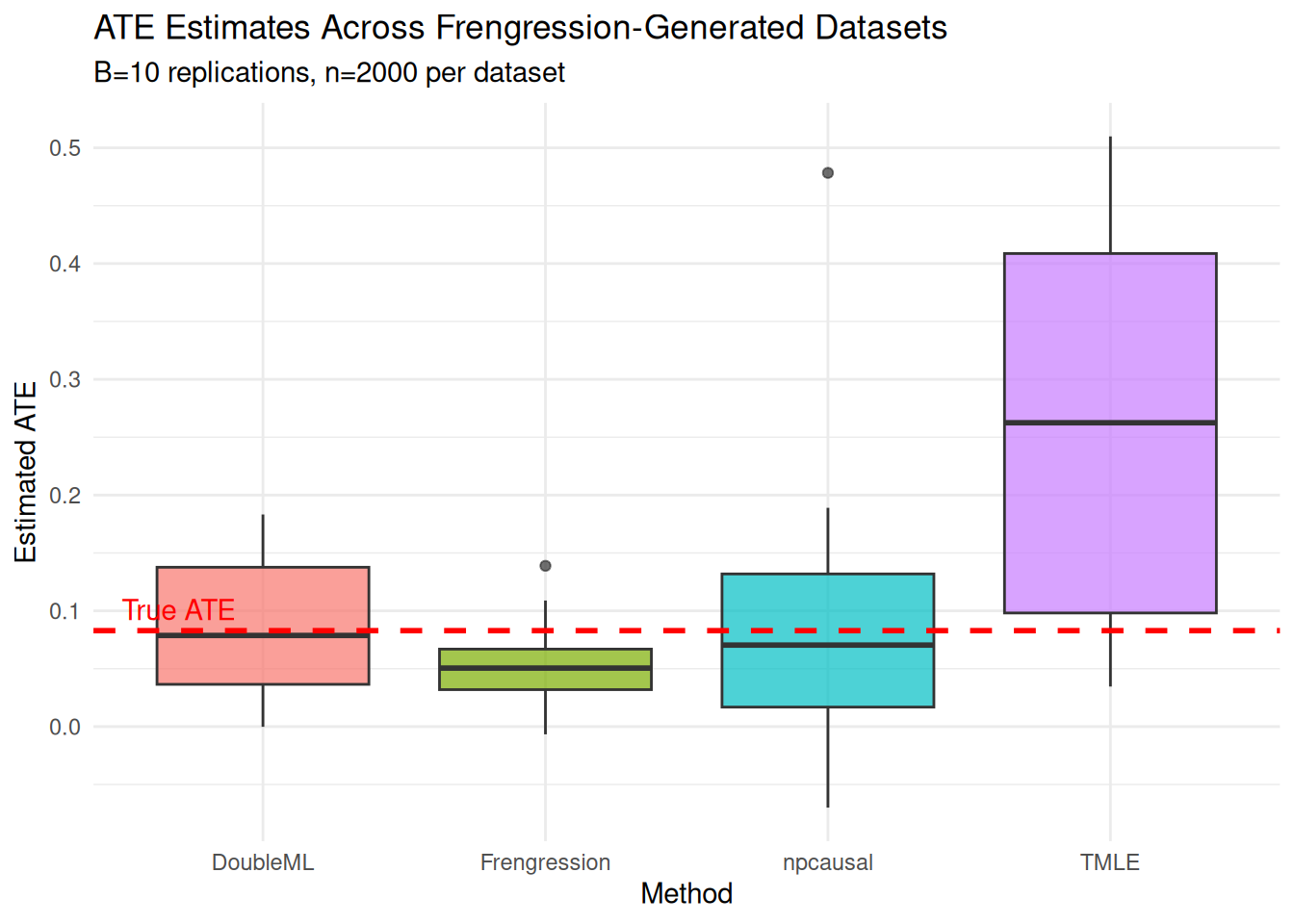
This is where frengression is more useful. Use the model trained above, plug in a known causal effect with `specify_causal()`, generate 10 synthetic datasets, and benchmark all four estimators.
```{r}
#| label: benchmark_sim
#| warning: false
#| cache: false
#| message: false
B <- 10
n_syn <- 2000

methods <- c("Frengression", "npcausal", "TMLE", "DoubleML")
ate_mat <- matrix(NA, nrow = B, ncol = length(methods),
                  dimnames = list(NULL, methods))
se_mat  <- ate_mat
cover_mat <- ate_mat

SL.lib_fast <- c("SL.glm.interaction", "SL.ranger", "SL.mean")

# True ATE from the specified model (already computed above as y1_true - y0_true)
true_ate_bench <- as.numeric(y1_true - y0_true)

set.seed(2024)
for (b in seq_len(B)) {
  syn <- sample_joint(model_bench, sample_size = n_syn)

  x_syn <- as.numeric(syn$x)
  y_syn <- as.numeric(syn$y)
  z_syn <- as.data.frame(syn$z)
  colnames(z_syn) <- paste0("z", 1:ncol(z_syn))
  df_syn <- cbind(data.frame(A = x_syn, Y = y_syn), z_syn)

  # --- Frengression ---
  tryCatch({
    mod_f <- frengression(x_dim = 1, y_dim = 1, z_dim = ncol(z_syn),
                          x_binary = TRUE, y_binary = TRUE,
                          noise_dim = 10, hidden_dim = 100, num_layer = 3)
    mod_f <- train_y(mod_f, matrix(x_syn, ncol=1), as.matrix(z_syn),
                     matrix(y_syn, ncol=1),
                     num_iters = 500, lr = 1e-3, silent = TRUE)
    mod_f <- train_xz(mod_f, matrix(x_syn, ncol=1), as.matrix(z_syn),
                       num_iters = 500, lr = 1e-4, silent = TRUE)

    y1_f <- predict(mod_f, matrix(1, ncol=1), type="mean", nsample=1000)
    y0_f <- predict(mod_f, matrix(0, ncol=1), type="mean", nsample=1000)
    ate_mat[b, "Frengression"] <- y1_f - y0_f

    ate_mc <- replicate(100, {
      predict(mod_f, matrix(1,ncol=1), type="mean", nsample=200) -
        predict(mod_f, matrix(0,ncol=1), type="mean", nsample=200)
    })
    se_mat[b, "Frengression"] <- sd(ate_mc)
    ci_f <- ate_mat[b, "Frengression"] + c(-1,1) * 1.96 * se_mat[b, "Frengression"]
    cover_mat[b, "Frengression"] <- (ci_f[1] <= true_ate_bench & true_ate_bench <= ci_f[2])
  }, error = function(e) message("Frengression failed on rep ", b, ": ", e$message))

  # --- npcausal ---
  tryCatch({
    fit_np <- ate(y = y_syn, a = x_syn, x = z_syn,
                  nsplits = 2, sl.lib = SL.lib_fast)
    ate_mat[b, "npcausal"] <- fit_np$res$est[3]
    se_mat[b, "npcausal"]  <- fit_np$res$se[3]
    ci <- c(fit_np$res$ci.ll[3], fit_np$res$ci.ul[3])
    cover_mat[b, "npcausal"] <- (ci[1] <= true_ate_bench & true_ate_bench <= ci[2])
  }, error = function(e) message("npcausal failed on rep ", b, ": ", e$message))

  # --- TMLE ---
  tryCatch({
    fit_tmle <- tmle(Y = y_syn, A = x_syn, W = z_syn, family = "binomial",
                     Q.SL.library = SL.lib_fast, g.SL.library = SL.lib_fast)
    ate_mat[b, "TMLE"] <- fit_tmle$estimates$ATE$psi
    se_mat[b, "TMLE"]  <- sqrt(fit_tmle$estimates$ATE$var.psi)
    ci_t <- fit_tmle$estimates$ATE$CI
    cover_mat[b, "TMLE"] <- (ci_t[1] <= true_ate_bench & true_ate_bench <= ci_t[2])
  }, error = function(e) message("TMLE failed on rep ", b, ": ", e$message))

  # --- DoubleML ---
  tryCatch({
    dml_d <- DoubleMLData$new(df_syn, y_col = "Y", d_cols = "A",
                               x_cols = colnames(z_syn))
    lr_l <- lrn("regr.ranger", num.trees = 300, max.depth = 5, min.node.size = 2)
    lr_m <- lr_l$clone()
    dml_obj <- DoubleMLPLR$new(dml_d, ml_l = lr_l, ml_m = lr_m)
    dml_obj$fit()
    ate_mat[b, "DoubleML"] <- dml_obj$coef
    se_mat[b, "DoubleML"]  <- dml_obj$se
    ci_d <- c(dml_obj$confint()[1], dml_obj$confint()[2])
    cover_mat[b, "DoubleML"] <- (ci_d[1] <= true_ate_bench & true_ate_bench <= ci_d[2])
  }, error = function(e) message("DoubleML failed on rep ", b, ": ", e$message))

  if (b %% 5 == 0) cat("Completed replication", b, "of", B, "\n")
}
```
```{r}
#| label: benchmark_results
#| warning: false
#| cache: true
#| message: false
bench_summary <- data.frame(
  Method = colnames(ate_mat),
  Mean_ATE = colMeans(ate_mat, na.rm = TRUE),
  Bias = colMeans(ate_mat, na.rm = TRUE) - true_ate_bench,
  SD = apply(ate_mat, 2, sd, na.rm = TRUE),
  RMSE = sqrt(colMeans((ate_mat - true_ate_bench)^2, na.rm = TRUE)),
  Mean_SE = colMeans(se_mat, na.rm = TRUE),
  Coverage_95 = colMeans(cover_mat, na.rm = TRUE),
  N_valid = colSums(!is.na(ate_mat))
)

kable(bench_summary, digits = 4,
      caption = paste0("Monte Carlo Benchmarking (B=", B,
                       ", n=", n_syn, ", True ATE=",
                       round(true_ate_bench, 4), ")"))
```
```{r}
#| label: benchmark_plot
#| warning: false
#| cache: true
#| message: false
#| fig-cap: "ATE Estimates Across Synthetic Datasets"
ate_long <- as.data.frame(ate_mat) |>
  pivot_longer(everything(), names_to = "Method", values_to = "ATE") |>
  filter(!is.na(ATE))

# Trim extreme outliers for readable plot
q_bounds <- quantile(ate_long$ATE, c(0.02, 0.98), na.rm = TRUE)
ate_long_trim <- ate_long |> filter(ATE >= q_bounds[1] & ATE <= q_bounds[2])

ggplot(ate_long_trim, aes(x = Method, y = ATE, fill = Method)) +
  geom_boxplot(alpha = 0.7) +
  geom_hline(yintercept = true_ate_bench, linetype = "dashed", color = "red",
             linewidth = 1) +
  annotate("text", x = 0.5, y = true_ate_bench, label = "True ATE",
           hjust = 0, vjust = -0.5, color = "red") +
  labs(title = "ATE Estimates Across Frengression-Generated Datasets",
       subtitle = paste0("B=", B, " replications, n=", n_syn, " per dataset"),
       y = "Estimated ATE") +
  theme_minimal() +
  theme(legend.position = "none")
```
### Monte Carlo Benchmarking (LaLonde)
Now do the same exercise with the LaLonde-trained model. Here the confounding structure comes from the real data rather than from my hand-written simulation.
```{r}
#| label: lalonde_bench
#| warning: false
#| cache: false
#| message: false
# Compute true ATE empirically from the specified model
y1_lal_true <- predict(model_lal_bench, matrix(1, ncol=1), type="mean", nsample=5000)
y0_lal_true <- predict(model_lal_bench, matrix(0, ncol=1), type="mean", nsample=5000)
true_ate_lal <- as.numeric(y1_lal_true - y0_lal_true)
cat("True ATE (standardized):", round(true_ate_lal, 4), "\n")
cat("True ATE (dollars):", round(true_ate_lal * sd(y_lal), 0), "\n")
B_lal <- 10
n_syn_lal <- 2000

methods <- c("Frengression", "npcausal", "TMLE", "DoubleML")
ate_mat_lal <- matrix(NA, nrow = B_lal, ncol = length(methods),
                       dimnames = list(NULL, methods))
se_mat_lal  <- ate_mat_lal
cover_mat_lal <- ate_mat_lal

SL.lib_fast <- c("SL.glm.interaction", "SL.ranger", "SL.mean")

set.seed(2024)
for (b in seq_len(B_lal)) {
  syn <- sample_joint(model_lal_bench, sample_size = n_syn_lal)

  x_syn <- as.numeric(syn$x)
  y_syn <- as.numeric(syn$y)
  z_syn <- as.data.frame(syn$z)
  colnames(z_syn) <- paste0("z", 1:ncol(z_syn))
  df_syn <- cbind(data.frame(A = x_syn, Y = y_syn), z_syn)

  # --- Frengression ---
  tryCatch({
    mod_f <- frengression(x_dim = 1, y_dim = 1, z_dim = ncol(z_syn),
                          x_binary = TRUE, y_binary = FALSE,
                          noise_dim = 10, hidden_dim = 100, num_layer = 3)
    mod_f <- train_y(mod_f, matrix(x_syn, ncol=1), as.matrix(z_syn),
                     matrix(y_syn, ncol=1),
                     num_iters = 500, lr = 1e-3, silent = TRUE)
    mod_f <- train_xz(mod_f, matrix(x_syn, ncol=1), as.matrix(z_syn),
                       num_iters = 500, lr = 1e-4, silent = TRUE)

    y1_f <- predict(mod_f, matrix(1, ncol=1), type="mean", nsample=1000)
    y0_f <- predict(mod_f, matrix(0, ncol=1), type="mean", nsample=1000)
    ate_mat_lal[b, "Frengression"] <- y1_f - y0_f

    ate_mc <- replicate(100, {
      predict(mod_f, matrix(1,ncol=1), type="mean", nsample=200) -
        predict(mod_f, matrix(0,ncol=1), type="mean", nsample=200)
    })
    se_mat_lal[b, "Frengression"] <- sd(ate_mc)
    ci_f <- ate_mat_lal[b, "Frengression"] + c(-1,1) * 1.96 * se_mat_lal[b, "Frengression"]
    cover_mat_lal[b, "Frengression"] <- (ci_f[1] <= true_ate_lal & true_ate_lal <= ci_f[2])
  }, error = function(e) message("Frengression failed on rep ", b, ": ", e$message))

  # --- npcausal ---
  tryCatch({
    fit_np <- ate(y = y_syn, a = x_syn, x = z_syn,
                  nsplits = 2, sl.lib = SL.lib_fast)
    ate_mat_lal[b, "npcausal"] <- fit_np$res$est[3]
    se_mat_lal[b, "npcausal"]  <- fit_np$res$se[3]
    ci <- c(fit_np$res$ci.ll[3], fit_np$res$ci.ul[3])
    cover_mat_lal[b, "npcausal"] <- (ci[1] <= true_ate_lal & true_ate_lal <= ci[2])
  }, error = function(e) message("npcausal failed on rep ", b, ": ", e$message))

  # --- TMLE ---
  tryCatch({
    fit_tmle <- tmle(Y = y_syn, A = x_syn, W = z_syn, family = "gaussian",
                     Q.SL.library = SL.lib_fast, g.SL.library = SL.lib_fast)
    ate_mat_lal[b, "TMLE"] <- fit_tmle$estimates$ATE$psi
    se_mat_lal[b, "TMLE"]  <- sqrt(fit_tmle$estimates$ATE$var.psi)
    ci_t <- fit_tmle$estimates$ATE$CI
    cover_mat_lal[b, "TMLE"] <- (ci_t[1] <= true_ate_lal & true_ate_lal <= ci_t[2])
  }, error = function(e) message("TMLE failed on rep ", b, ": ", e$message))

  # --- DoubleML ---
  tryCatch({
    dml_d <- DoubleMLData$new(df_syn, y_col = "Y", d_cols = "A",
                               x_cols = colnames(z_syn))
    lr_l <- lrn("regr.ranger", num.trees = 300, max.depth = 5, min.node.size = 2)
    lr_m <- lr_l$clone()
    dml_obj <- DoubleMLPLR$new(dml_d, ml_l = lr_l, ml_m = lr_m)
    dml_obj$fit()
    ate_mat_lal[b, "DoubleML"] <- dml_obj$coef
    se_mat_lal[b, "DoubleML"]  <- dml_obj$se
    ci_d <- c(dml_obj$confint()[1], dml_obj$confint()[2])
    cover_mat_lal[b, "DoubleML"] <- (ci_d[1] <= true_ate_lal & true_ate_lal <= ci_d[2])
  }, error = function(e) message("DoubleML failed on rep ", b, ": ", e$message))

  if (b %% 5 == 0) cat("Completed replication", b, "of", B_lal, "\n")
}
```
```{r}
#| label: lalonde_results
#| warning: false
#| cache: true
#| message: false
bench_lal <- data.frame(
  Method = colnames(ate_mat_lal),
  Mean_ATE = colMeans(ate_mat_lal, na.rm = TRUE),
  Bias = colMeans(ate_mat_lal, na.rm = TRUE) - true_ate_lal,
  SD = apply(ate_mat_lal, 2, sd, na.rm = TRUE),
  RMSE = sqrt(colMeans((ate_mat_lal - true_ate_lal)^2, na.rm = TRUE)),
  Mean_SE = colMeans(se_mat_lal, na.rm = TRUE),
  Coverage_95 = colMeans(cover_mat_lal, na.rm = TRUE),
  N_valid = colSums(!is.na(ate_mat_lal))
)

kable(bench_lal, digits = 4,
      caption = paste0("LaLonde-Based Benchmarking (B=", B_lal,
                       ", n=", n_syn_lal,
                       ", True ATE=", round(true_ate_lal, 4),
                       " [", round(true_ate_lal * sd(y_lal), 0), " dollars])"))
```
```{r}
#| label: lalonde_plot
#| warning: false
#| cache: true
#| message: false
#| fig-cap: "ATE Estimates from LaLonde-Based Synthetic Data"
ate_long_lal <- as.data.frame(ate_mat_lal) |>
  pivot_longer(everything(), names_to = "Method", values_to = "ATE") |>
  filter(!is.na(ATE))

q_bounds_lal <- quantile(ate_long_lal$ATE, c(0.02, 0.98), na.rm = TRUE)
ate_long_lal_trim <- ate_long_lal |>
  filter(ATE >= q_bounds_lal[1] & ATE <= q_bounds_lal[2])

ggplot(ate_long_lal_trim, aes(x = Method, y = ATE, fill = Method)) +
  geom_boxplot(alpha = 0.7) +
  geom_hline(yintercept = true_ate_lal, linetype = "dashed", color = "red",
             linewidth = 1) +
  annotate("text", x = 0.5, y = true_ate_lal, label = "True ATE",
           hjust = 0, vjust = -0.5, color = "red") +
  labs(title = "ATE Estimates: LaLonde-Based Frengression DGP",
       subtitle = paste0("B=", B_lal, " replications, n=", n_syn_lal,
                         " per dataset (confounding learned from real data)"),
       y = "Estimated ATE (standardized)") +
  theme_minimal() +
  theme(legend.position = "none")
```
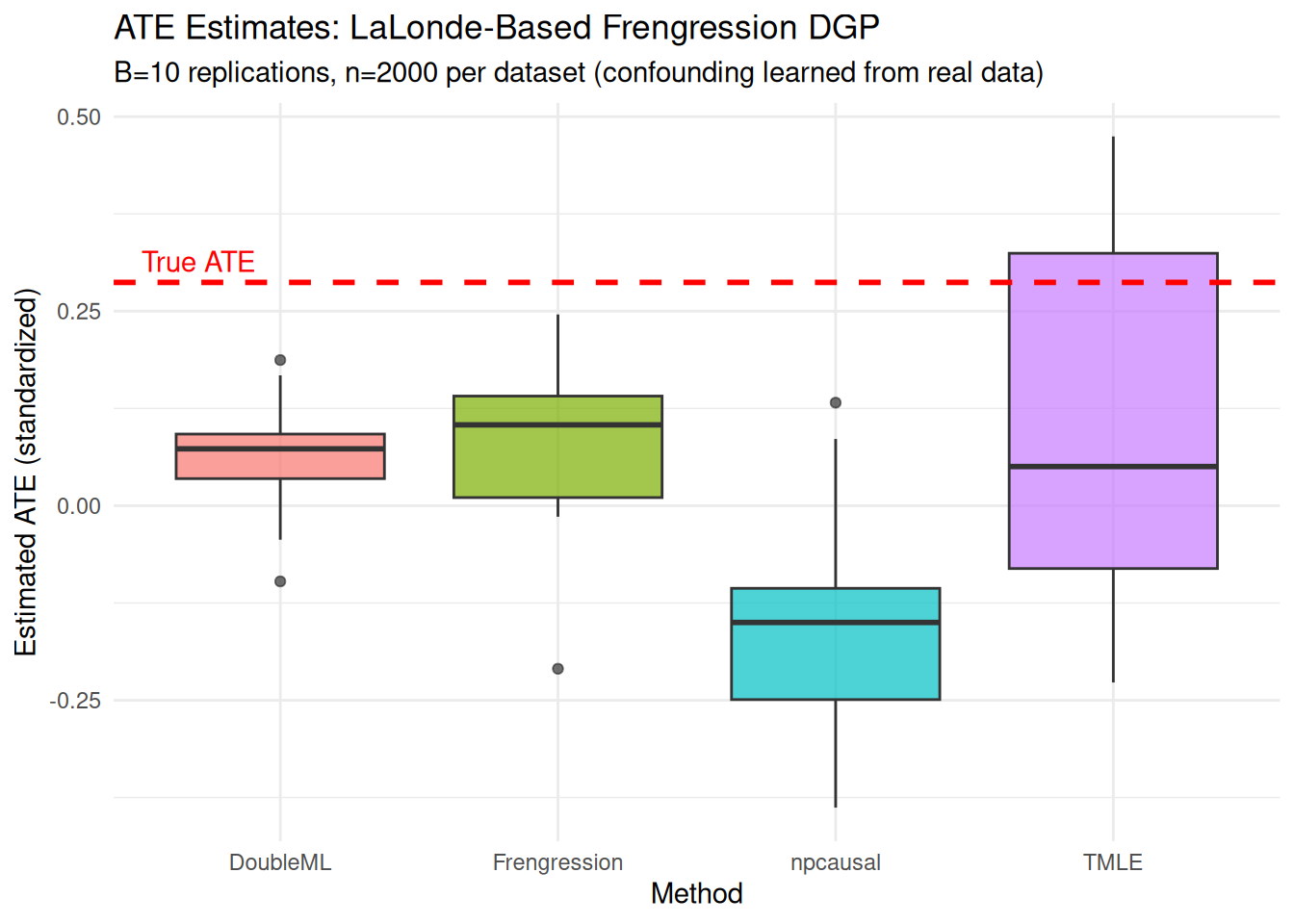
The numbers are stark. On the hand-written DGP (true ATE 0.0662), frengression
has a bias of 0.0013 and 100% coverage, DoubleML 0.0066 and 100%, while npcausal
is off by 0.1532 with 40% coverage and TMLE by 0.2207 with 10%. On the
LaLonde-generated data (true ATE 0.2846), frengression has a bias of $-0.0465$
with 90% coverage, while npcausal is off by $-0.2918$ with **0%** coverage and
TMLE by 0.0372 with 30%.
Read the coverage column rather than the bias column. A method whose interval
covers the truth in 0 or 1 of 10 replications is not merely imprecise; its
reported standard error is wrong. TMLE's mean SE on the simulated benchmark is
0.0187 against an actual sampling SD of 0.2401 — understating the uncertainty by
more than a factor of ten.
One caveat before drawing conclusions: $B = 10$ replications is a very small
Monte Carlo, so these coverage rates carry a standard error of about 0.15
themselves. The qualitative ordering is clear; the individual percentages are
not precise.
The semiparametric methods show more bias on the LaLonde-generated data than on the hand-written simulation. That is the point of this exercise. The synthetic data has a more realistic propensity surface and prior-earnings distribution, so it is harder than the usual clean simulation.
## Summary
Frengression uses the Evans and Didelez simulation decomposition, but learns the
pieces nonparametrically. The practical use is not that it beats TMLE or AIPW
for a simple ATE. The practical use is that it can learn a realistic
observational distribution, let us impose a known causal effect, and then
generate synthetic data where the truth is known.
That makes it useful for benchmarking. The simulation is still artificial, but
it is less artificial than writing down a clean logistic model and pretending
that it looks like real observational data.
---
<!-- see-also-footer -->
*Systematic treatment: [Julia](https://xiangao.github.io/causal_econometrics_julia/distributional-effects.html).*