13  Matching and Weighting Part 1: matching

Published

May 29, 2025

This is based on R’s MatchIt and WeightIt packages and their documentations. All credits go to Noal Greifer and coauthors. I write to summarize what I have learned.

13.1 Assumptions

Matching or weighting is usually used in observational studies. We have the following assumptions before using matching or weighting to make a causal claim:

  1. SUTVA
  2. ignorability (unconfoundedness, or no unobserved confounders)
  3. overlap (common support, or positivity)

With these assmptions, we can try to identify the treatment effect in an observational study.

13.2 Problem

The second assmption is saying controlling for \(X\), the treatment assignment \(D\) is independent of the potential outcomes \(Y(0)\) and \(Y(1)\), i.e., we have a pseudo-randomized experiment.

In reality, it’s rare we have a balanced distribution of \(X\) for treated and control. That’s when we need to use matching or weighting to balance the distribution of \(X\) between treatment and control groups.

13.3 Distance

The idea of matching is to find a set of control units that are similar(close) to the treatment units in terms of \(X\). The first question is: how to define “close”? There are several distance measures.

13.3.1 Propensity score

The most common distance measure is the propensity score (PS), which is the probability of being treated given \(X\). The benefit is that when there is high dimension of \(X\), we can reduce the dimension to a single number, the PS.

There are many ways to estimate the propensity score, such as logit, or more flexible parametric “gam”, or other machine learning methods, such as “gbm”, “lasso”, “rpart”, “randomforest”, “cbps”, etc. Here CBPS has seen more popularity. The propensity scores are estimated using the covariate balancing propensity score (CBPS) algorithm, which is a form of logistic regression where balance constraints are incorporated to a generalized method of moments estimation of of the model coefficients.

13.3.2 Distance from covariates

Or we can compute distance from covariates directly, not using propensity score. The distance can be computed using Mahalanobis distance, or Euclidean distance, or other distance measures.

13.4 matching methods

With a distance, we then decide which method to use. The first few matching methods all need to specify a distance measure. They are matching based on distance. Then there are stratum matching methods, which do not need a distance measure. The last two methods are subsetting methods.

13.4.1 Nearest neighbor matching

NNM is widely used; it is also known as greedy matching. It matches each treated unit to the closest control unit in terms of distance. The closest control unit is defined as the one with the smallest distance to the treated unit. If there are multiple control units with the same distance and we want a 1:1 match, one is randomly selected.

13.4.2 Optimal pair matching

NNM is not optimal in the sense that it does not necessarily minimize the total distance between matched pairs. Optimal pair matching is a method that minimizes the total distance (or some other overall criterion) between matched pairs. It is more computationally intensive than NNM, but it can lead to better balance.

13.4.3 Optimal full matching

OFM assigns each unit (treated or control) to a subclass. For each subclass then to calculate the sum of within-subclass distances, and then to minimize the total distance across all subclasses. It is more computationally intensive than NNM and optimal pair matching. Weights are used based on subclass membership. Because all units are included, it can be used to estimate ATE.

13.4.4 Generalized Full matching

GFM is a variant of OFM. It uses a faster algorithm for large datasets.

13.4.5 Generic matching

Generic matching is to use NNM on the scaled generalized Mhalanobis distance.

13.4.6 Exact matching

It’s a stratum matching. First subclasses are defined, by combinations of covariate values. Then units are assigned to subclasses. When a subclass has only either control or treated units, it is discarded.

Exact matching is nonparametric, but it works only when covariates are discrete and it happens that there are enough treated and control units in each subclass.

13.4.7 Coarsened exact matching

CEM is a more popular stratum matching. First bins are created after coarsensing the covariates. then use exact matching on the covariate bins. CEM is nonparametric. User needs to decide how many bins to create for each covariate.

13.4.8 Subclassification

Subclassification is another kind of stratum matching. It uses the propensity score to define bins, usually quantiles of PS in the treated group, or control group or overall, depending on target estimand.

13.4.9 Cardinality and profile matching

Cardinality matching involves finding the largest sample that satisfies user-supplied balance constraints and constraints on the ratio of matched treated to matched control units. Profile matching involves identifying a target distribution (e.g., the full sample for the ATE or the treated units for the ATT) and finding the largest subset of the treated and control groups that satisfy user-supplied balance constraints with respect to that target.

13.5 Example

Here is an example with Lalonde data, we are intrested in the effect of treatment on “rep78”.

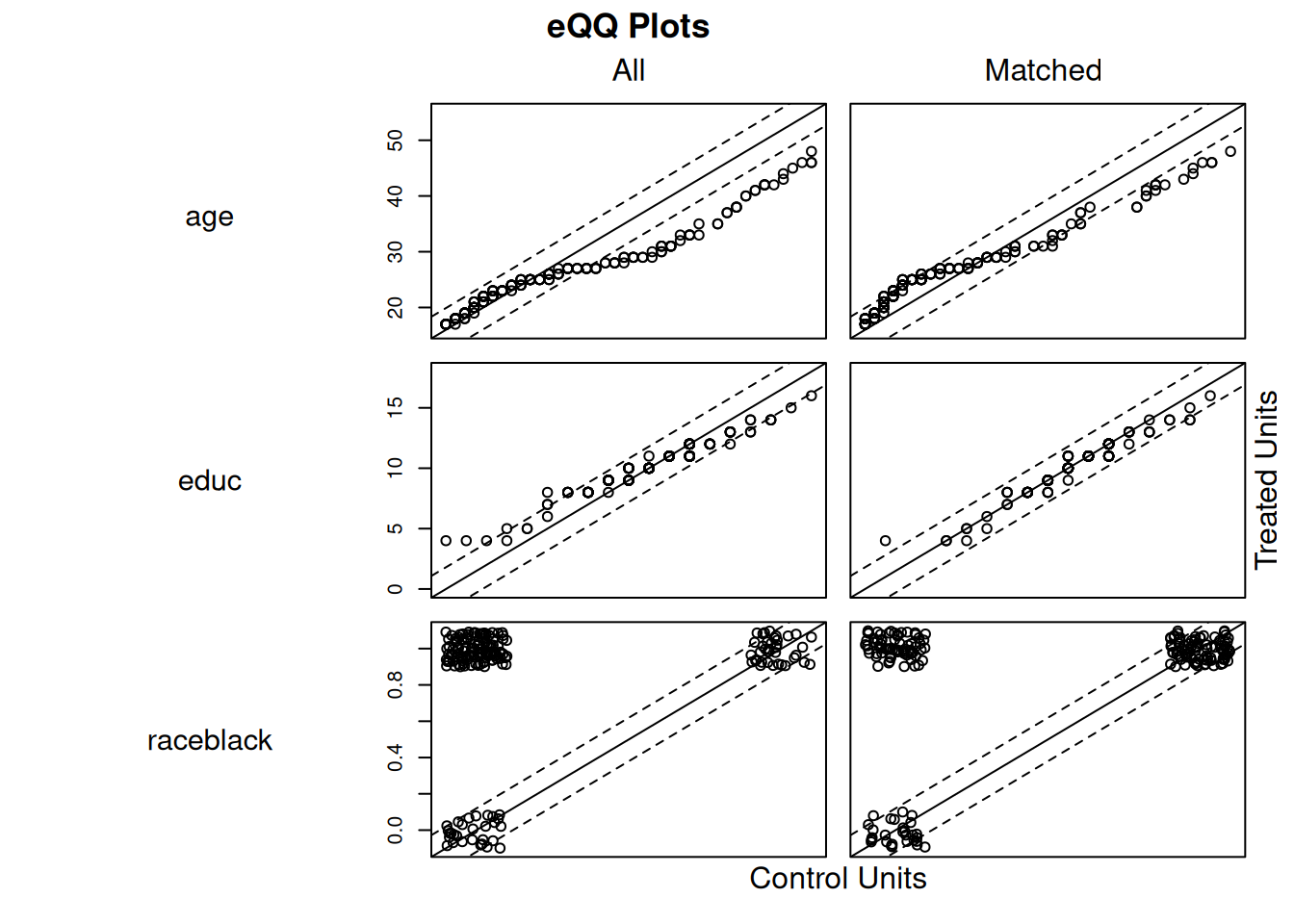
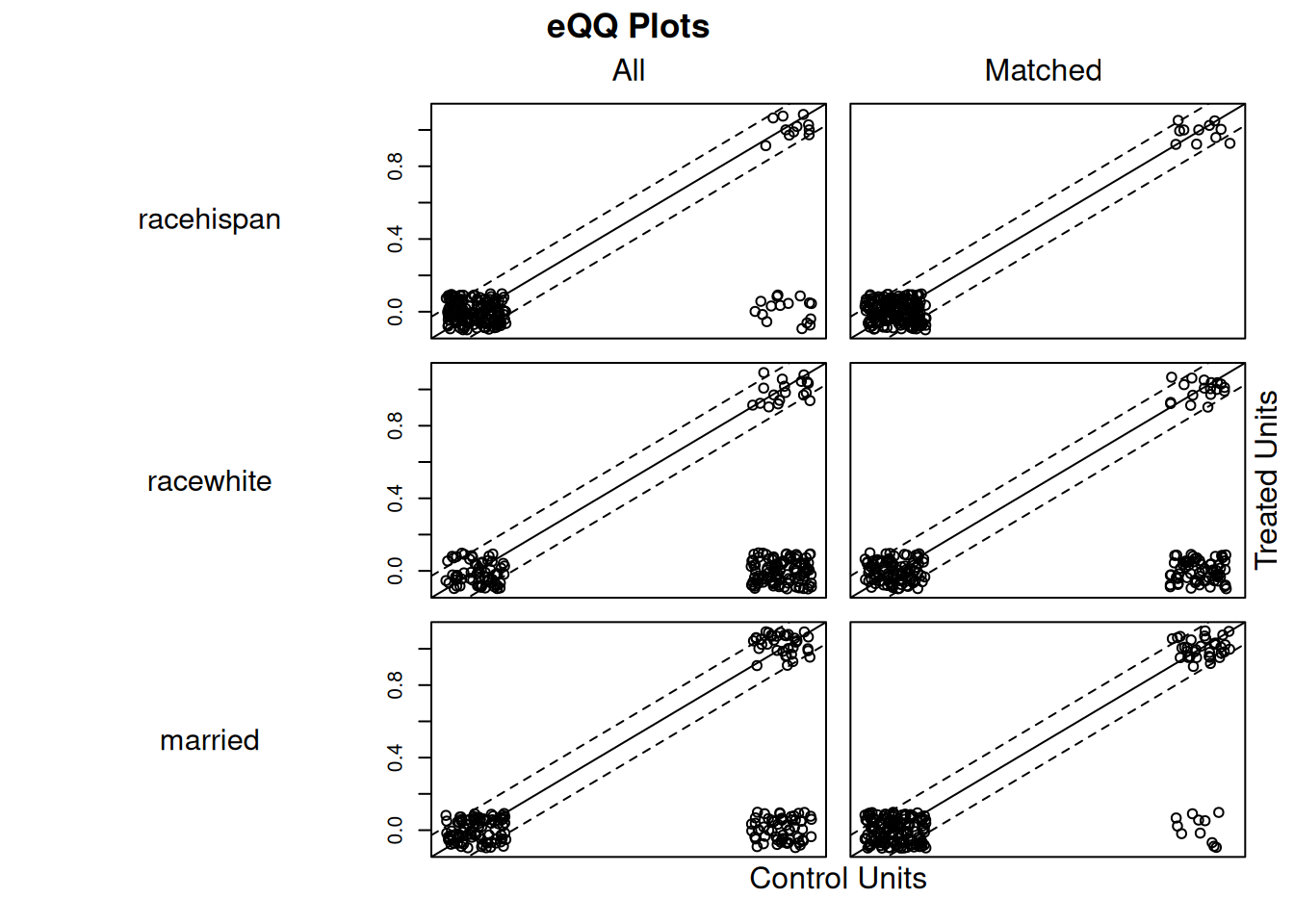
Or use “cobalt” to see the balance:

First do a PS match.

# Matching on logit of a PS estimated with logistic
# regression:
m.out1 <- matchit(treat ~ age + educ + race + married +
                    nodegree + re74 + re75,
                  data = lalonde,
                  distance = "glm",
                  link = "linear.logit")
summary(m.out1)

Call:
matchit(formula = treat ~ age + educ + race + married + nodegree + 
    re74 + re75, data = lalonde, distance = "glm", link = "linear.logit")

Summary of Balance for All Data:
           Means Treated Means Control Std. Mean Diff. Var. Ratio eCDF Mean
distance          0.2657       -2.1500          2.1426     0.5398    0.3774
age              25.8162       28.0303         -0.3094     0.4400    0.0813
educ             10.3459       10.2354          0.0550     0.4959    0.0347
raceblack         0.8432        0.2028          1.7615          .    0.6404
racehispan        0.0595        0.1422         -0.3498          .    0.0827
racewhite         0.0973        0.6550         -1.8819          .    0.5577
married           0.1892        0.5128         -0.8263          .    0.3236
nodegree          0.7081        0.5967          0.2450          .    0.1114
re74           2095.5737     5619.2365         -0.7211     0.5181    0.2248
re75           1532.0553     2466.4844         -0.2903     0.9563    0.1342
           eCDF Max
distance     0.6444
age          0.1577
educ         0.1114
raceblack    0.6404
racehispan   0.0827
racewhite    0.5577
married      0.3236
nodegree     0.1114
re74         0.4470
re75         0.2876

Summary of Balance for Matched Data:
           Means Treated Means Control Std. Mean Diff. Var. Ratio eCDF Mean
distance          0.2657       -0.7706          0.9192     0.7712    0.1321
age              25.8162       25.3027          0.0718     0.4568    0.0847
educ             10.3459       10.6054         -0.1290     0.5721    0.0239
raceblack         0.8432        0.4703          1.0259          .    0.3730
racehispan        0.0595        0.2162         -0.6629          .    0.1568
racewhite         0.0973        0.3135         -0.7296          .    0.2162
married           0.1892        0.2108         -0.0552          .    0.0216
nodegree          0.7081        0.6378          0.1546          .    0.0703
re74           2095.5737     2342.1076         -0.0505     1.3289    0.0469
re75           1532.0553     1614.7451         -0.0257     1.4956    0.0452
           eCDF Max Std. Pair Dist.
distance     0.4216          0.9193
age          0.2541          1.3938
educ         0.0757          1.2474
raceblack    0.3730          1.0259
racehispan   0.1568          1.0743
racewhite    0.2162          0.8390
married      0.0216          0.8281
nodegree     0.0703          1.0106
re74         0.2757          0.7965
re75         0.2054          0.7381

Sample Sizes:
          Control Treated
All           429     185
Matched       185     185
Unmatched     244       0
Discarded       0       0
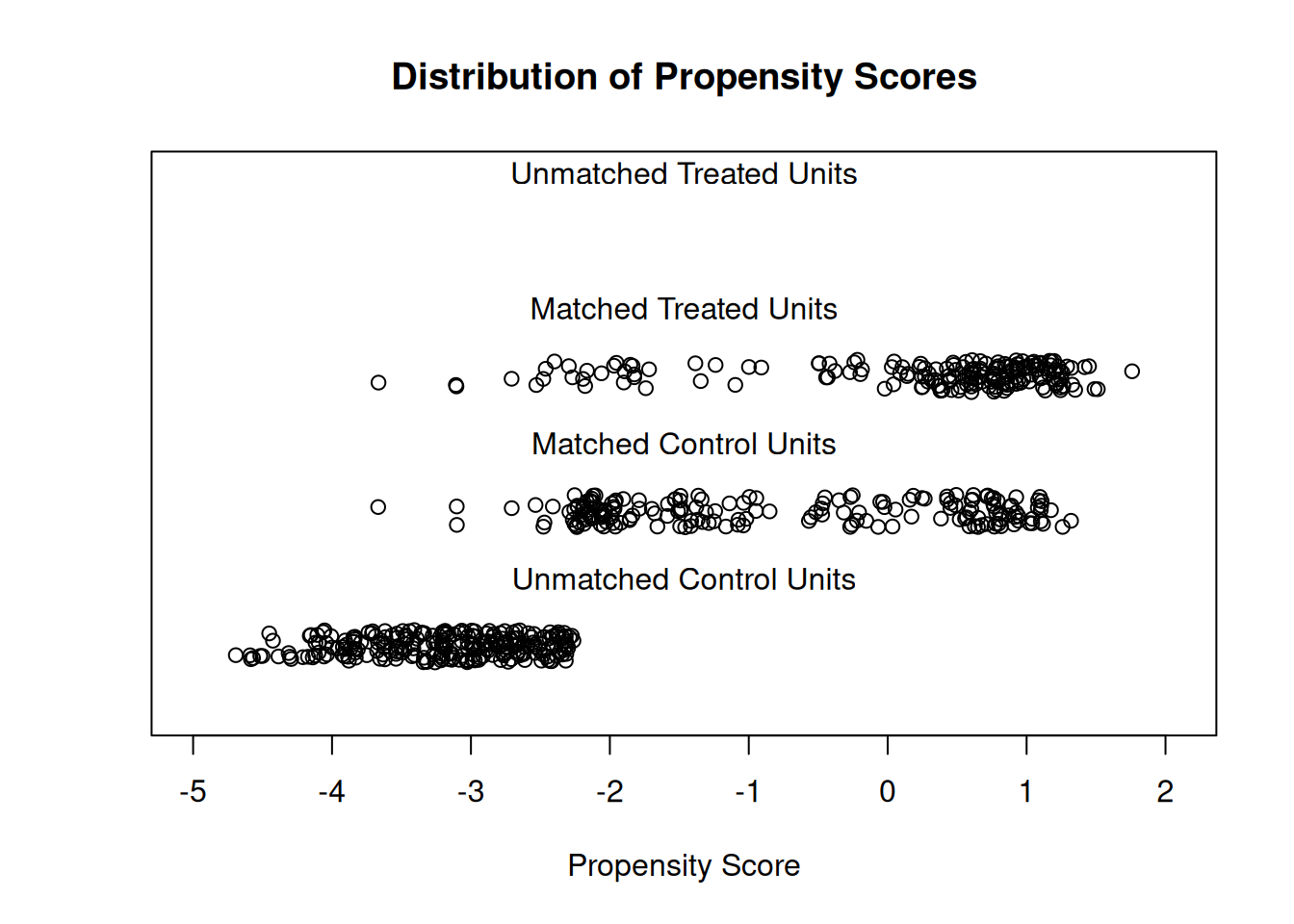
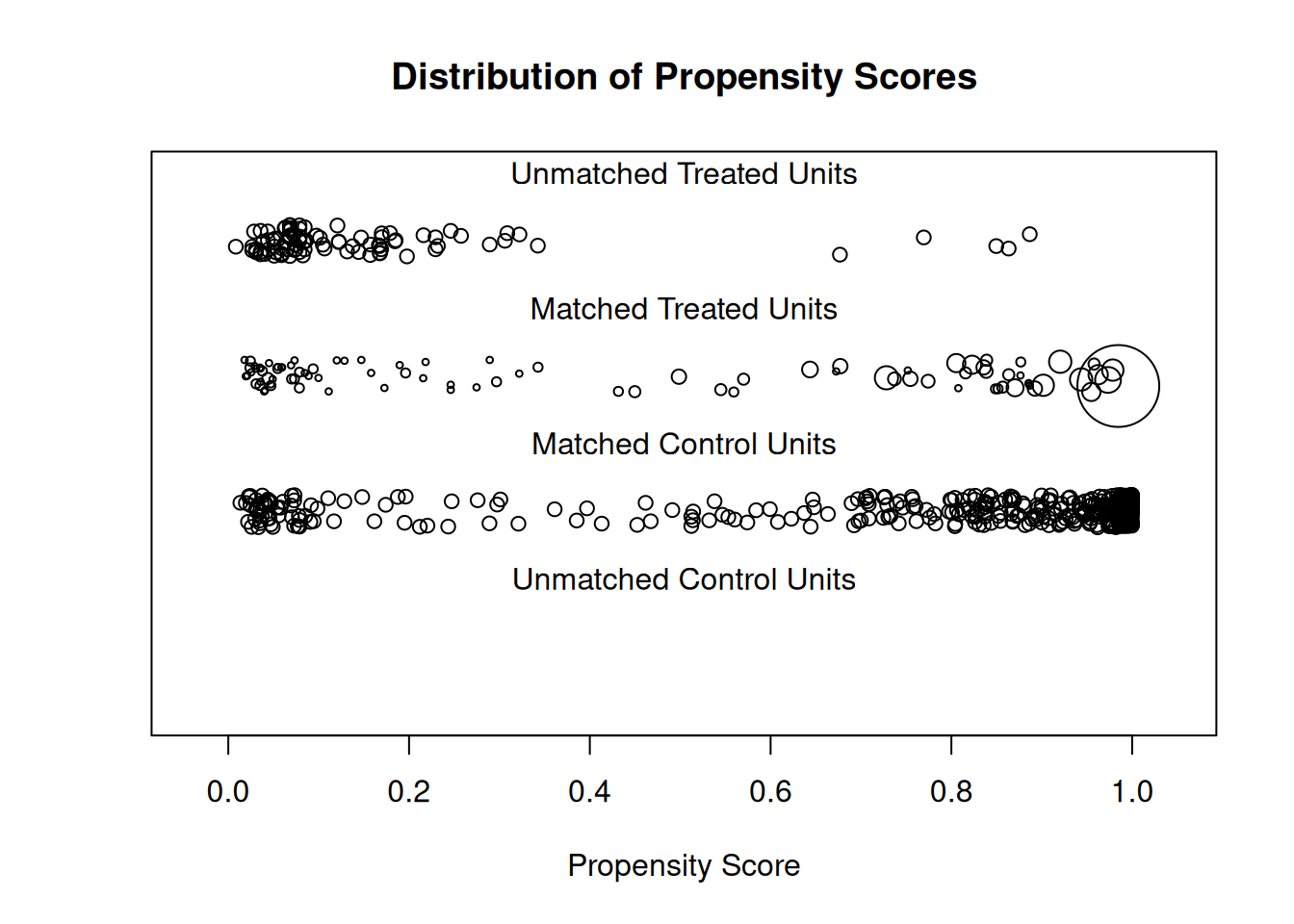
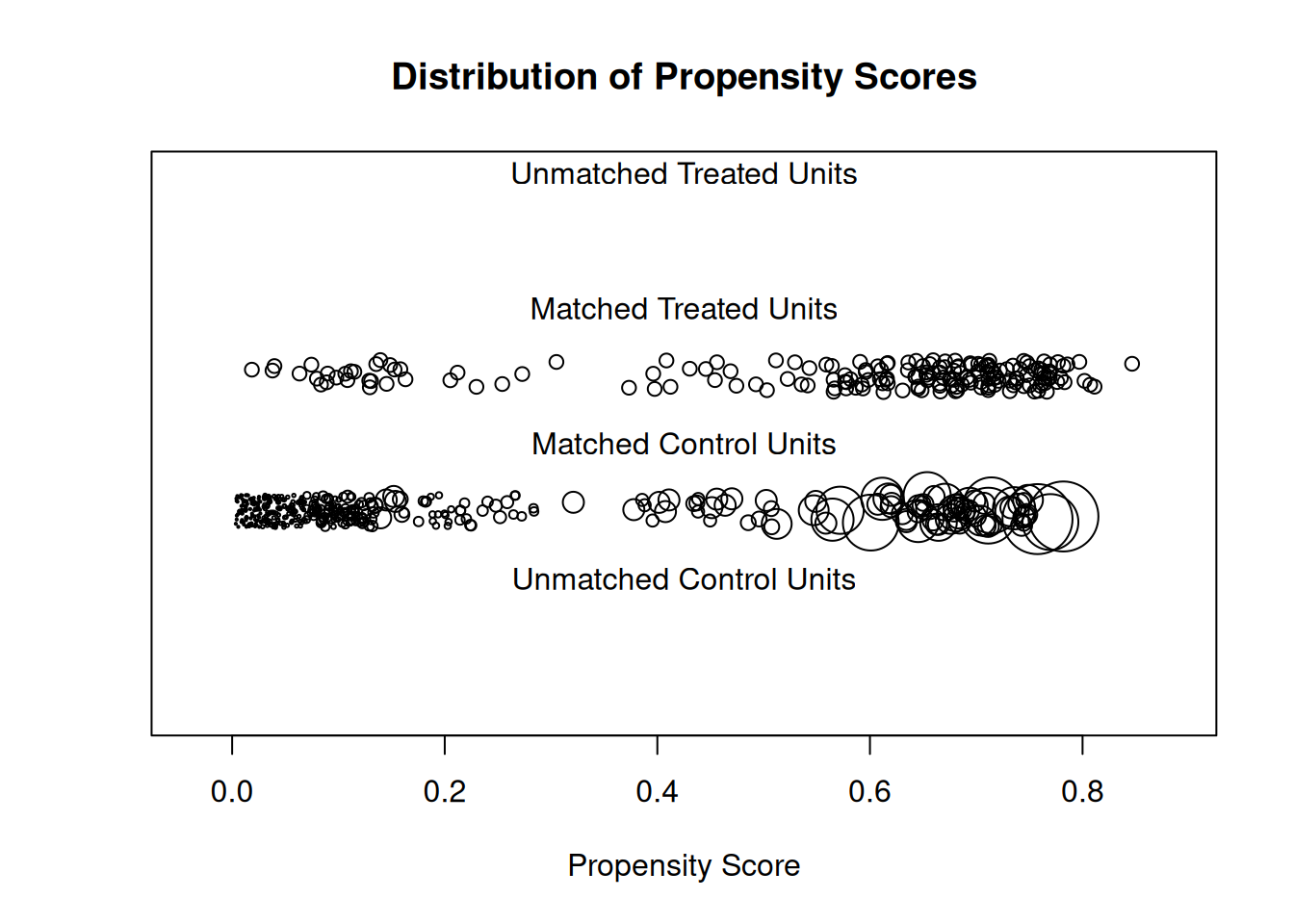
plot(m.out1, type = "jitter", interactive = FALSE)

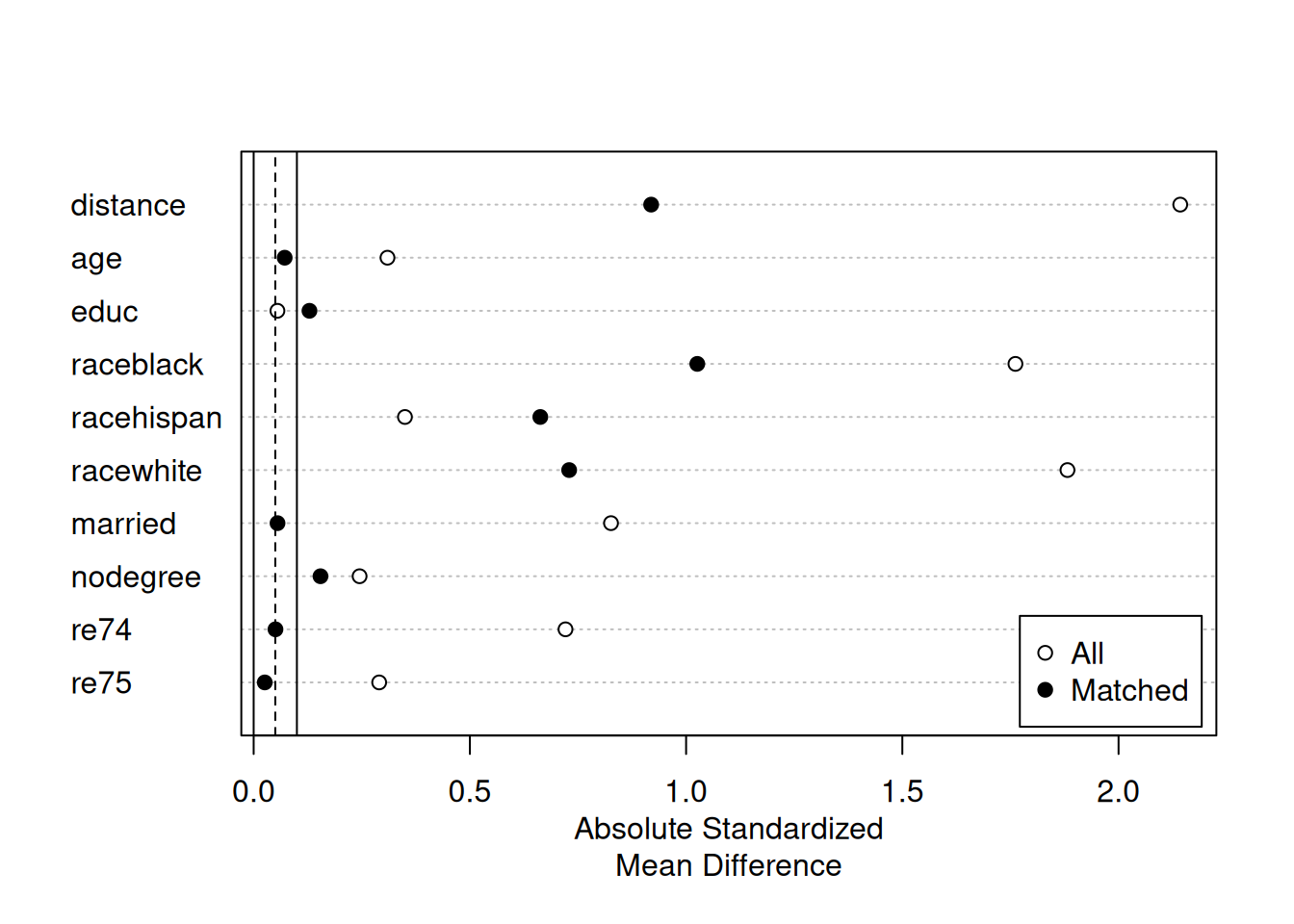
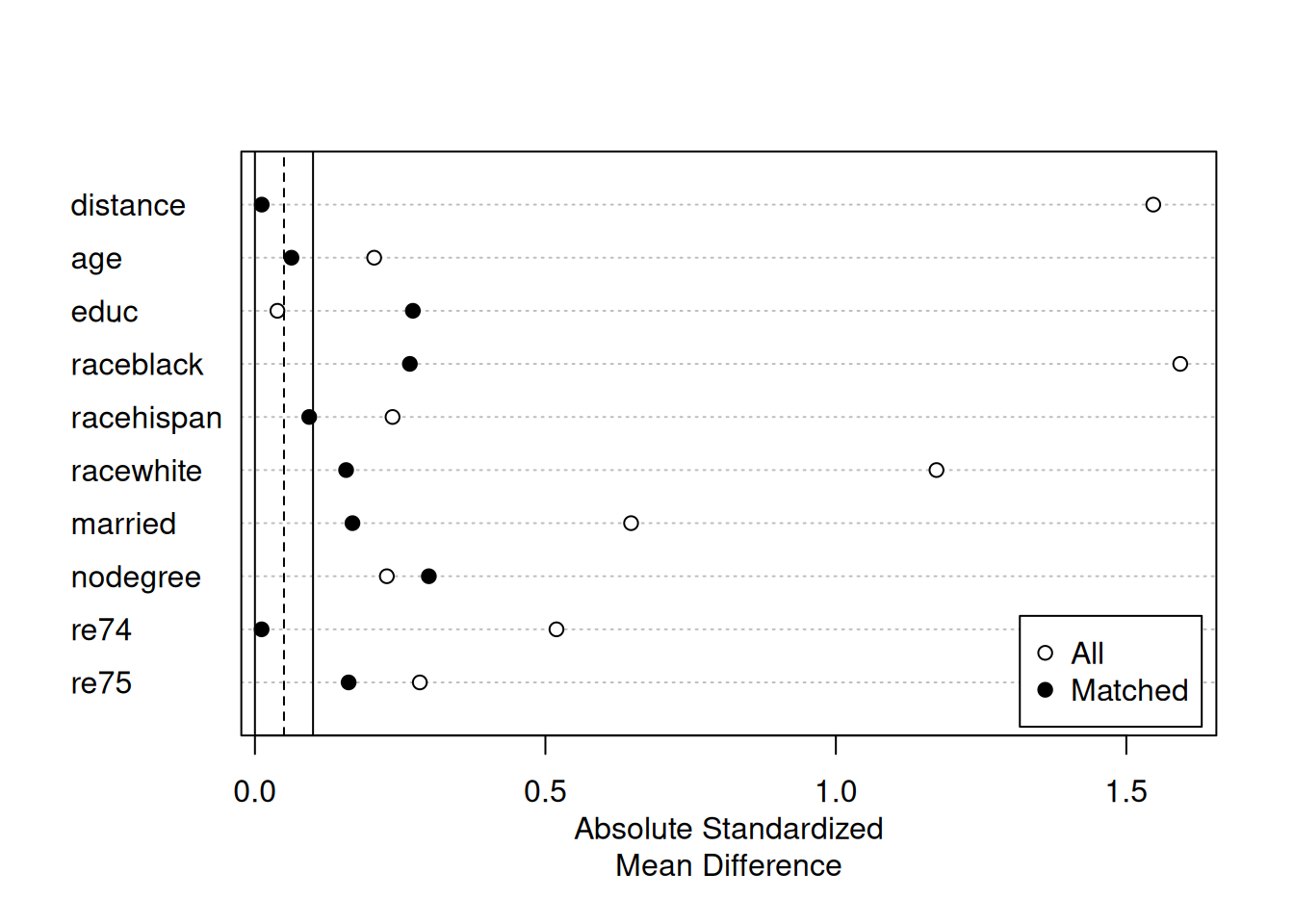
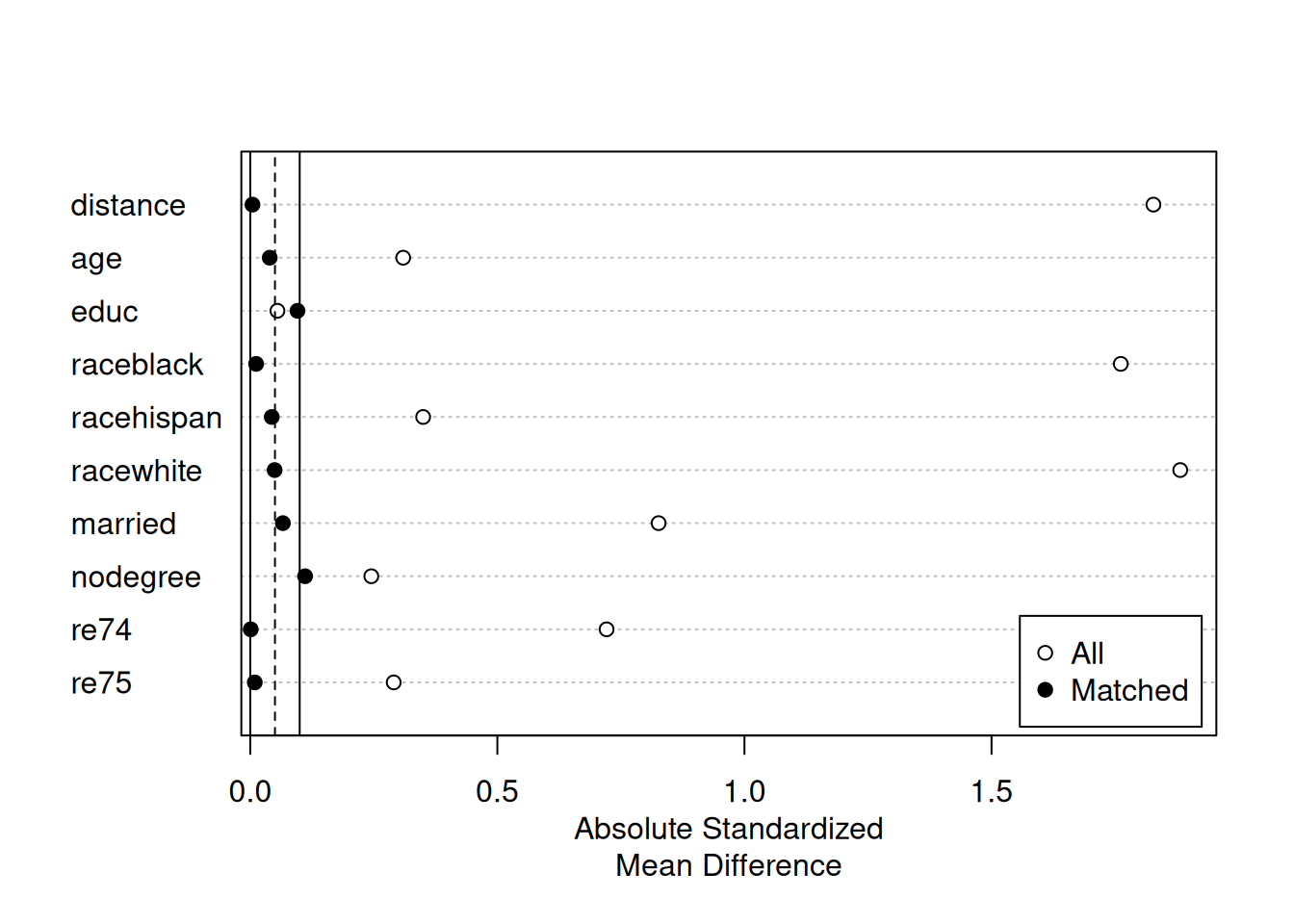
plot(summary(m.out1))

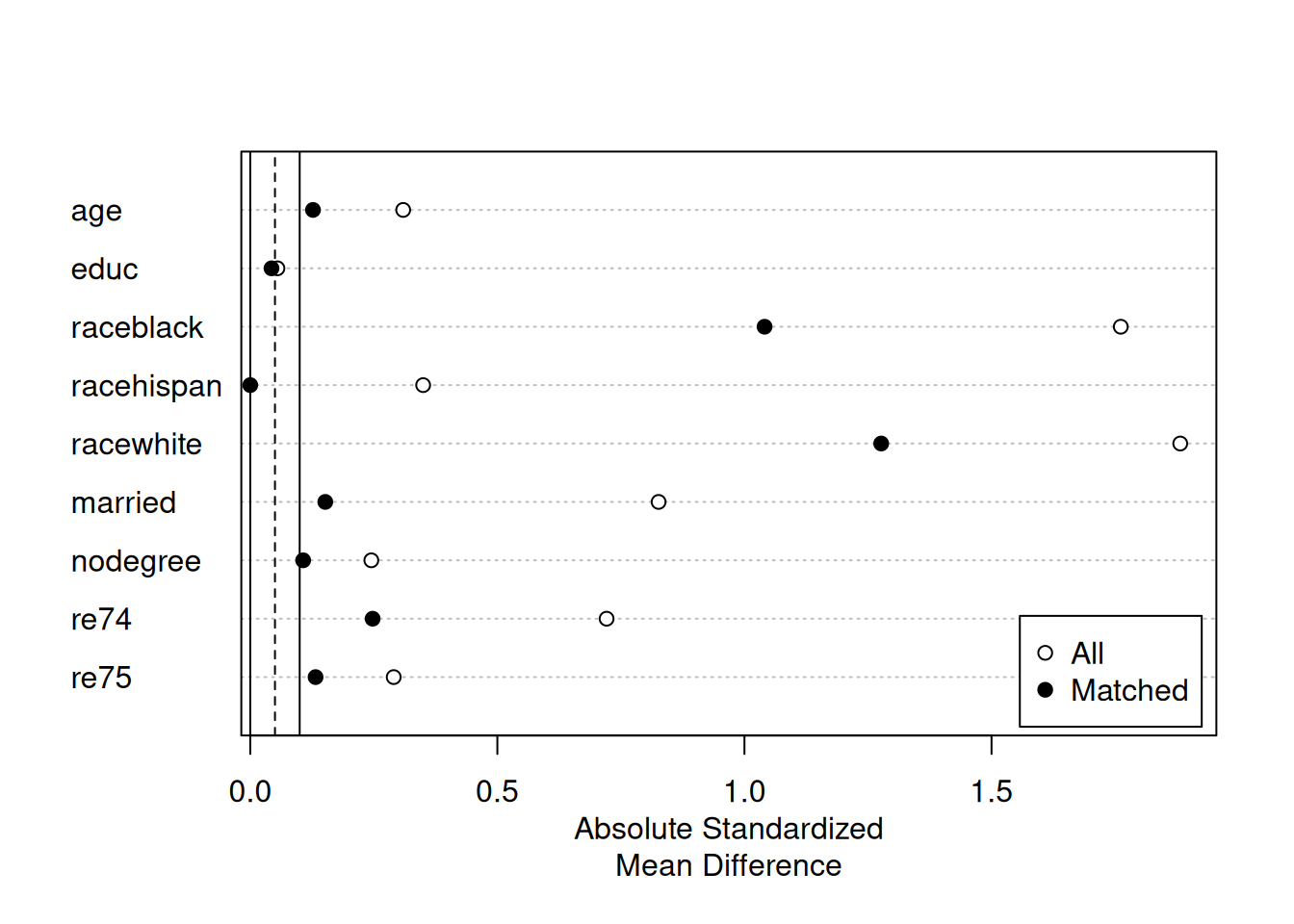
We see there are still some imbalance on variables such as “raceblack”. We can use more flexible models for the PS.

# GAM logistic PS with smoothing splines (s()):
m.out2 <- matchit(treat ~ s(age) + s(educ) +
                    race + married +
                    nodegree + re74 + re75,
                  data = lalonde,
                  distance = "gam")
summary(m.out2)

Call:
matchit(formula = treat ~ s(age) + s(educ) + race + married + 
    nodegree + re74 + re75, data = lalonde, distance = "gam")

Summary of Balance for All Data:
           Means Treated Means Control Std. Mean Diff. Var. Ratio eCDF Mean
distance          0.6566        0.1481          1.9123     1.6161    0.4155
raceblack         0.8432        0.2028          1.7615          .    0.6404
racehispan        0.0595        0.1422         -0.3498          .    0.0827
racewhite         0.0973        0.6550         -1.8819          .    0.5577
married           0.1892        0.5128         -0.8263          .    0.3236
nodegree          0.7081        0.5967          0.2450          .    0.1114
re74           2095.5737     5619.2365         -0.7211     0.5181    0.2248
re75           1532.0553     2466.4844         -0.2903     0.9563    0.1342
age              25.8162       28.0303         -0.3094     0.4400    0.0813
educ             10.3459       10.2354          0.0550     0.4959    0.0347
           eCDF Max
distance     0.7172
raceblack    0.6404
racehispan   0.0827
racewhite    0.5577
married      0.3236
nodegree     0.1114
re74         0.4470
re75         0.2876
age          0.1577
educ         0.1114

Summary of Balance for Matched Data:
           Means Treated Means Control Std. Mean Diff. Var. Ratio eCDF Mean
distance          0.6566        0.3055          1.3204     1.2324    0.1853
raceblack         0.8432        0.4432          1.1002          .    0.4000
racehispan        0.0595        0.1730         -0.4800          .    0.1135
racewhite         0.0973        0.3838         -0.9667          .    0.2865
married           0.1892        0.3568         -0.4278          .    0.1676
nodegree          0.7081        0.6541          0.1189          .    0.0541
re74           2095.5737     3521.7556         -0.2919     1.0512    0.1346
re75           1532.0553     2056.2000         -0.1628     1.2120    0.0917
age              25.8162       25.7081          0.0151     0.7958    0.0270
educ             10.3459       10.1568          0.0941     0.6186    0.0270
           eCDF Max Std. Pair Dist.
distance     0.5189          1.3204
raceblack    0.4000          1.1002
racehispan   0.1135          0.8914
racewhite    0.2865          1.1491
married      0.1676          1.0627
nodegree     0.0541          0.9749
re74         0.4270          0.8894
re75         0.2378          0.8453
age          0.0865          1.1619
educ         0.0919          1.2447

Sample Sizes:
          Control Treated
All           429     185
Matched       185     185
Unmatched     244       0
Discarded       0       0
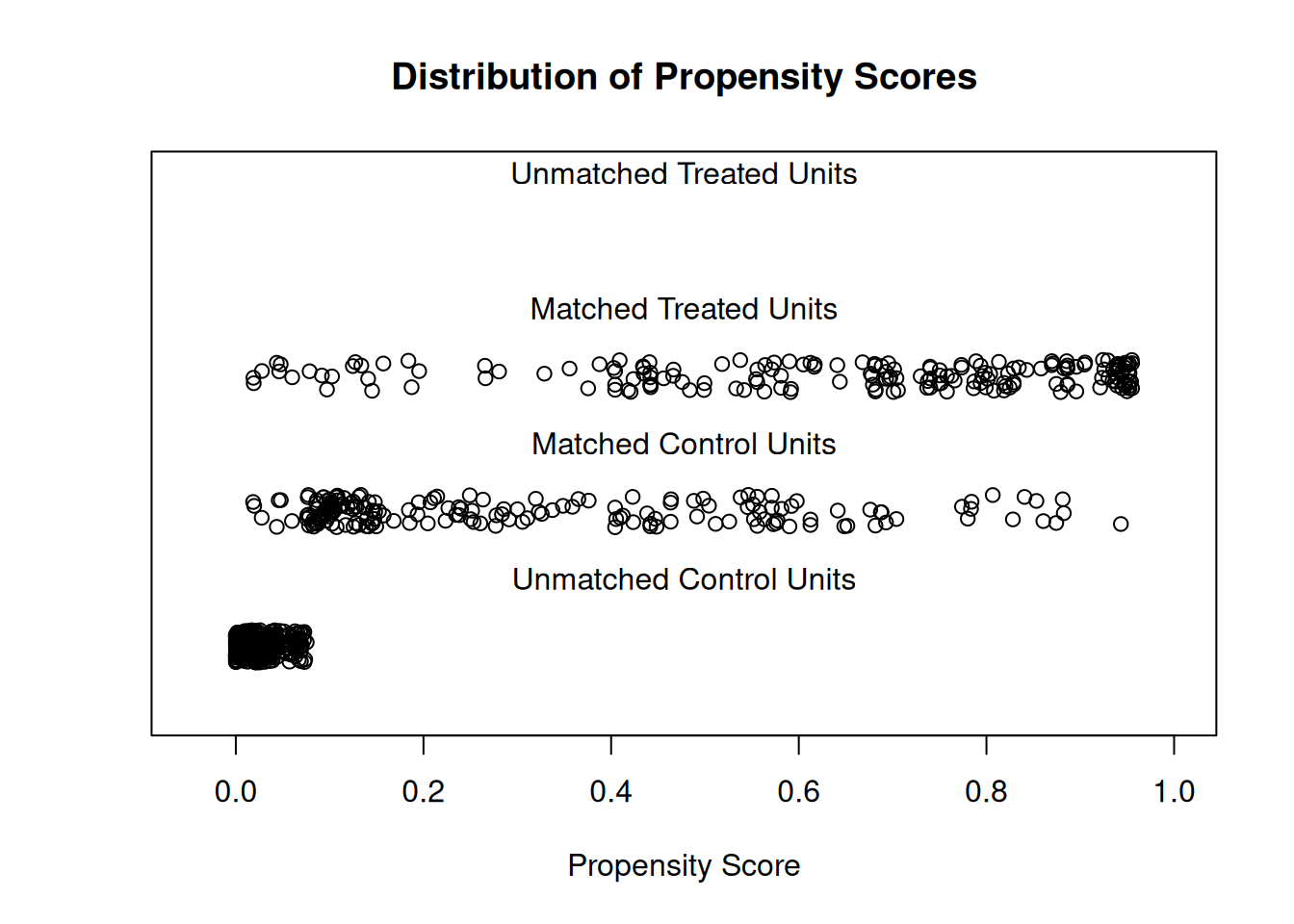
plot(m.out2, type = "jitter", interactive = FALSE)

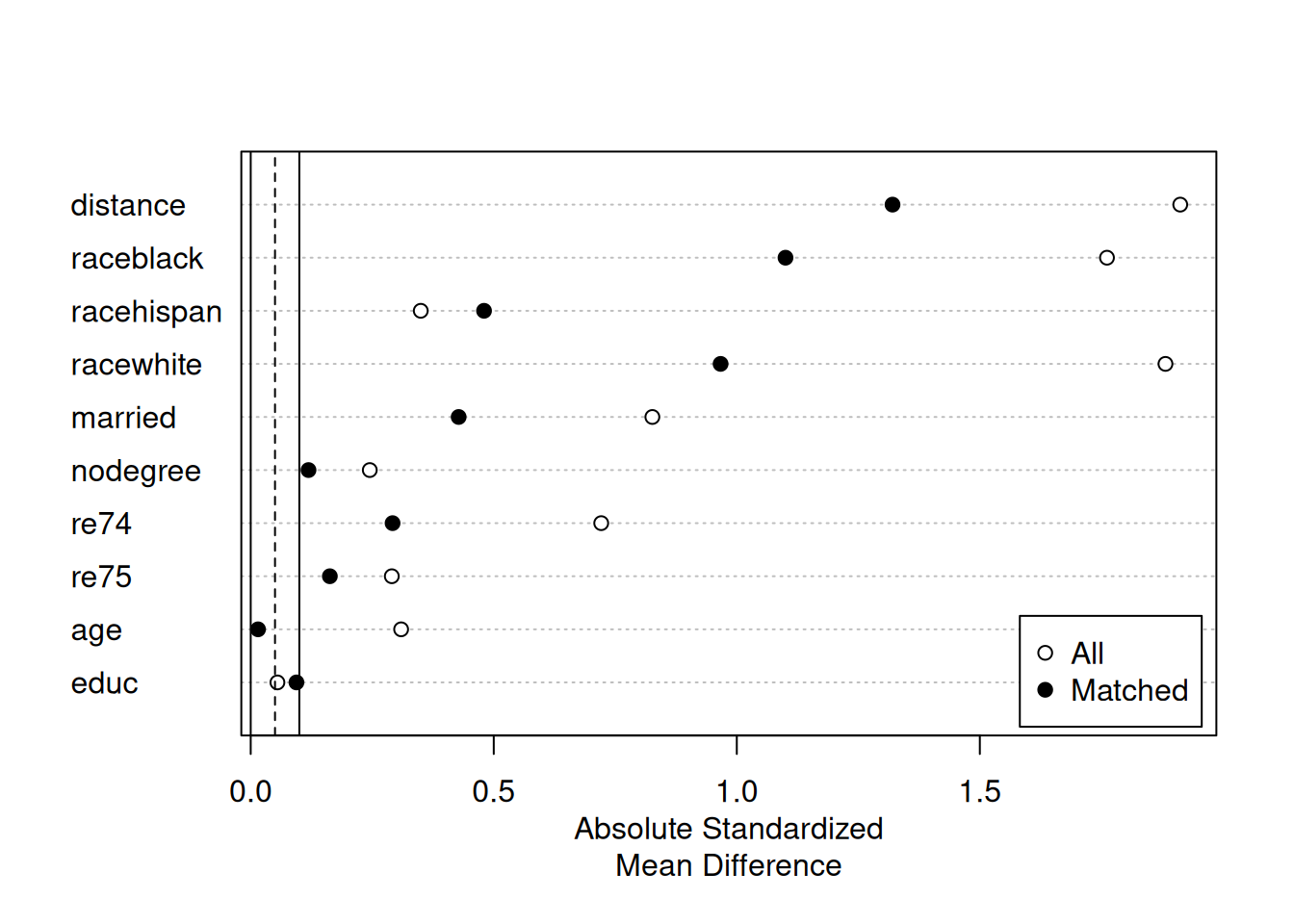
plot(summary(m.out2))

Or use CBPS.

# CBPS for ATC matching w/replacement, using the just-
# identified version of CBPS (setting method = "exact"):
m.out3 <- matchit(treat ~ age + educ + race + married +
                    nodegree + re74 + re75,
                  data = lalonde,
                  distance = "cbps",
                  estimand = "ATC",
                  distance.options = list(method = "exact"),
                  replace = TRUE)
summary(m.out3)

Call:
matchit(formula = treat ~ age + educ + race + married + nodegree + 
    re74 + re75, data = lalonde, distance = "cbps", distance.options = list(method = "exact"), 
    estimand = "ATC", replace = TRUE)

Summary of Balance for All Data:
           Means Treated Means Control Std. Mean Diff. Var. Ratio eCDF Mean
distance          0.2801        0.7758         -1.5464     0.9710    0.3525
age              25.8162       28.0303         -0.2053     0.4400    0.0813
educ             10.3459       10.2354          0.0387     0.4959    0.0347
raceblack         0.8432        0.2028          1.5928          .    0.6404
racehispan        0.0595        0.1422         -0.2369          .    0.0827
racewhite         0.0973        0.6550         -1.1732          .    0.5577
married           0.1892        0.5128         -0.6475          .    0.3236
nodegree          0.7081        0.5967          0.2270          .    0.1114
re74           2095.5737     5619.2365         -0.5190     0.5181    0.2248
re75           1532.0553     2466.4844         -0.2838     0.9563    0.1342
           eCDF Max
distance     0.5967
age          0.1577
educ         0.1114
raceblack    0.6404
racehispan   0.0827
racewhite    0.5577
married      0.3236
nodegree     0.1114
re74         0.4470
re75         0.2876

Summary of Balance for Matched Data:
           Means Treated Means Control Std. Mean Diff. Var. Ratio eCDF Mean
distance          0.7720        0.7758         -0.0117     1.1568    0.0499
age              27.3520       28.0303         -0.0629     0.4383    0.1091
educ             11.0117       10.2354          0.2719     0.7323    0.0566
raceblack         0.3100        0.2028          0.2667          .    0.1072
racehispan        0.1096        0.1422         -0.0934          .    0.0326
racewhite         0.5804        0.6550         -0.1569          .    0.0746
married           0.5967        0.5128          0.1679          .    0.0839
nodegree          0.4499        0.5967         -0.2994          .    0.1469
re74           5696.9438     5619.2365          0.0114     0.8562    0.0994
re75           1935.6090     2466.4844         -0.1613     1.5194    0.1071
           eCDF Max Std. Pair Dist.
distance     0.3543          0.0194
age          0.2191          0.8676
educ         0.2727          1.0719
raceblack    0.1072          0.3826
racehispan   0.0326          0.6407
racewhite    0.0746          0.5492
married      0.0839          0.5596
nodegree     0.1469          1.0692
re74         0.2541          0.7513
re75         0.2727          0.9781

Sample Sizes:
              Control Treated
All               429  185.  
Matched (ESS)     429    6.67
Matched           429   93.  
Unmatched           0   92.  
Discarded           0    0.  
plot(m.out3, type = "jitter", interactive = FALSE)

plot(summary(m.out3))

# Mahalanobis distance matching - no PS estimated
m.out4 <- matchit(treat ~ age + educ + race + married +
                    nodegree + re74 + re75,
                  data = lalonde,
                  distance = "mahalanobis")
summary(m.out4)

Call:
matchit(formula = treat ~ age + educ + race + married + nodegree + 
    re74 + re75, data = lalonde, distance = "mahalanobis")

Summary of Balance for All Data:
           Means Treated Means Control Std. Mean Diff. Var. Ratio eCDF Mean
age              25.8162       28.0303         -0.3094     0.4400    0.0813
educ             10.3459       10.2354          0.0550     0.4959    0.0347
raceblack         0.8432        0.2028          1.7615          .    0.6404
racehispan        0.0595        0.1422         -0.3498          .    0.0827
racewhite         0.0973        0.6550         -1.8819          .    0.5577
married           0.1892        0.5128         -0.8263          .    0.3236
nodegree          0.7081        0.5967          0.2450          .    0.1114
re74           2095.5737     5619.2365         -0.7211     0.5181    0.2248
re75           1532.0553     2466.4844         -0.2903     0.9563    0.1342
           eCDF Max
age          0.1577
educ         0.1114
raceblack    0.6404
racehispan   0.0827
racewhite    0.5577
married      0.3236
nodegree     0.1114
re74         0.4470
re75         0.2876

Summary of Balance for Matched Data:
           Means Treated Means Control Std. Mean Diff. Var. Ratio eCDF Mean
age              25.8162       24.9081          0.1269     0.5327    0.0695
educ             10.3459       10.4324         -0.0430     0.8345    0.0108
raceblack         0.8432        0.4649          1.0407          .    0.3784
racehispan        0.0595        0.0595          0.0000          .    0.0000
racewhite         0.0973        0.4757         -1.2767          .    0.3784
married           0.1892        0.2486         -0.1518          .    0.0595
nodegree          0.7081        0.6595          0.1070          .    0.0486
re74           2095.5737     3305.4420         -0.2476     0.8705    0.1012
re75           1532.0553     1957.5097         -0.1322     1.0071    0.0654
           eCDF Max Std. Pair Dist.
age          0.2378          0.6195
educ         0.0486          0.2903
raceblack    0.3784          1.0407
racehispan   0.0000          0.0000
racewhite    0.3784          1.2767
married      0.0595          0.1794
nodegree     0.0486          0.1070
re74         0.3351          0.4546
re75         0.2162          0.4113

Sample Sizes:
          Control Treated
All           429     185
Matched       185     185
Unmatched     244       0
Discarded       0       0
m.out4$distance #NULL
NULL
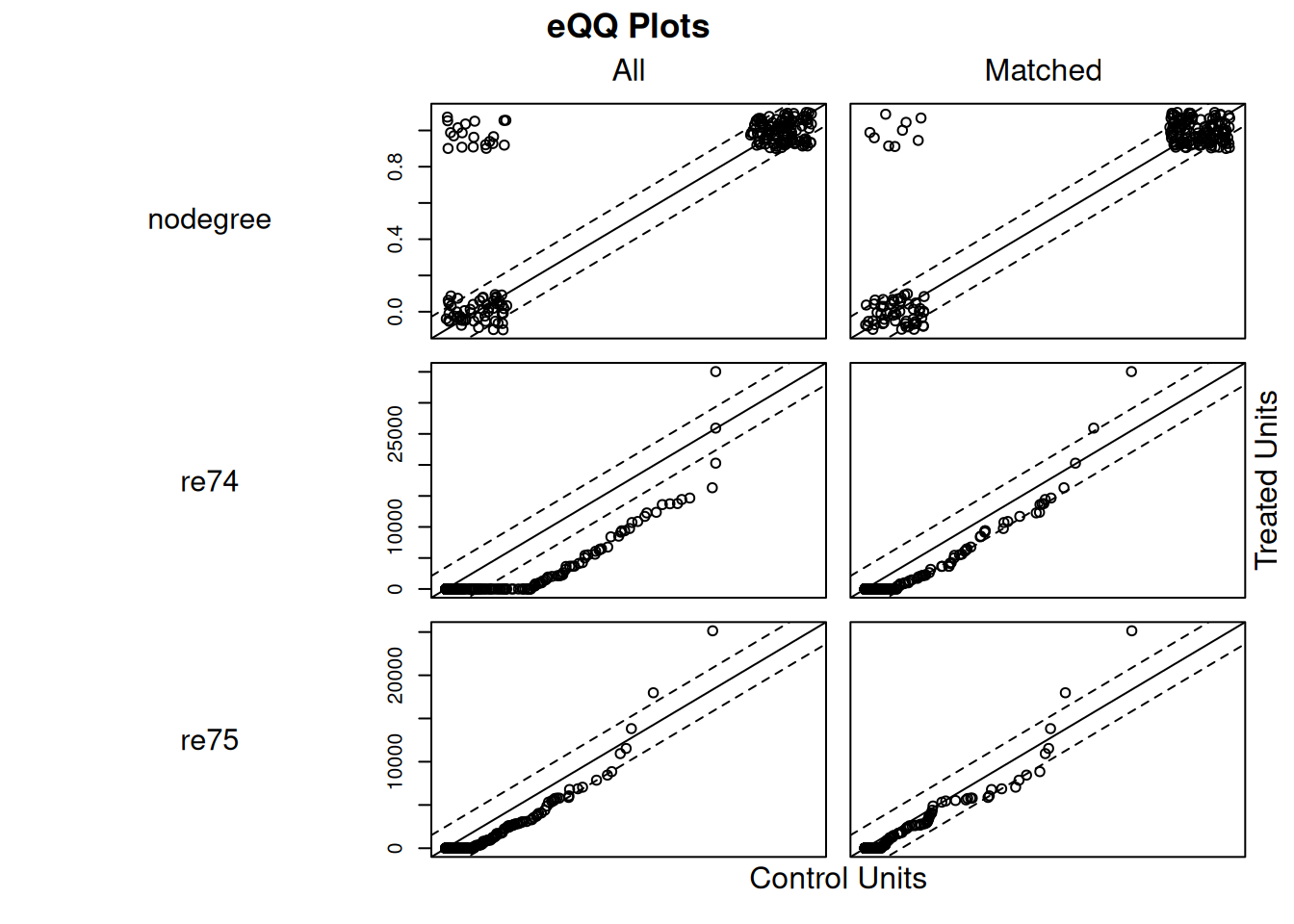
plot(m.out4,  interactive = FALSE)

plot(summary(m.out4))

# Full matching on a probit PS
m.out5 <- matchit(treat ~ age + educ + race + married + 
                    nodegree + re74 + re75,
                  data = lalonde,
                  method = "full",
                  distance = "glm",
                  link = "probit")

summary(m.out5)

Call:
matchit(formula = treat ~ age + educ + race + married + nodegree + 
    re74 + re75, data = lalonde, method = "full", distance = "glm", 
    link = "probit")

Summary of Balance for All Data:
           Means Treated Means Control Std. Mean Diff. Var. Ratio eCDF Mean
distance          0.5773        0.1817          1.8276     0.8777    0.3774
age              25.8162       28.0303         -0.3094     0.4400    0.0813
educ             10.3459       10.2354          0.0550     0.4959    0.0347
raceblack         0.8432        0.2028          1.7615          .    0.6404
racehispan        0.0595        0.1422         -0.3498          .    0.0827
racewhite         0.0973        0.6550         -1.8819          .    0.5577
married           0.1892        0.5128         -0.8263          .    0.3236
nodegree          0.7081        0.5967          0.2450          .    0.1114
re74           2095.5737     5619.2365         -0.7211     0.5181    0.2248
re75           1532.0553     2466.4844         -0.2903     0.9563    0.1342
           eCDF Max
distance     0.6413
age          0.1577
educ         0.1114
raceblack    0.6404
racehispan   0.0827
racewhite    0.5577
married      0.3236
nodegree     0.1114
re74         0.4470
re75         0.2876

Summary of Balance for Matched Data:
           Means Treated Means Control Std. Mean Diff. Var. Ratio eCDF Mean
distance          0.5773        0.5764          0.0045     0.9949    0.0043
age              25.8162       25.5347          0.0393     0.4790    0.0787
educ             10.3459       10.5381         -0.0956     0.6192    0.0253
raceblack         0.8432        0.8389          0.0119          .    0.0043
racehispan        0.0595        0.0492          0.0435          .    0.0103
racewhite         0.0973        0.1119         -0.0493          .    0.0146
married           0.1892        0.1633          0.0660          .    0.0259
nodegree          0.7081        0.6577          0.1110          .    0.0504
re74           2095.5737     2100.2150         -0.0009     1.3467    0.0314
re75           1532.0553     1561.4420         -0.0091     1.5906    0.0536
           eCDF Max Std. Pair Dist.
distance     0.0486          0.0198
age          0.2742          1.2843
educ         0.0730          1.2179
raceblack    0.0043          0.0162
racehispan   0.0103          0.4412
racewhite    0.0146          0.3454
married      0.0259          0.4473
nodegree     0.0504          0.9872
re74         0.1881          0.8387
re75         0.1984          0.8240

Sample Sizes:
              Control Treated
All            429.       185
Matched (ESS)   50.76     185
Matched        429.       185
Unmatched        0.         0
Discarded        0.         0
plot(m.out5, type = "jitter", interactive = FALSE)

plot(summary(m.out5))

13.6 Estimation

After we get a matched data that we think is good enough, we can estimate the treatment effect.

m.data <- match_data(m.out5)

head(m.data)
     treat age educ   race married nodegree re74 re75       re78  distance
NSW1     1  37   11  black       1        1    0    0  9930.0460 0.6356769
NSW2     1  22    9 hispan       0        1    0    0  3595.8940 0.2298151
NSW3     1  30   12  black       0        0    0    0 24909.4500 0.6813558
NSW4     1  27   11  black       0        1    0    0  7506.1460 0.7690590
NSW5     1  33    8  black       0        1    0    0   289.7899 0.6954138
NSW6     1  22    9  black       0        1    0    0  4056.4940 0.6943658
     weights subclass
NSW1       1        1
NSW2       1       55
NSW3       1       63
NSW4       1       70
NSW5       1       79
NSW6       1       86

What “match_data” does is to grab the matched data with a few additional variables such as “weights”, “subclass”, and “distance”. Then we can use it in a simple linear model with weights.

library("marginaleffects")

fit <- lm(re78 ~ treat * (age + educ + race + married +
                            nodegree + re74 + re75),
          data = m.data,
          weights = weights)

avg_comparisons(fit,
                variables = "treat",
                vcov = ~subclass,
                newdata = subset(treat == 1))

 Estimate Std. Error    z Pr(>|z|)   S 2.5 % 97.5 %
     1977        704 2.81  0.00501 7.6   596   3357

Term: treat
Type: response
Comparison: 1 - 0

Note we allow interaction of treatment and covariates, but we do no need to demean the covariates here, since we are relying on “marginaleffects” and its “avg_comparisons” function to compute the average treatment effect. The “newdata” argument is used to specify the effect, in this case ATT. Note the weights are generated this way: since it’s ATT, all treated units are weighted by 1, and control units are weighted by \(p/(1-p)\), where \(p\) is proportion of treated units in the subclass. Anyway, for full matching, we get the comparison of potential outcomes for the treated, with weights, and clustered standard errors on subclasses, because that the level the comparison is conducted.