5 Sensitivity Analysis
The previous chapters often treat identification as yes or no. Applied work is usually less clean. We may believe the adjustment set is good, but still worry about some remaining confounding. Sensitivity analysis asks a practical question: how strong would unmeasured confounding have to be to change the conclusion?
Related reading: An extended treatment of the Cinelli-Hazlett robustness value and benchmark interpretations appears in the companion blog chapter on sensitivity analysis of Topics on Econometrics and Causal Inference.
Here I use three methods:
- Cinelli-Hazlett (2020) omitted-variable bias bounds — for OLS regression estimates, quantifies how strong an omitted variable would need to be (in terms of partial \(R^2\) with treatment and outcome) to bring the estimate to zero.
- E-values (VanderWeele-Ding 2017) — for risk ratios, the minimum strength of association (on the risk-ratio scale) that an unmeasured confounder would need with both treatment and outcome to fully explain the observed association.
- Rosenbaum bounds — for matched estimators, the magnitude of non-random treatment assignment within matched pairs that would render the test result insignificant.
5.1 The NHEFS smoking-cessation example
We use the National Health and Nutrition Examination Survey I Epidemiologic Follow-up Study (NHEFS) data — the same dataset used in the applied DAG-workflow chapter. The question: what is the effect of quitting smoking (qsmk) on weight gain over 10 years (wt82_71)? We start from the raw comparison.
Code
n = 1566Treated (quit smoking) = 403Mean weight gain (treated): 4.53 kgMean weight gain (untreated): 1.98 kgOf the 1,566 complete cases, 403 quit. Quitters gained 4.53 kg on average and continuing smokers 1.98 kg, a naive difference of 2.55 kg. But quitters and continuers differ on many baseline characteristics. We adjust for the standard set by OLS — sex, age, race, education, smoking intensity, years smoked, exercise, activity and baseline weight — and print the first three coefficients along with the treatment estimate:
Code
| term | estimate | std.error | statistic | p.value |
|---|---|---|---|---|
| (Intercept) | 16.090 | 1.508 | 10.673 | 0.000 |
| qsmk | 3.381 | 0.441 | 7.665 | 0.000 |
| sex1 | -1.429 | 0.456 | -3.131 | 0.002 |
Code
Adjusted ACE estimate: 3.381 kg (SE = 0.441)The adjusted estimate is 3.381 kg with a standard error of 0.441, larger than the naive 2.55 kg. Adjustment moved the answer away from zero, not toward it. But the identification assumption requires that we have controlled for all relevant confounders. What if we missed one — say, a propensity to gain weight that also correlates with quitting decisions? Sensitivity analysis addresses this directly.
5.2 Cinelli-Hazlett OVB bounds
The framework is Cinelli and Hazlett (2020).
sensemakr implements the Cinelli-Hazlett (2020) approach. The key inputs are:
- a fitted regression
- the treatment variable name
- one or more benchmark covariates whose strength serves as a reference for how strong a hypothetical unobserved confounder might be
Code
Sensitivity Analysis to Unobserved Confounding

Model Formula: wt82_71 ~ qsmk + sex + age + race + education + smokeintensity +
    smokeyrs + exercise + active + wt71

Null hypothesis: q = 1 and reduce = TRUE
-- This means we are considering biases that reduce the absolute value of the current estimate.
-- The null hypothesis deemed problematic is H0:tau = 0

Unadjusted Estimates of 'qsmk':
  Coef. estimate: 3.3812
  Standard Error: 0.4411
  t-value (H0:tau = 0): 7.6649

Sensitivity Statistics:
  Partial R2 of treatment with outcome: 0.0365
  Robustness Value, q = 1: 0.1767
  Robustness Value, q = 1, alpha = 0.05: 0.1347

Verbal interpretation of sensitivity statistics:

-- Partial R2 of the treatment with the outcome: an extreme confounder (orthogonal to the covariates) that explains 100% of the residual variance of the outcome, would need to explain at least 3.65% of the residual variance of the treatment to fully account for the observed estimated effect.

-- Robustness Value, q = 1: unobserved confounders (orthogonal to the covariates) that explain more than 17.67% of the residual variance of both the treatment and the outcome are strong enough to bring the point estimate to 0 (a bias of 100% of the original estimate). Conversely, unobserved confounders that do not explain more than 17.67% of the residual variance of both the treatment and the outcome are not strong enough to bring the point estimate to 0.

-- Robustness Value, q = 1, alpha = 0.05: unobserved confounders (orthogonal to the covariates) that explain more than 13.47% of the residual variance of both the treatment and the outcome are strong enough to bring the estimate to a range where it is no longer 'statistically different' from 0 (a bias of 100% of the original estimate), at the significance level of alpha = 0.05. Conversely, unobserved confounders that do not explain more than 13.47% of the residual variance of both the treatment and the outcome are not strong enough to bring the estimate to a range where it is no longer 'statistically different' from 0, at the significance level of alpha = 0.05.

Bounds on omitted variable bias:

--The table below shows the maximum strength of unobserved confounders with association with the treatment and the outcome bounded by a multiple of the observed explanatory power of the chosen benchmark covariate(s).

       Bound Label R2dz.x R2yz.dx Treatment Adjusted Estimate Adjusted Se
 1x smokeintensity 0.0143  0.0010      qsmk            3.3157      0.4442
 2x smokeintensity 0.0287  0.0020      qsmk            3.2492      0.4473
 3x smokeintensity 0.0430  0.0029      qsmk            3.1817      0.4504
       1x smokeyrs 0.0056  0.0015      qsmk            3.3299      0.4422
       2x smokeyrs 0.0112  0.0031      qsmk            3.2783      0.4431
       3x smokeyrs 0.0168  0.0046      qsmk            3.2264      0.4440
 Adjusted T Adjusted Lower CI Adjusted Upper CI
     7.4636            2.4443            4.1871
     7.2641            2.3718            4.1266
     7.0640            2.2982            4.0652
     7.5308            2.4626            4.1972
     7.3989            2.4092            4.1474
     7.2667            2.3555            4.0973
The summary tells us:
- Robustness value (RV): the minimum strength of association (in terms of partial \(R^2\)) that an unmeasured confounder would need with both the treatment and the outcome to reduce the estimate to zero. Higher = more robust.
- RV_q: the strength needed to “explain away” a fraction \(q\) of the estimate (here \(q = 1\) means complete explanation).
- Benchmark comparisons: how the RV compares to multiples of the observed covariates.
For this regression the partial \(R^2\) of quitting with weight change is 3.65%. The robustness value at \(q=1\) is 17.67%: a confounder orthogonal to the covariates would have to explain more than 17.67% of the residual variance of both quitting and weight change to bring the estimate to zero. To leave it merely statistically indistinguishable from zero at the 5% level, 13.47% would be enough.
The benchmark rows put those numbers on a scale. Smoking intensity explains 1.43% of the residual variance of quitting and 0.10% of the residual variance of weight change. A confounder three times as strong on both margins would move the estimate from 3.381 to 3.182, with a 95% interval of \([2.30, 4.07]\). None of the measured covariates comes near the 17.67% that would be needed, so the estimate is robust to a confounder resembling the ones we already control for.
The same information is easier to read as a contour plot. The horizontal axis is the confounder’s partial \(R^2\) with the treatment, the vertical axis its partial \(R^2\) with the outcome, and the contours give the adjusted estimate at each combination. The benchmark diamonds mark 1x, 2x and 3x smoking intensity and years smoked. All six sit very close to the origin, so we cut the axes at 0.06 and 0.006 to keep their labels apart; the robustness value of 0.177 that would drive the estimate to zero is far outside this window.
Code
plot(sens, lim = 0.06, lim.y = 0.006, cex.label.text = 0.6)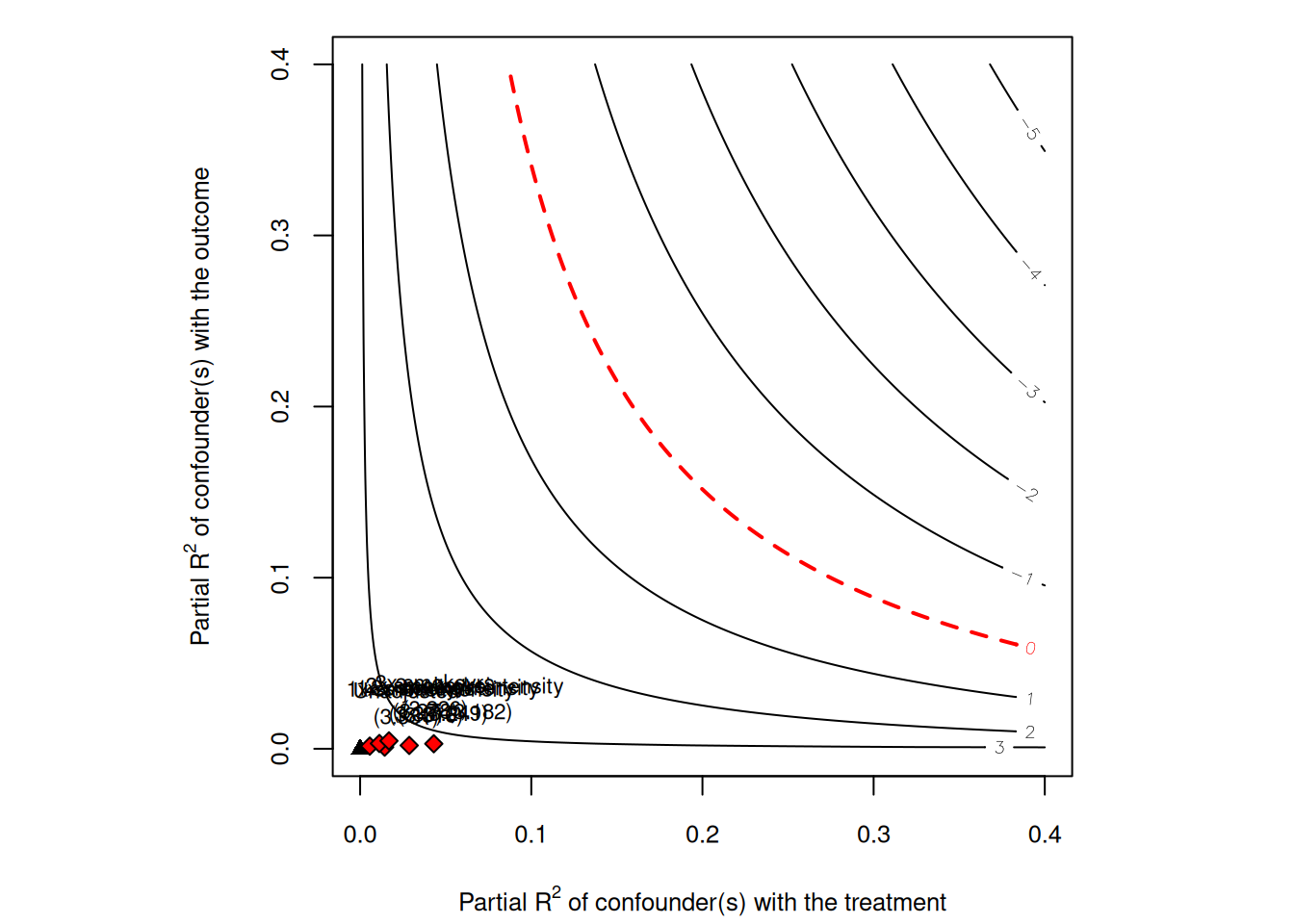
All six benchmark points sit below 0.05 on the treatment axis and below 0.005 on the outcome axis, in the region where the adjusted estimate stays above 3 kg. The contour that reaches zero is a long way out.
5.3 E-values for risk ratios
The E-value is VanderWeele and Ding (2017).
For binary outcomes and risk-ratio-type estimands, VanderWeele and Ding (2017) propose the E-value: the minimum strength of association on the risk-ratio scale that an unmeasured confounder would need to have with both the treatment and the outcome to fully explain the observed risk ratio.
To illustrate, we dichotomize weight change into any gain versus none, fit the risk ratio by Poisson regression with a log link on the same nine covariates, and take the confidence interval from robust standard errors:
Code
nhefs$gain <- as.numeric(nhefs$wt82_71 > 0)

rr_fit <- glm(gain ~ qsmk + sex + age + race + education + smokeintensity +
                     smokeyrs + exercise + active + wt71,
              data = nhefs, family = poisson(link = "log"))
rr_summary <- tidy(rr_fit, exp = TRUE, conf.int = TRUE)

rr_est <- exp(coef(rr_fit)["qsmk"])
# The Poisson likelihood is misspecified for a binary outcome (the Zou 2004
# log-binomial-via-Poisson trick), so the model-based variance is wrong.
# Use robust (sandwich/HC) standard errors for the RR confidence interval.
rr_ci  <- lmtest::coefci(rr_fit, parm = "qsmk",
                         vcov. = sandwich::vcovHC(rr_fit, type = "HC0"))
rr_lo  <- exp(rr_ci[1])
rr_hi  <- exp(rr_ci[2])

cat(sprintf("Adjusted RR (quit vs not): %.3f  [%.3f, %.3f]\n",
            rr_est, rr_lo, rr_hi))
Adjusted RR (quit vs not): 1.218 [1.135, 1.307]Code
ev <- evalues.RR(est = rr_est, lo = rr_lo, hi = rr_hi)
print(ev)
point lower upper
RR 1.217702 1.134911 1.306534
E-values 1.732578 1.526206 NAThe E-value reports two numbers:
- E-value (point estimate): an unmeasured confounder would need to be associated with both treatment and outcome by risk ratios of at least this value, above and beyond the measured confounders, to fully explain away the observed effect.
- E-value (confidence interval): the minimum strength needed to shift the lower confidence bound to 1.
The adjusted risk ratio is 1.218, with a 95% interval of \([1.135, 1.307]\). Quitters are about 22% more likely to gain any weight. The E-value for the point estimate is 1.73: an unmeasured confounder would need risk-ratio associations of at least 1.73 with both quitting and weight gain, beyond the nine measured covariates, to account for the whole association. The E-value for the confidence limit is 1.53, the strength that would push the lower bound to 1.
An E-value much greater than 1 suggests the result is hard to explain by unmeasured confounding. An E-value close to 1 means a modest unmeasured confounder could overturn the conclusion. At 1.73 this result sits in between: a confounder as strong as that is not implausible, but it would have to be unrelated to everything already in the model.
The useful part of the E-value is that it is on the risk-ratio scale. It can be explained without specifying a model for the unobserved confounder.
5.4 Rosenbaum bounds (matched estimators)
The sensitivity model and the bound computed below are Rosenbaum’s (2002).
For matching estimators, Rosenbaum bounds (Rosenbaum 2002) provide a sensitivity analysis based on the maximum deviation from random assignment within matched pairs.
Suppose units in a matched pair are observationally identical, but one might still be more likely than the other to receive treatment due to unobserved factors. Let \(\Gamma\) bound the ratio of treatment odds between the two units of a pair: \(\Gamma = 1\) means matched pairs are perfectly randomised (both units equally likely to be the treated one); \(\Gamma = 2\) means hidden bias could make one unit’s odds of treatment up to twice the other’s.
Rosenbaum bounds compute the range of \(p\)-values for the matched test under each value of \(\Gamma\). The critical \(\Gamma\) is the smallest value at which the test becomes insignificant.
Here is a worked example on the same NHEFS data. We fit the propensity score by logistic regression on the nine baseline covariates, match each of the 403 quitters to its nearest unmatched control on that score, take the paired differences in weight change, and compute the upper-bound Wilcoxon signed-rank \(p\)-value on a grid \(\Gamma \in [1, 4]\) in steps of 0.25:
Code
# Estimate propensity score
ps_fit <- glm(qsmk ~ sex + age + race + education + smokeintensity +
                     smokeyrs + exercise + active + wt71,
              data = nhefs, family = binomial)
nhefs$ps <- predict(ps_fit, type = "response")

# Simple 1:1 nearest-neighbour matching on propensity score
treated_idx <- which(nhefs$qsmk == 1)
control_idx <- which(nhefs$qsmk == 0)

set.seed(1)
matched_pairs <- data.frame(t_idx = integer(), c_idx = integer())
available_controls <- control_idx
for (ti in treated_idx) {
  if (length(available_controls) == 0) break
  dists <- abs(nhefs$ps[ti] - nhefs$ps[available_controls])
  best  <- which.min(dists)
  matched_pairs <- rbind(matched_pairs,
                         data.frame(t_idx = ti,
                                    c_idx = available_controls[best]))
  available_controls <- available_controls[-best]
}

# Compute paired differences in outcome
paired_diff <- nhefs$wt82_71[matched_pairs$t_idx] -
               nhefs$wt82_71[matched_pairs$c_idx]
cat(sprintf("N matched pairs: %d\n", nrow(matched_pairs)))
N matched pairs: 403Mean paired difference (matched ATT): 2.926 kgCode
# Rosenbaum bound calculation: range of p-values for Wilcoxon signed-rank
# under each Gamma. We compute a large-sample NORMAL APPROXIMATION to the
# weighted Bernoulli rank sum directly rather than using a package. With 403
# pairs it tracks the canonical bound closely, but it is an approximation:
# there is no exact Poisson-binomial tail and no continuity correction here.
# to keep the dependency footprint small.
rosenbaum_pvalue <- function(diffs, gamma) {
  # The Wilcoxon signed-rank protocol discards exact-zero paired differences
  # before ranking (a zero carries no information about the sign) and
  # reduces the effective sample size accordingly; including them would
  # skew both the rank sum and its null variance.
  diffs <- diffs[diffs != 0]
  abs_d <- abs(diffs)
  signs <- sign(diffs)
  ranks <- rank(abs_d)
  # Under Gamma, P(positive sign) is bounded between 1/(1+Γ) and Γ/(1+Γ).
  # Upper-bound p-value: assume P(positive) = Γ/(1+Γ) (against null of zero)
  p_pos_upper <- gamma / (1 + gamma)
  # Test statistic: sum of positive ranks
  T_obs <- sum(ranks[signs > 0])
  n <- length(diffs)
  mu_upper  <- p_pos_upper * sum(ranks)
  var_upper <- p_pos_upper * (1 - p_pos_upper) * sum(ranks^2)
  z <- (T_obs - mu_upper) / sqrt(var_upper)
  1 - pnorm(z)
}

gammas <- seq(1, 4, by = 0.25)
pvals  <- sapply(gammas, function(g) rosenbaum_pvalue(paired_diff, g))

result <- tibble(Gamma = gammas, p_value_upper = pvals)
knitr::kable(result, digits = 4,
caption = "Upper-bound p-values from Rosenbaum sensitivity analysis")| Gamma | p_value_upper |
|---|---|
| 1.00 | 0.0000 |
| 1.25 | 0.0004 |
| 1.50 | 0.0334 |
| 1.75 | 0.2905 |
| 2.00 | 0.7106 |
| 2.25 | 0.9374 |
| 2.50 | 0.9921 |
| 2.75 | 0.9993 |
| 3.00 | 1.0000 |
| 3.25 | 1.0000 |
| 3.50 | 1.0000 |
| 3.75 | 1.0000 |
| 4.00 | 1.0000 |
Matching gives 403 pairs, one per quitter, with a mean paired difference of 2.926 kg. The upper-bound \(p\)-value is 0.0334 at \(\Gamma = 1.50\) and 0.2905 at \(\Gamma = 1.75\), so the crossing of 0.05 falls between those two grid points.
The critical \(\Gamma\) is the value at which the upper-bound \(p\)-value crosses 0.05. If it is around 2 or higher, the result is robust to moderate hidden bias. If it is close to 1, even small unmeasured confounding could overturn the conclusion. We read it off the grid:
Code
sig_idx <- which(result$p_value_upper > 0.05)
critical_gamma <- if (length(sig_idx) > 0) result$Gamma[min(sig_idx)] else NA
if (is.na(critical_gamma)) {
  cat(sprintf("No Gamma up to %.2f pushed the p-value above 0.05 -- the result is robust across the whole grid tested; extend `gammas` to find the true crossing.\n", max(result$Gamma)))
} else {
  cat(sprintf("Critical Gamma (p > 0.05): %.2f\n", critical_gamma))
}
Critical Gamma (p > 0.05): 1.75The critical \(\Gamma\) is 1.75. This is the first value on the 0.25 grid at which significance is lost; the true crossing lies between 1.50 and 1.75, and a finer grid would locate it more precisely. The convention in applied work is often to report the largest \(\Gamma\) at which significance is retained, which here is 1.50.
So hidden bias that made one member of a matched pair up to about 1.5 times more likely to quit than the other would leave the result significant, and bias beyond that would not.
The three analyses do not share a scale. \(\Gamma\) bounds an odds ratio within a matched pair, the E-value bounds a risk ratio, and the robustness value is a partial \(R^2\). They also ask different questions: \(\Gamma\) and the E-value ask when the result stops being significant, the robustness value asks when the point estimate reaches zero. Reporting one of them is normal practice; the numbers should not be averaged or compared directly.
5.5 What about partial identification?
The bounding tradition here starts with Manski (1990); Lee (2009) gives the treatment-selection bounds used in applied work.
When sensitivity analysis shows the point estimate is fragile, partial identification is often the next step. Instead of one estimate, report bounds under weaker assumptions.
The Manski (1990) “no-assumption” bounds say:
\[ \begin{aligned} \text{ATE} &\ge \mathbb{E}[Y|D{=}1]P(D{=}1) - \mathbb{E}[Y|D{=}0]P(D{=}0) - K\,P(D{=}1), \\ \text{ATE} &\le \mathbb{E}[Y|D{=}1]P(D{=}1) - \mathbb{E}[Y|D{=}0]P(D{=}0) + K\,P(D{=}0). \end{aligned} \tag{5.1}\]
Each potential-outcome mean is split by the law of total expectation, filling in the unobserved arm with its worst/best case. With outcomes bounded in \(Y \in [0, K]\), this is a single interval of width exactly \(K\) — bounded, but often too wide to be useful. Tighter bounds come from adding structure to a specific problem: Lee (2009) bounds address sample selection/attrition (the outcome is observed only for selected units) by combining random assignment with monotone selection and trimming the over-selected arm. For IV settings, Mourifié and Wan (2017) provide a test of the LATE identifying assumptions (instrument validity plus monotonicity).
These bounds usually complement a point estimate. They are useful when the point estimate depends too much on an untestable assumption.
5.6 Summary
- Sensitivity analysis asks how strong hidden confounding must be to change the result.
- Cinelli-Hazlett bounds are useful for regression estimates.
- E-values are useful for risk ratios.
- Rosenbaum bounds are useful for matched pairs.
- Observational causal estimates should usually include at least one sensitivity analysis.