17 Survival Analysis with Causal Inference
When the outcome is time-to-event, such as death, readmission, job exit, or machine failure, ordinary regression is not enough. Some observations are censored. We know the event had not happened by the end of follow-up, but we do not know the event time. Dropping those observations or treating the observed follow-up time as the event time creates bias.
I cover:
- Cox proportional hazards models with covariate adjustment.
- Inverse probability of censoring weighting (IPCW).
- Restricted mean survival time (RMST) differences.
- Doubly robust survival estimators in
riskRegression.
17.1 The challenge of censored outcomes
Censoring means we observe \(\min(T_i, C_i)\) and \(\delta_i = \mathbb{1}\{T_i \le C_i\}\), where \(T_i\) is the event time and \(C_i\) is the censoring time. The main quantity of interest is the survival function
\[ S(t) = P(T > t) \tag{17.1}\]
the probability of surviving past time \(t\). Treatment effects are usually reported as:
- Hazard ratio (HR): \(HR = h_1(t) / h_0(t)\) (the ratio of hazards under treatment vs control). Easy to estimate but hard to interpret causally (Hernán 2010).
- Restricted mean survival difference (RMST): \(\int_0^\tau [S_1(t) - S_0(t)] dt\) — the difference in mean survival up to time \(\tau\). Causally interpretable as a “years gained” quantity.
- Survival probability difference: \(S_1(t) - S_0(t)\) at a specified time. Reports a direct probability difference.
17.2 Setup: simulated survival data
The data are simulated once and shared with the Julia companion, so both books report the same numbers. The generator is data/gen_survival.R.
We draw \(n = 1500\) people with \(\text{age} \sim N(60, 10^2)\) and \(\text{sex} \sim \text{Bernoulli}(0.5)\). Treatment is \(\text{trt} \sim \text{Bernoulli}(\Lambda(-1.0 + 0.03(\text{age}-60) + 0.4\,\text{sex}))\), so older people and one sex are more likely to be treated. Event times follow a Weibull proportional-hazards model with shape \(k = 1.4\) and scale \(\lambda_0 = 0.11\),
\[ S(t \mid X) = \exp\!\bigl(-(\lambda_0 t)^k e^{\eta}\bigr), \qquad \eta = -0.4\,\text{trt} + 0.03(\text{age}-60) + 0.3\,\text{sex}, \tag{17.2}\]
so the true log hazard ratio for treatment is \(-0.4\) and the true hazard ratio is \(e^{-0.4} = 0.670\). Censoring is exponential dropout with mean 40 years, capped by administrative end of follow-up at 12 years, and we observe \(\min(T, C)\) with an event indicator.
Because the model is fully specified, the other estimands follow by integration. Over the population distribution of age and sex, the true five-year risk is 0.295 under treatment and 0.403 under control, a risk difference of \(-0.108\), and the true restricted mean survival to five years is 4.341 years under treatment against 4.070 under control, an RMST difference of 0.271 years. Note that treatment is confounded in the direction that hides its benefit: age raises both the chance of treatment and the hazard, so the treated are sicker at baseline.
Code
n = 1500, events = 1010 (67.3%), censored = 490Of the 1,500 people, 1,010 have an observed event (67.3%) and 490 are censored.
17.3 Kaplan-Meier survival curves
The Kaplan-Meier estimator is the basic nonparametric estimate of \(S(t)\):
Code
km_fit <- survfit(Surv(time, event) ~ trt, data = df)
ggsurvplot(km_fit, data = df,
           pval = TRUE,
           risk.table = TRUE,
           xlab = "Time (years)",
           legend.labs = c("Control", "Treatment"))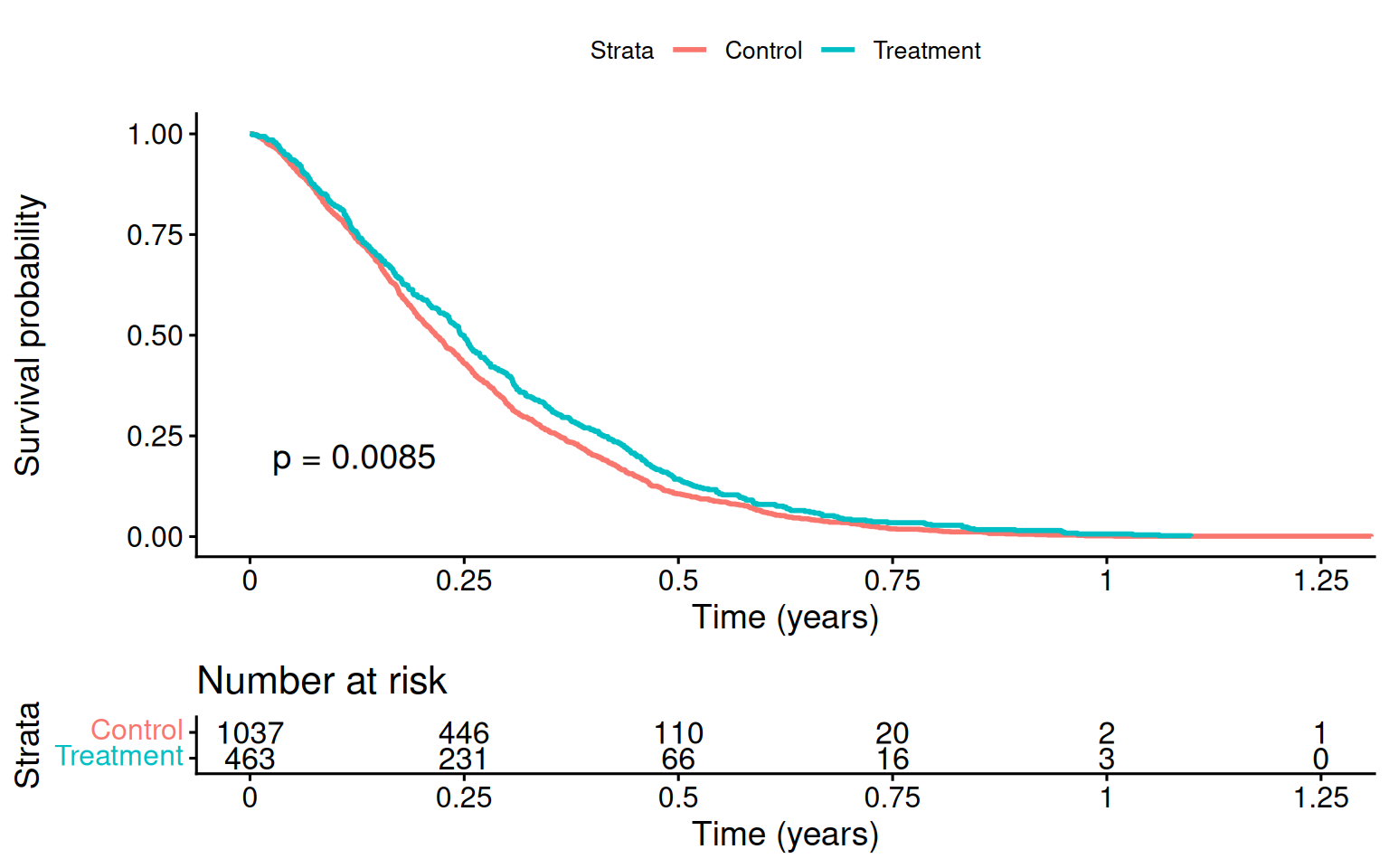
The KM curve is descriptive. It is not enough for causal inference here because treatment is related to baseline covariates.
17.4 Cox proportional hazards with adjustment
The familiar regression approach is a Cox proportional hazards model with covariate adjustment:
Code
| term | estimate | std.error | statistic | p.value | conf.low | conf.high |
|---|---|---|---|---|---|---|
| trt | 0.669 | 0.072 | -5.608 | 0 | 0.582 | 0.770 |
| age | 1.035 | 0.003 | 10.754 | 0 | 1.029 | 1.042 |
| sex | 1.347 | 0.064 | 4.663 | 0 | 1.189 | 1.527 |
The estimated hazard ratio for treatment is 0.669 with a 95% interval of \([0.582, 0.770]\), against the true \(e^{-0.4} = 0.670\). The Cox model is correctly specified here — the DGP is proportional hazards with linear covariate effects — so this is a check that the machinery works, not evidence about robustness. Age carries a hazard ratio of 1.035 per year and sex 1.347, against the true \(e^{0.03} = 1.030\) and \(e^{0.3} = 1.350\).
17.4.1 The interpretation problem with hazard ratios
The Cox hazard ratio is not a simple mean treatment effect. It compares hazards among those still at risk at time \(t\), and that risk set is itself affected by treatment. I would report it, but not rely on it as the only causal summary.
17.5 Restricted Mean Survival Time (RMST)
The restricted mean survival time is the expected survival time up to a cutoff \(\tau\):
\[ \text{RMST}(\tau) = E[\min(T, \tau)] = \int_0^\tau S(t)\, dt. \tag{17.3}\]
The RMST difference is easier to interpret:
\[ \Delta_{\text{RMST}}(\tau) = \text{RMST}_1(\tau) - \text{RMST}_0(\tau) = \int_0^\tau [S_1(t) - S_0(t)]\, dt. \tag{17.4}\]
It also does not require proportional hazards.
Code
# Use survRM2 via riskRegression / manually computing from KM
tau <- 5  # restrict to 5 years

# Manual RMST: integrate the KM curve up to tau.
# (For production use, prefer a tested implementation such as
#  survRM2::rmst2; the helper below is for transparency.)
# Read the step function directly from fit$time / fit$surv, anchor
# S(0) = 1 explicitly, and integrate as a left-endpoint rectangle sum
# over the grid (0, event times <= tau, tau). This avoids relying on
# how summary.survfit emits a row at time 0 and never duplicates tau in
# a way that drops the final [last event, tau] interval.
rmst_arm <- function(time, event, tau) {
  fit  <- survfit(Surv(time, event) ~ 1)
  keep <- fit$time <= tau
  t_grid <- c(0, fit$time[keep], tau)
  # Survival height on each interval [t_j, t_{j+1}): S(0) = 1, then the
  # KM value just after each event; the trailing value is a placeholder
  # dropped by head(., -1) below.
  last_s <- if (any(keep)) fit$surv[keep][sum(keep)] else 1
  s_grid <- c(1, fit$surv[keep], last_s)
  sum(diff(t_grid) * head(s_grid, -1))
}

rmst_trt  <- rmst_arm(df$time[df$trt == 1], df$event[df$trt == 1], tau)
rmst_ctrl <- rmst_arm(df$time[df$trt == 0], df$event[df$trt == 0], tau)

cat(sprintf("RMST(τ=5) under treatment: %.3f years\n", rmst_trt))
RMST(τ=5) under treatment: 4.351 yearsRMST(τ=5) under control: 4.147 yearsDifference: 0.203 yearsThe unadjusted RMST is 4.351 years under treatment and 4.147 under control, a difference of 0.203 years, against a true 0.271. The RMST difference says how many survival years are gained up to the cutoff \(\tau\), and this one understates the gain by a quarter, because the treated are older and therefore at higher baseline hazard.
17.5.1 Adjusted RMST via IPW
To adjust for confounding, weight the KM curve by the inverse propensity score:
Code
# Propensity score
ps_fit <- glm(trt ~ age + sex, data = df, family = binomial)
df$ps  <- predict(ps_fit, type = "response")
df$ipw <- ifelse(df$trt == 1, 1 / df$ps, 1 / (1 - df$ps))
df$ipw <- pmin(df$ipw, quantile(df$ipw, 0.99))  # trim

km_ipw <- survfit(Surv(time, event) ~ trt, data = df, weights = ipw)
print(km_ipw, rmean = tau)
Call: survfit(formula = Surv(time, event) ~ trt, data = df, weights = ipw)
records n events rmean* se(rmean) median 0.95LCL 0.95UCL
trt=0 1039 1499 1061 4.12 0.0365 6.46 5.95 6.91
trt=1 461 1494 897 4.40 0.0317 7.73 6.94 8.85
* restricted mean with upper limit = 5 The weighted restricted means are 4.40 years under treatment and 4.12 under control, a difference of 0.28 against the true 0.271. Weighting moved the estimate from 0.203 to 0.28 and closed almost the whole gap. Note that the n column now reports the weighted totals, 1,494 and 1,499, rather than the 461 and 1,039 actual records — that is the pseudo-population the weights construct.
17.6 Inverse Probability of Censoring Weighting (IPCW)
If censoring is informative, for example if sicker patients drop out earlier, treating censoring as random is biased. IPCW weights observations by the inverse probability of remaining uncensored, conditional on covariates.
Code
# Model the censoring hazard
# Use 1 - event as the "censoring" indicator
cens_fit <- coxph(Surv(time, 1 - event) ~ trt + age + sex, data = df)

# Predict survival of censoring at each event time for each unit
df_sub <- df |>
  arrange(time)
times_at_risk <- df_sub$time
# G(t | X): probability of being uncensored at time t given X
# Use survfit on cens_fit to get S_C(t | X)
sc_fit <- survfit(cens_fit, newdata = df_sub)
# We only need each subject's OWN survival at their OWN event time, not the
# full cross product of all N subjects' curves at all N event times.
# summary(sc_fit, times=df_sub$time, extend=TRUE)$surv followed by diag()
# builds that full N x N matrix just to throw away everything off the
# diagonal -- for N in the tens of thousands this is a multi-GB allocation
# and can OOM. Look each subject's own time up in sc_fit's existing
# per-subject step function instead (sc_fit$surv is already an
# n_times x N matrix that survfit(newdata=) computes regardless; this just
# avoids building a second, larger one on top of it). For very large N,
# packages like `riskRegression`/`pec` avoid materializing even that
# per-subject curve matrix and would scale further.
sc_idx  <- findInterval(df_sub$time, sc_fit$time)
sc_at_t <- sc_fit$surv[cbind(pmax(sc_idx, 1), seq_len(nrow(df_sub)))]
sc_at_t[sc_idx == 0] <- 1  # before the first censoring event, S_C = 1

# IPCW weight: 1 / P(C > T_i | X_i) for event times, 0 for censoring times
df_sub$ipcw <- ifelse(df_sub$event == 1, 1 / pmax(sc_at_t, 0.01), 0)
summary(df_sub$ipcw[df_sub$event == 1])
Min. 1st Qu. Median Mean 3rd Qu. Max.
1.001 1.075 1.137 1.149 1.219 1.353 IPCW upweights observations that remain uncensored despite having a high predicted chance of censoring. The weights here run from 1.001 to 1.353 with a mean of 1.149, which is mild. That is expected in this simulation: censoring is exponential dropout with a 40-year mean plus an administrative cutoff, and neither depends on the covariates in a way that would make censoring strongly informative. The correction is available and small; in a study where sicker patients drop out, it would not be.
17.7 Doubly-robust survival estimation
The riskRegression package combines the outcome model, propensity score, and censoring model:
Code
# Average treatment effect on survival probability at t = 5
# ATE(t) = P(T(1) > t) - P(T(0) > t)
df$trt_f <- factor(df$trt)
cox_for_ate <- coxph(Surv(time, event) ~ trt_f + age + sex, data = df,
                     x = TRUE, y = TRUE)
ps_for_ate  <- glm(trt_f ~ age + sex, data = df, family = binomial, x = TRUE)
# With right-censoring, the IPTW/AIPTW survival estimator needs a model for
# the censoring mechanism (a Cox model for time-to-censoring).
# Treatment belongs in the censoring model unless design knowledge rules it out.
# Censoring is treatment-independent in this simulation, so including trt_f
# changes little here -- but the assumption that has to hold is independent
# censoring *conditional on treatment and covariates*, plus censoring
# positivity, and the code should say so to be reusable.
cens_for_ate <- coxph(Surv(time, event == 0) ~ trt_f + age + sex, data = df,
                      x = TRUE, y = TRUE)

ate_surv <- ate(
  event       = cox_for_ate,
  treatment   = ps_for_ate,
  censor      = cens_for_ate,
  data        = df,
  times       = 5,
  estimator   = c("Gformula", "IPTW", "AIPTW"),
  cause       = 1,
  se          = TRUE,
  B           = 0,
  verbose     = FALSE
)

summary(ate_surv)
Average treatment effect
- Treatment : trt_f (2 levels: "0" "1")
- Event : event (cause: 1, censoring: 0)
- Time [min;max] : time [0.0372;12]
- at risk/time : 5
number in treatment 0 561
number in treatment 1 283
Estimation procedure
- Estimators : G-formula, Inverse probability of treatment weighting, Augmented and double robust estimator
- Uncertainty: Gaussian approximation
where the variance is estimated via the influence function
Testing procedure
- Null hypothesis : given two treatments (A,B) and a specific timepoint, equal risks
- Confidence level : 0.95
Results:
- Difference in standardized risk (B-A) between time zero and 'time'
reported on the scale [-1;1] (difference between two probabilities)
(difference in average risks when treating all subjects with the experimental treatment (B),
vs. treating all subjects with the reference treatment (A))
time trt_f=A risk(trt_f=A) trt_f=B risk(trt_f=B) difference ci
5 0 0.393 1 0.287 -0.106 [-0.14;-0.07]
p.value
5.36e-09
difference : estimated difference in standardized risks
ci : pointwise confidence intervals
p.value : (unadjusted) p-value Code
# The summary displays one estimator; put all three side by side
ate_tab <- as.data.frame(data.table::as.data.table(ate_surv, type = "diffRisk"))
knitr::kable(ate_tab[, c("estimator", "estimate", "se", "lower", "upper")],
             digits = 3,
caption = "Risk difference at t = 5 under each estimator.")| estimator | estimate | se | lower | upper |
|---|---|---|---|---|
| GFORMULA | -0.106 | 0.018 | -0.142 | -0.070 |
| IPTW | -0.095 | 0.027 | -0.148 | -0.043 |
| AIPTW | -0.099 | 0.027 | -0.152 | -0.046 |
The object contains three estimators, shown side-by-side in the table:
- Gformula — parametric g-computation using the Cox model only.
- IPTW — inverse probability of treatment weighting.
- AIPTW — augmented IPTW (doubly robust); usually the best default, though not unconditionally. It earns that status when the nuisance models are flexible and cross-fitted, treatment and censoring probabilities stay away from zero, and the censoring assumption holds conditional on treatment and covariates. Where positivity is thin it can be less stable than a simpler estimator.
All three agree, and all three are close to the truth: \(-0.106\), \(-0.095\) and \(-0.099\) against a true risk difference of \(-0.108\). Treatment cuts the five-year risk of the event by about ten percentage points. The g-formula has the smallest standard error, 0.018 against 0.027 for the other two, because it leans entirely on the Cox model, which is correctly specified here. That is an efficiency gain bought with an assumption, and AIPTW’s wider interval is the price of not needing it.
Agreement across these estimates is reassuring. Disagreement is a warning about model specification.
17.8 Hazard ratio vs RMST: which to report?
For causal reporting, RMST is often easier to defend than the hazard ratio:
| Quantity | Pro | Con |
|---|---|---|
| Hazard ratio | Compact summary; familiar | Requires PH; no causal interpretation; conditional on survivors |
| RMST difference | Directly interpretable as “years gained”; no PH assumption | Depends on cutoff \(\tau\); less familiar |
| Survival probability difference at t | Direct probability statement | Depends on choice of \(t\) |
In practice, report at least:
- The KM curves with risk tables (description).
- The Cox HR with adjustment (familiar comparison to literature).
- The RMST difference at a clinically meaningful \(\tau\) (interpretable causal contrast).
- The DR ATE on survival probability at one or two follow-up times.
17.9 Connections
- The G-Methods chapter covers IPTW with time-varying treatments — directly applicable when treatment evolves during follow-up. The IPCW machinery here is the censoring analogue.
- The Heterogeneous Effects chapter ML methods extend to survival via causal survival forests (
grf::causal_survival_forest). - The Bayesian Causal Inference chapter extends to survival via Bayesian additive regression trees for time-to-event outcomes (
BART::surv.bartfor discrete-time survival, orBART::abartfor an accelerated-failure-time model with right-censoring).
17.10 Summary
- Survival outcomes require methods that handle censoring.
- Cox models are familiar, but hazard ratios are hard to interpret causally.
- RMST differences are often the clearest causal summary.
- IPCW handles informative censoring.
-
riskRegression::atereports g-formula, IPTW, and AIPTW estimates for survival probabilities.